
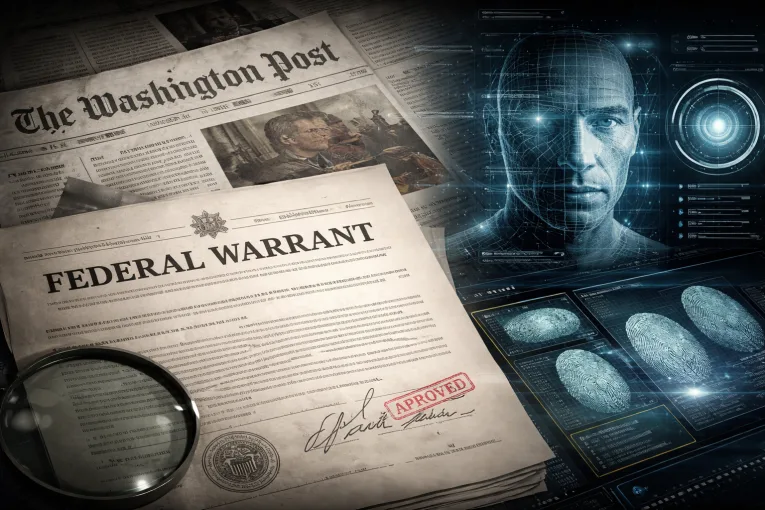
WASHINGTON — A recent federal raid on the home of Washington Post reporter Hannah Natanson has intensified concerns about press freedom and digital privacy after court documents obtained by The Intercept showed investigators were authorized to attempt to unlock her phone using her face or fingerprints.
The search-and-seizure warrant issued in the case included a section titled “Biometric Unlock,” which permitted federal agents to hold Natanson’s phone in front of her face or forcibly use her fingers in an effort to bypass biometric security protections. The warrant did not authorize agents to ask Natanson which biometric features she used to unlock her device, though it allowed investigators to use any information she volunteered. Natanson has not been charged with a crime. The Washington Post did not respond to requests for comment, and the FBI declined to comment.
Investigators searched Natanson’s home as part of an inquiry into alleged communications between the reporter and a government contractor accused of unlawfully retaining and transmitting national defense information. Prosecutors have since added additional charges against the contractor, though no allegations have been made against Natanson herself.
Legal and digital privacy experts say the warrant highlights how biometric security features, such as fingerprint and facial recognition, can be compelled by law enforcement in ways that passcodes cannot. Andrew Crocker, surveillance litigation director at the Electronic Frontier Foundation, said warrants authorizing compelled biometric unlocking are not new but noted that recent court decisions have begun to recognize limits.
Crocker pointed to a 2024 ruling by the U.S. Court of Appeals for the D.C. Circuit, which held that forcing a person to demonstrate which biometric feature unlocks their device can constitute testimonial evidence protected under the Fifth Amendment. He said the restriction in Natanson’s warrant barring agents from asking which finger or facial feature unlocked her phone likely reflected that evolving case law.
Crocker said constitutional protections against self-incrimination should not hinge on whether a person uses biometric security or a passcode. He added that courts should treat biometric unlocking the same as password protection, rather than allowing access based on technological convenience.
The warrant also raised concerns among press freedom and digital security advocates about the risks journalists face when covering sensitive government activity. Martin Shelton, deputy director of digital security at the Freedom of the Press Foundation, said journalists are often advised to disable biometric authentication when they anticipate situations involving searches, such as protests, border crossings, or interactions with law enforcement.
Privacy advocates generally recommend using long alphanumeric passcodes rather than biometric authentication, particularly in situations where a device could be seized. Turning off a phone entirely can also place it in an encrypted state until it is unlocked again, adding another layer of protection.
While biometric security can offer advantages in some public settings, such as reducing the risk of passcodes being observed, experts caution that it may leave users more vulnerable to compelled access during law enforcement encounters. The Natanson warrant, they say, illustrates how legal authority can override biometric safeguards even when a person does not consent.
The case comes amid broader concerns among journalists and civil liberties groups about government actions targeting members of the press and the potential chilling effect on newsgathering. Press advocates say the ability of law enforcement to access reporters’ devices raises significant questions about source confidentiality, newsroom independence and constitutional protections.
As the investigation continues, digital rights organizations say the incident underscores the importance of journalists understanding how their devices can be accessed under current law and the limits of biometric privacy in encounters with law enforcement.
Follow the Vanguard on Social Media – X, Instagram and Facebook. Subscribe the Vanguard News letters. To make a tax-deductible donation, please visit davisvanguard.org/donate or give directly through ActBlue. Your support will ensure that the vital work of the Vanguard continues.
