
One wise and great President of a great country once said; “We all have to recognize, no matter how great our strength that we must deny ourselves the license to do always as we please.”
“The responsibility of the great states is to serve and not to dominate the peoples of the world.”
“If we do not want to die together in war, we must learn to live together in peace.”
“You have before you a hopeful task, a great responsibility.”
“If we should fail to seize this chance to set up a world organization for peace, our failure will be tragic.”
“The Charter of the United Nations which you are about to frame is not a treaty in the old sense of the word.”
“It is a solid structure upon which we can build a better world, the world does not need words; it needs action.”
All these great, emotional and reasonable statements were made by just one person, the then president of the United States of America “Harry. S Truman” At the end, all his above speeches culminated to the charter for the United Nations, but a lot have gone wrong from his vision.
The United States, one of the founding members of the United Nations, appears to have strayed far from the vision articulated by President Harry S. Truman. As Truman once stated, “We all have to recognize, no matter how great our strength, that we must deny ourselves the license to do always as we please.” Yet today, the reverse seems to be true.
When Israel began pummeling Gaza with bombs and high-explosive shells—using U.S.-made munitions to demolish high-rise buildings with occupants still inside—it represented a reversal of another of Truman’s principles: “The responsibility of the great states is to serve and not to dominate the peoples of the world.” The United Nations and the United States often champion better living conditions, improved employment, and expanded health care in the European Union and North America, yet families like Mamdouh Hassan’s were stripped of the most basic dignity promised under the United Nations Charter.
When Hassan and his pregnant wife awoke to the sound of high-rise buildings collapsing under the sheer force of Israeli Defense Forces bombardment, their sense of security and dignity was shattered. Whether it was unexploded shells, or the night they were jolted awake by shattering glass from the shock waves of missile strikes, the trauma became inescapable. One wonders whether such repeated terror could trigger a miscarriage.
Hassan’s life was transformed. Once a breadwinner with multiple degrees, living in a stable home with a comfortable plan for feeding his family, he became dependent on aid for survival. He went from a department manager at an investment and insurance company—armed with a bachelor’s degree in accounting and a freshly completed master’s degree in business administration—to an aid-dependent father in an internally displaced persons camp. The company where he worked no longer exists, at least not in physical form, destroyed amid waves of Israeli strikes carried out with American-supplied bombs and missiles.
His wife, Mrs. Abeer, an aspiring pharmacist, watched as the hospital where she worked was invaded several times by Israeli forces before an air-dropped bomb eventually destroyed it. Their child, Al-Hassan, now grows up to the sounds of gunfire, airstrikes, and explosions as a kind of grim lullaby. The infant requires special medical care, but medical infrastructure has been crippled. As aid trucks and medical supplies were restricted from entering Gaza, hospitals— including children’s and specialty care facilities—were reduced to rubble by bombs supplied through U.S. support.
Now, attempts are being made to ease children’s trauma by giving them virtual reality goggles to distract them from the devastation around them. But for how long can such measures shield them? Will they wear these devices to sleep? In the long term, such strategies may deepen the psychological struggle, as children wrestle with the gulf between virtual escape and harsh reality.
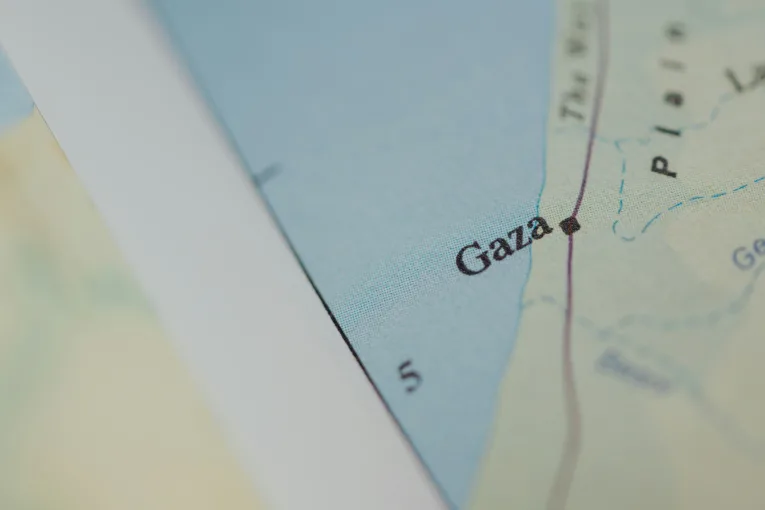
Today, Gaza stands devastated, with pestilence and famine threatening to engulf its people. A stronger nation has chosen war over peace and domination over coexistence. In doing so, it risks undermining not only regional stability but also the principles enshrined in the United Nations Charter.
The United States has a choice: it can allow Truman’s vision to become a relic of the past by continuing to fund Israel’s war effort without meaningful pressure for restraint, or it can apply diplomatic leverage to halt and reverse what many view as devastation inflicted upon Palestinians. If it fails to act, the Charter of the United Nations risks losing both its character and its essence.
Precious Allwell is a Nigerian engineer, a geopolitical analyst and writer. He has been featured by many newspapers and magazines around the globe.
Follow the Vanguard on Social Media – X, Instagram and Facebook. Subscribe the Vanguard News letters. To make a tax-deductible donation, please visit davisvanguard.org/donate or give directly through ActBlue. Your support will ensure that the vital work of the Vanguard continues.
