
Part 1: San Francisco’s Debt, America’s Fear, and the Lie of “Societal Discrimination”
By Malik Washington, Destination Freedom Media Group / The Davis Vanguard
San Francisco likes to describe itself as a city of progress.
A city of conscience.
A city that understands history.
But when history demands accountability—real accountability, not symbolism, not statements, not slogans—San Francisco suddenly develops amnesia.
That amnesia has now been dressed up in constitutional language.
On February 5, 2026, the Pacific Legal Foundation—a conservative legal organization with a decades-long record of challenging civil rights protections—filed suit in San Francisco Superior Court seeking to halt the city’s reparations framework. The plaintiffs are the Californians for Equal Rights Foundation and two San Francisco residents, Richard “Richie” Greenberg and Arthur Ritchie.
They argue that San Francisco may not acknowledge race.
May not acknowledge ancestry.
May not acknowledge inherited harm.
Even when that harm was created, enforced, documented, and sustained by the City and County of San Francisco itself.
This lawsuit is being marketed as a defense of “individual equality.”
In reality, it is an attempt to freeze inequality in place—and call that justice.
THIS CASE IS NOT ABOUT GENEROSITY. IT IS ABOUT LIABILITY
Let us be clear at the outset:
San Francisco is not being sued for generosity toward Black residents.
San Francisco is being sued for acknowledging its own record.
The plaintiffs claim that the city’s reparations framework addresses only “societal discrimination”—a phrase carefully chosen because, under modern constitutional doctrine, “societal discrimination” is treated as too abstract, too generalized, too impersonal to justify race-conscious remedies.
But what happened to Black San Franciscans was not societal.
It was municipal.
It was planned.
It was legislated.
It was enforced.
And it was profitable.
San Francisco did not merely witness Black displacement.
San Francisco engineered it.
SAN FRANCISCO DID NOT MERELY WITNESS DISPLACEMENT — IT ENGINEERED IT
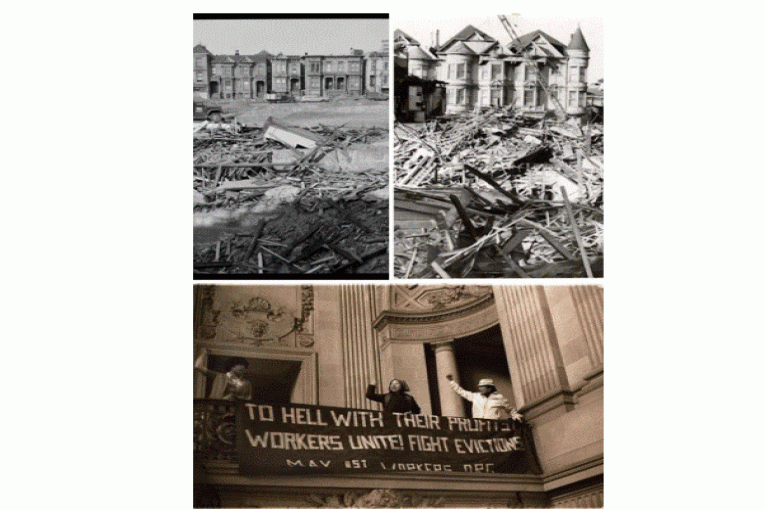
Through the San Francisco Redevelopment Agency, the City bulldozed the Fillmore District—the “Harlem of the West.”
Over 20,000 Black residents displaced.
883 Black-owned businesses destroyed.
Homes seized.
Churches erased.
Culture dismantled.
The city called it “urban renewal.”
Black San Franciscans named it correctly: removal.
This was not market drift.
This was not accidental.
This was not societal.
It was a government project—documented in agency minutes, eminent-domain filings, compensation records, and demographic data. Between 1950 and 1980, the Western Addition’s Black population collapsed from roughly 20,000 residents to fewer than 4,000.
Homes were routinely compensated at 40–60 percent below market value—when compensation was offered at all.
The paper trail exists.
The plaintiffs do not deny it.
They dismiss it.
REDLINING, EXCLUSION, AND THE MANUFACTURE OF INHERITED WEALTH
San Francisco participated fully in federally sanctioned redlining.
The Home Owners’ Loan Corporation’s Residential Security Maps—created in the 1930s—marked Black neighborhoods as “hazardous,” not because of infrastructure, but because of who lived there. San Francisco’s own maps include the explicit notation: “Detrimental influences: Negro concentration.”
The Federal Housing Administration’s underwriting manuals, used by lenders operating in San Francisco, instructed that neighborhood “stability” required racial homogeneity.
City planning decisions followed those maps.
Lending decisions enforced them.
Zoning decisions reinforced them.
Wealth was denied by policy, not by chance.
The plaintiffs acknowledge this history.
They claim it is too vague to repair.
POLICING, CRIMINALIZATION, AND STATE VIOLENCE
From over-policing to under-protection, Black communities in San Francisco have long experienced law enforcement as an occupying force rather than a public service.
The War on Drugs criminalized entire neighborhoods. Arrest and sentencing data show racially disparate enforcement that was not incidental, not accidental, and not unknown to city leadership.
In 2016, the U.S. Department of Justice issued a civil-rights investigation finding systemic racial bias within the San Francisco Police Department.
This, too, appears in the plaintiffs’ complaint.
And this, too, is dismissed as “societal discrimination.”
ENVIRONMENTAL RACISM IN BAYVIEW-HUNTERS POINT
Bayview-Hunters Point did not become toxic by coincidence.
Nuclear decontamination at the Hunters Point Naval Shipyard.
Decades of pollution from power plants.
Delayed, mismanaged, and falsified cleanup efforts.
Rising sea levels threatening to spread buried contamination.
These were siting decisions.
Budget decisions.
Policy decisions.
Environmental harm is not race-neutral when exposure is not race-neutral.
The plaintiffs list these facts.
Then wave them away.
Marie Harrison would not allow anyone to dismiss her or “wave her away” and now her daughter Arieann Harrison continues the struggle against environmental racism and injustice with the battle cry of “Can we Live!”.
EXPOSING AND DISMANTLING THE SO-CALLED “LEGAL” ATTACK ON REPARATIONS
The Pacific Legal Foundation wants the public to believe this lawsuit is about constitutional fidelity. It is not. It is about legal erasure—a carefully constructed attempt to acknowledge San Francisco’s documented harm to Black residents while declaring that harm legally invisible.
Read their complaint closely and a pattern emerges. The plaintiffs do not deny what happened. They do not argue that the Redevelopment Agency did not displace Black families. They do not dispute redlining, discriminatory lending, racially disparate drug prosecutions, police violence, school segregation, or the forced removal of Black children through the foster care system. In fact, they list these harms themselves.
Then they dismiss them.
Their argument hinges on a sleight of hand: because San Francisco’s discrimination was systematic, documented at the community level, and executed through policy, it is supposedly too “general” to remedy. Unless the city can name every individual victim, identify a specific ordinance violated on a specific date, and attach a personal constitutional injury to a particular government employee, the harm—no matter how devastating—does not count.
This is not constitutional law.
It is a trap.
Historical discrimination was not designed to leave individualized receipts. Redlining maps targeted neighborhoods, not named families. Redevelopment bulldozed communities, not isolated households. The War on Drugs criminalized entire zip codes, not one defendant at a time. School segregation operated through systems, not signed confessions of racial intent.
To now demand individualized proof is to demand evidence that discriminatory systems were deliberately designed never to produce.
And let me be clear.
For years, I have read and studied case law. I am married to a paralegal, and together we have confronted bad-faith legal attacks on Black people by conservatives before. This maneuver is familiar. Conservative legal actors routinely wrap themselves in technical language—not to pursue justice, but to obscure it. They hide behind doctrine, citations, and procedure while advancing arguments rooted in long-festering resentment, bigotry, and racial hostility. The animus is real. The harm is intentional. It is simply laundered through “neutral” legal vocabulary to make it palatable.
I see them.
And I want everyone reading this to see them as well.
The plaintiffs attempt to legitimize this maneuver by rebranding San Francisco’s record as mere “societal discrimination,” borrowing language from cases like City of Richmond v. Croson and Shaw v. Hunt. But those cases involved cities relying on national or regional statistics to justify local race-based programs.
San Francisco is doing the opposite.
It is relying on its own archives.
Its own agencies.
Its own maps.
Its own arrest records.
Its own consent decrees.
This is not abstract history.
It is municipal record.
Redevelopment Agency minutes labeling Black neighborhoods “blighted.”
Federal housing maps marking communities “hazardous” due to “Negro concentration.”
Arrest and sentencing data showing racialized enforcement.
School desegregation orders confirming unlawful segregation.
Foster-care removals that shattered Black families at disproportionate rates.
These are not societal trends.
They are government actions.
And here is the deeper deception: the plaintiffs’ proposed legal standard would make accountability inversely proportional to harm. The more thoroughly a city discriminates through policy rather than paperwork, the safer it becomes from remedy. The more completely a community is targeted and erased, the harder it becomes to prove the harm ever mattered.
Under this logic, Japanese American internment reparations would fail.
Native land settlements would fail.
Holocaust reparations would fail.
Any injustice that operated at scale would become legally untouchable—precisely because it was systemic.
That is not strict scrutiny.
That is selective amnesia dressed up as doctrine.
What Pacific Legal Foundation is really arguing is not that San Francisco is innocent—but that its guilt is inconvenient. That the victims lived too long ago. That the records are too collective. That the harm was too effective.
And that accountability should expire with memory.
If this argument prevails, the precedent will be devastating: government records will no longer be specific enough to prove government wrongdoing; community-wide discrimination will become immune from community-based repair; and history itself will be rendered constitutionally irrelevant once its victims are gone.
That is the real threat on trial.
Not reparations—but whether the law will recognize documented truth or continue perfecting the art of forgetting.
BRIDGE TO PART II: WHEN TRUTH ENTERS THE ROOM
What has been laid out here is not conjecture.
It is record.
It is archive.
It is the city’s own handwriting.
But lawsuits like this are never only about history. They are about the present—and about who inside government is willing to let documented truth stand without apology.
Because once the record is acknowledged, the pressure shifts.
Toward institutions tasked with naming harm.
Toward those responsible for preserving memory.
Toward those who refuse erasure.
Part II confronts that reality directly—examining why this lawsuit targets the Human Rights Commission, why truth-telling itself is being chilled, and why Mawuli Tugbenyoh stands at the center of a test far larger than any single ordinance, with the Black community watching closely—and standing firmly behind him.
Because when the law is used to perfect forgetting, the question is no longer what history says.
It is who is willing to defend it when it matters most.
As always, here’s our song/video for this article:
GLORY
Common & John Legend
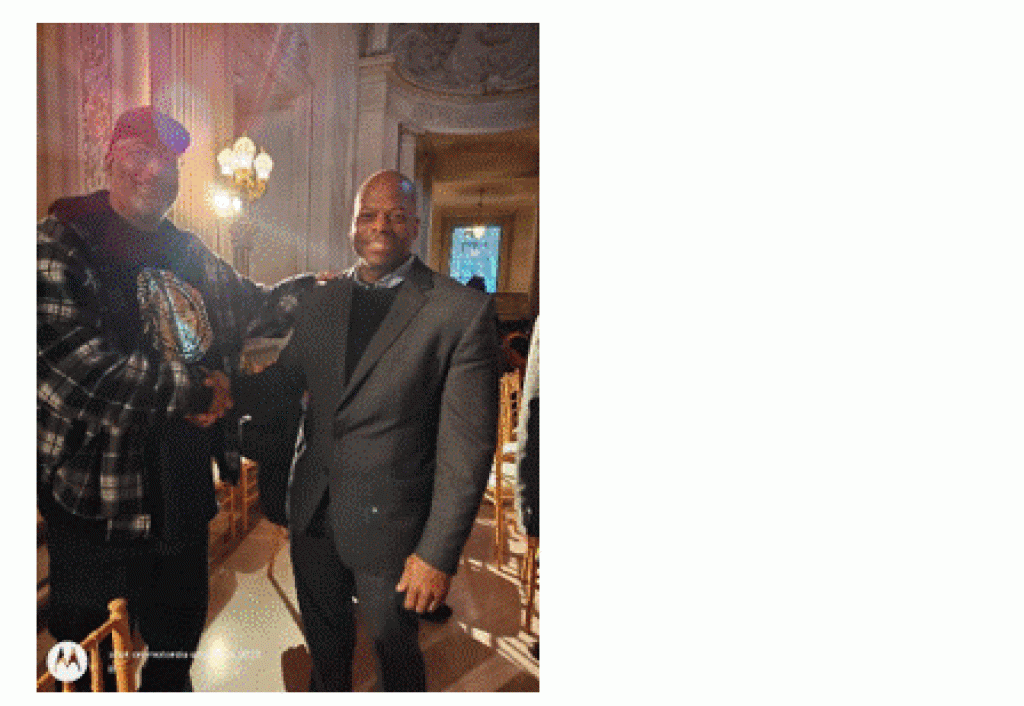
This is Journalist Malik Washington with The Executive Director of the San Francisco Human Rights Commission Mawuli Tugbenyoh
ABOUT THE AUTHOR
Malik Washington is a San Francisco-based journalist and co-founder of Destination Freedom Media Group, an independent nonprofit newsroom dedicated to accountability reporting at the intersection of civil rights, public integrity, and community survival. He has been a published journalist for over 14 years.
His work—published in partnership with the Davis Vanguard—focuses on government power, criminal justice, environmental justice, and the human consequences of policy decisions too often insulated from public scrutiny. Washington’s reporting amplifies the voices of impacted communities while insisting on documentary evidence, transparency, and the unvarnished truth—especially when institutions demand silence.
His work appears on platforms such as Muck Rack and Black Voice News, examining the intersection of justice, governance, and community.
You can reach him via email: mwashington2059@gmail.com or call him at (719) 715-9592.
Suggestions or leads on stories are always welcome.
Please follow us on:
Facebook: https://www.facebook.com/destfreedom13
Instagram: https://www.instagram.com/destinationfreedom13/
X: https://x.com/dest_freedom
Follow the Vanguard on Social Media – X, Instagram and Facebook. Subscribe the Vanguard News letters. To make a tax-deductible donation, please visit davisvanguard.org/donate or give directly through ActBlue. Your support will ensure that the vital work of the Vanguard continues.

No reparations…ever