
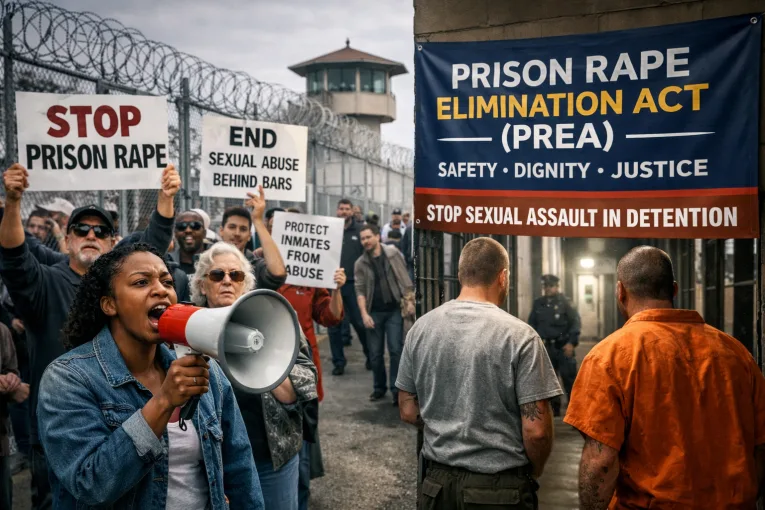
NEW YORK, N.Y. — A recent article published by the Brennan Center for Justice at NYU Law documents how federal funding cuts are undermining safeguards designed to reduce sexual violence and rape in prisons, raising concerns about the safety and rights of incarcerated people nationwide. The brief is part of a Brennan Center series examining the effects of federal funding reductions on public safety.
The Brennan Center discusses the importance of the 2003 Prison Rape Elimination Act, a law passed unanimously by Congress that established national standards to identify, prevent and report inmate sexual violence. Federal funding for the Department of Justice supports the act, as well as other initiatives that increase the safety and effectiveness of correctional and community supervision programs.
Under PREA, significant advances in the human rights of incarcerated individuals have been achieved. Alongside a broader movement toward improving prison conditions, the scope of sexual violence was quantified, and systemic mechanisms were put in place to support victims. In 2010, the National PREA Resource Center was created to conduct periodic audits of correctional facilities and provide training. As of 2025, 47 states reported full compliance or were working toward full compliance with the act.
A National Institute of Justice national study found that 60,500 inmates reported experiencing sexual violence over a 12-month period of imprisonment. The NIJ also found that in 2004, just one year after PREA’s enactment, 33 of 45 state departments had implemented related measures. Over time, as PREA established a framework focused on improving conditions and standard-setting, a broader network of victim resources became available to incarcerated individuals who experienced sexual violence.
“These estimates understate the true scope of sexual violence in prisons. Many cases go unreported due to weak internal procedures … and insufficient staff intervention,” the Brennan Center states. “Sexual violence in custody remains an entrenched problem that requires robust federal oversight … and funding has been essential to equipping corrections agencies with universal tools that promote sexual safety.”
The Brennan Center cites an article by The Imprint, which described the Department of Justice’s April 2025 funding cuts as “fast, sudden, unexplainable and potentially catastrophic,” according to University of South Dakota psychology professor Cindy Struckman-Johnson, a member of the Prison Rape Elimination Act Commission. The Imprint is a nonprofit, independent organization that covers child welfare and youth justice nationwide.
The Imprint article details the heightened dangers incarcerated juveniles face as the National PREA Resource Center becomes underfunded. It reports that in New York, 16 substantiated cases of sexual assault occurred among 607 juveniles admitted in 2023. Of those 16 cases, four involved staff members.
The article also details a New York case in which prison psychologist Maya Hayes, 47, was accused by four inmates ages 15 to 18 of sexual misconduct. Three of the four accusers said Hayes threatened them with additional parole time if they reported her. At the time of the alleged assaults, the New York juvenile prison, Brookwood, had recently undergone a PREA audit.
“PREA is more of a risk reduction policy,” said Hayden Smith, a criminology and criminal justice professor at the University of South Carolina who studies PREA. Smith said he believes the current administration’s motivation behind the funding cuts is the belief that “‘these external sources aren’t bringing much to the table,’ but every bit of research that I’ve done on this topic counters that. Inmates, frontline staff and administrators desperately want these organizations to come in.”
The Brennan Center reports that as a result of the April 2025 funding cuts, the National PREA Resource Center temporarily shut down and now focuses only on auditing operations, including auditor training and audit system management. As a result, incarcerated victims will lose access to victim advocacy organizations because of the center’s reduced capacity.
Both the Brennan Center and The Imprint highlight increased risks for LGBTQ+ individuals resulting from the funding loss. PREA previously required that transgender or intersex individuals be housed in gendered facilities based on what would best ensure safety.
That policy was affected in January 2025 by an executive order requiring that “males are not detained in women’s prisons or housed in women’s detention centers,” according to The Imprint.
The Brennan Center also notes that the Bureau of Justice Statistics removed gender identity questions from its Survey of Sexual Victimization, a PREA-mandated survey used to monitor sexual abuse in correctional facilities nationwide.
“The loss of this data erases victimization experienced by transgender and nonbinary people and makes it harder for facilities to serve the needs of abuse survivors,” the Brennan Center states. “These actions worsen the impact of recent funding cuts that targeted support for correctional agencies and limited their ability to build partnerships with service providers, along with cuts to victim services overall.”
The Brennan Center urges the Trump administration to restore funding for resources such as the National PREA Resource Center, citing their essential role in protecting incarcerated individuals who are at risk of sexual violence. Without restoration, the group warns, the funding decisions threaten decades of progress toward safer confinement facilities.
Follow the Vanguard on Social Media – X, Instagram and Facebook. Subscribe the Vanguard News letters. To make a tax-deductible donation, please visit davisvanguard.org/donate or give directly through ActBlue. Your support will ensure that the vital work of the Vanguard continues.
