
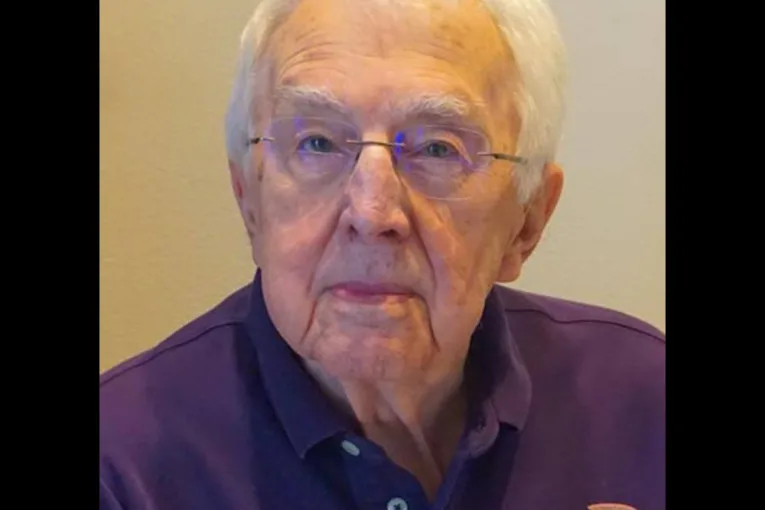
John Franklin Lofland, spouse, professor, sociologist-historian and bemused observer died in Davis, California, February 4, 2026. He was a complex man. Occasionally disagreeable, he was loyal, loving and kind; a brilliant man who could deliver a barrage of questions that would result in the target’s being confused and defensive. He could be cordial and charming when it suited him.
He very much enjoyed watching people in public settings (and could be a little nosy). His observations seemed on the mark — who was courting whom, how the tables were being worked, the solitary soul, the cliques, the power elites.
Born March 4, 1936, to working-class parents (soon to be divorced) in a small Delaware town, John never thought about being an academic, which is what happened. Involved as a youth in the Methodist Church and the Boy Scouts, he gained two important templates for a scholarly life. The church taught him to contemplate “large questions,” which is what academia is about. The scouts taught him how to navigate intricate hierarchies and to execute multi-step plans, which is what university research is about.
Despite his mother’s death his senior year, he was successful in high school, participating in multiple school activities (class of twenty-six students). He earned a scholarship to Swarthmore College. While still an undergraduate, he married his high school sweetheart, Nancy Wheatley Longmeyer. She provided inestimable support through the subsequent graduate student years at Columbia and UC Berkeley where he received his doctorate in Sociology in 1964.
His early scholarship brought national attention with the publication of Doomsday Cult (1966), a seminal ethnographic work based on his field study of the Unification Church. This work is widely regarded as a classic in the study of new religious movements and remains a cornerstone of qualitative methods training.
Moving to the University of Michigan as a new professor, he fell in love with his to-be soul mate of 50+ years, Lyn Hebert. They ran off to divorce in Mexico and married in 1964. Relocating in California, after a two-year stint at Sonoma State University, John became a professor of Sociology at UC Davis.
During the 1980s, Lofland did field work among peace demonstrators in the U.S. and Europe subsequently described in the Polite Protesters (1988). He held administrative roles in several social science associations and contributed as an editor or associate editor to sociological publications. He was active in community organizations in the city of Davis.
Over the years, John had become fascinated by Davis. Taking advantage of the university’s 1994 early retirement program, with a sociologist’s eye and a historian’s curiosity, he extensively chronicled the architectural, political, and cultural evolution of Davis through both writing and community involvement.
He authored or co-authored several local history books, including Davis: Radical Changes, Deep Constants and Davis, California, 1910s–1940s. These richly detailed works offer not only historical timelines but also sociocultural analysis of how Davis developed from a small agricultural town into a unique university-centered city with a strong tradition of civic activism, environmentalism, and progressive politics. His documentation helped preserve and elevate awareness of the city’s architectural heritage and political roots.
John and Lyn lived what he termed a “a life of conversational music.” In his view, “she gave me my life.” Lyn’s health began seriously to decline in 2016, and John and others cared for her at home until she died in September 2022. They were exceptionally close, and he was profoundly grieved by her loss.
Unable any longer to remain in the house they shared for 48 years, he moved to a retirement community in Davis. Following Lyn’s death, he and Barbara Sommer formed a deep relationship. This romantic, even soulmate, bond, began when she was 84 and he 86. It is a miracle of good fortune and bliss.
As his request, there is no memorial service. His will establishes the Lofland Funds for emergency veterinary treatment and for Davis history research at the University of California, Davis. Remembrances can be addressed to the University of California, Davis Foundation.
Follow the Vanguard on Social Media – X, Instagram and Facebook. Subscribe the Vanguard News letters. To make a tax-deductible donation, please visit davisvanguard.org/donate or give directly through ActBlue. Your support will ensure that the vital work of the Vanguard continues.

What an absolutely lovely memorial to John Lofland that brings out the true human and not just a rosy sanitation or high-point simplification. Especially the opening line:
“He was a complex man. Occasionally disagreeable, he was loyal, loving and kind; a brilliant man who could deliver a barrage of questions that would result in the target’s being confused and defensive. He could be cordial and charming when it suited him.”
That is brilliantly written, and that is John. Whomever wrote that, seriously, thank you.
I met and knew John through the campaign to save the historic Aggie Hotel at 2nd and G Streets, a campaign we ultimately lost. I was amazed by his activism and love for local history and preservation and considered him a friend back then. He wrote a book on that campaign and my writings in the Enterprise appear in it.
I didn’t see John for awhile, years, and the next and last contact I had with him with digital, right here in the Vanguard comment pages, where he said something I didn’t like about our neighborhood in fighting the Trackside project, and I snapped back at him, and he seemed a bit taken aback. And that was it . . .
And what a stupid way for me to leave it with someone I’d respected and considered a friend. I didn’t know about his wife’s illness, and he was probably caring for her when that happened, and of course he was much older. I did hope I’d run into him some day and the digital tiff would disappear in the light of the human interaction, but I was still thinking of the John I’d known probably his 60’s living in Old North Davis, still frozen there in my mind as if time did not apply.
Reading of John’s death today, I am wholly reminded that I liked John and should have sought him out intentionally to patch what was really just a small digital tiff over local politics and ultimately unimportant. Very nice to hear he found loving companionship in his 80s.
I will remember John fondly on this side of the Divide; I am hopeful that John will remember me fondly from his new home on the Other Side.