
The 400 meters used to be described as the toughest single event in track and field. Given the caliber of athletes today, and the fact that even high schoolers are running world-class times, I doubt that still holds.
But the one-lap quarter mile remains an extraordinarily difficult race to master. It’s a sprint but no one can run it all-out without the bear jumping on your back, as quarter-milers say. (“The bear” is an excruciating buildup of lactic acid in the legs that makes you feel like you’re running and breathing underwater.)
I competed as a sub-masters (30-40) and masters’ sprinter until I was 45. My last race was at an all-comers meet in the San Francisco Bay Area that held races for everyone from kids to Olympic athletes in training.
Just before my 400-meter race, I watched astounded as an 80 year-old fellow ran, with perfect form, a world-record for his age group in the 200 meters.
My race was up. I took my lane just ahead of a short, lean fellow in my age group. Intuiting that he was faster than me in the short sprints, pre-race nerves focused the mind. I assessed my chances.
I had been doing longer intervals of 500 meters, and had four or five inches of height on this fellow. As we took our marks in our staggered lanes, I thought, if I don’t quit but relax through the final 100 meters, I have a chance.
I knew my competitor was going to pass me coming off the last turn, just when the bear starts to climb onto your back. Sure enough, he did. When that happens in a 400, the psychological blow, in addition to rigor mortis setting in, almost always means the race is over.
But I relaxed and lengthened my stride as much as I could. We ran nearly side-by-side in what felt like slow motion, and with each stride I could feel him tighten up a bit. I caught him at the tape and won by an inch or two.
We were both completely spent, but I had won and run the smartest and gutsiest race of my life. After recovering my wind a bit, I looked up to see my competitor crestfallen as he sat at the fence surrounding the track. I went over and congratulated him on an excellent race.
As I turned around the octogenarian sprinter who had run the world record for his age group in 200 meters came up, shook my hand and said, “That was a very good race.”
I thanked him, and as I walked away a fellow about my age came up to me and said with an incredulous tone, “Do you know who that was?”
No, who is he? “That’s Payton Jordon. When he tells you that you ran a good race, it’s a compliment of a lifetime.”
Of course I knew who Payton Jordon was. He’s considered one of the best track coaches in the long history of the sport, having coached the best track team ever fielded at the Olympic games.
That was the 1968 Olympic games in Mexico City, during which the American track and field team broke 10 world records, capturing 24 medals (12 gold).
That was the game in which Bob Beamon long jumped 29 feet 2 and ½ inches, breaking the record by 21 and ¾ inches in an event where records are measured in fractions of inches and millimeters.
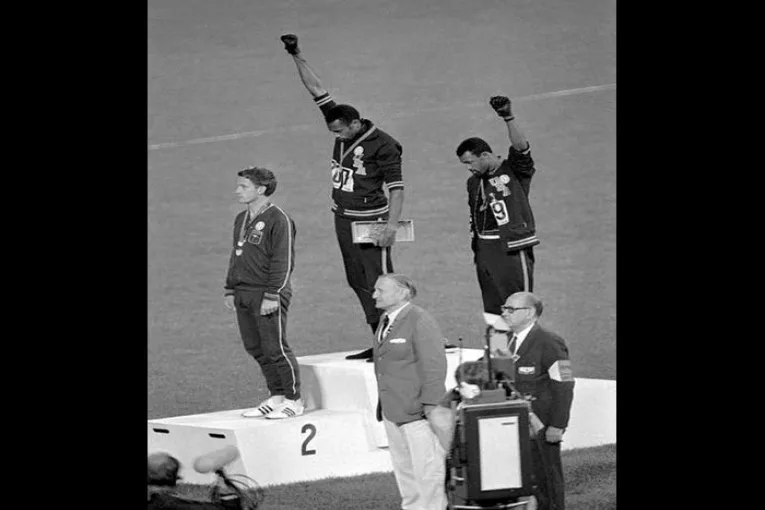
That was also the Olympics when Tommie Smith, who had run a world record 19.8 in the 200, and John Carlos, who placed third, raised their black-gloved fists and bowed their heads on the podium during the playing of the national anthem.
At the time it was a shocking and powerful symbol of black unity and solidarity during the depths of the civil rights movement. Smith and Carlos also wore black socks without shoes on the podium to symbolize poverty.
They were stripped of their medals, sent home, and never competed at the international level again. Few appreciate the courage it took for them to stand, on the world stage, in such a somber and self-sacrificing protest in 1968, while the Vietnam War was at its height.
Since the turn of the 21st century, the United States has gone from the first black president in American history to the most racist president in American history.
During the current winter Olympics, President Trump called American athletes “losers” for indirectly criticizing his brutal immigration policies, and not being nationalistic enough.
This week in the High Sierra, nine Californians were killed in an avalanche, the worst death toll in nearly 50 years, and the second worst in US history.
Things have gotten surreal. Trump’s environmental policies are so malicious and malevolent that they can only be fully understood in the context of race between the worst and the best in us as humans.
It’s not a competition, but it is a race human beings can’t afford to lose.
Follow the Vanguard on Social Media – X, Instagram and Facebook. Subscribe the Vanguard News letters. To make a tax-deductible donation, please visit davisvanguard.org/donate or give directly through ActBlue. Your support will ensure that the vital work of the Vanguard continues.

From the article (in the order that they appear):
Since the turn of the 21st century, the United States has gone from the first black president in American history to the most racist president in American history.
During the current winter Olympics, President Trump called American athletes “losers” for indirectly criticizing his brutal immigration policies, and not being nationalistic enough.
This week in the High Sierra, nine Californians were killed in an avalanche, the worst death toll in nearly 50 years, and the second worst in US history.
How are any of these comments related to each other, let alone the first part of your article regarding your own experiences running track?
Readers who look below the surface are connecting the dots. Petty people who have nothing to say, but just want to tear those who do down won’t understand no matter how much explanation.