
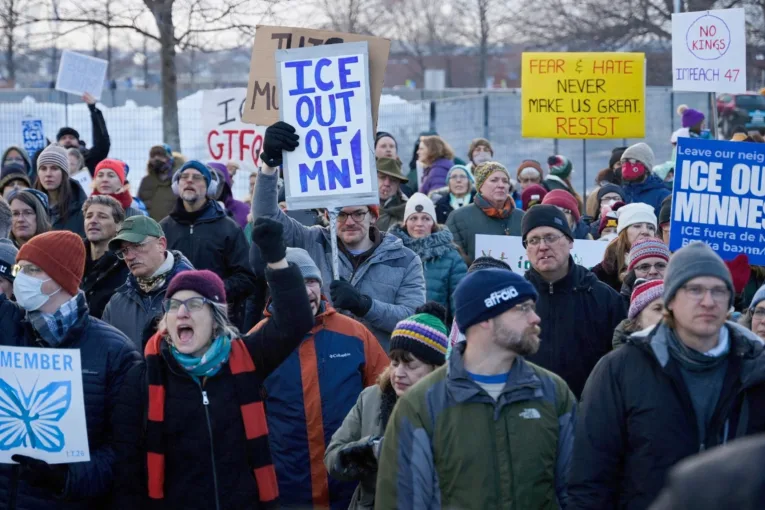
MINNEAPOLIS — White Minnesotans are being urged to sustain their engagement “after [the] shock fades” from Operation Metro Surge, according to a guest opinion by Delta Larkey and co-author Robin DiAngelo published in the Star Tribune.
According to the Star Tribune, as a “lifelong resident of the Twin Cities,” Delta has “been spending mornings protesting at the Whipple Building, where Immigration and Customs Enforcement agents gather before heading into the streets … serving as a legal observer.” The paper notes that she is “not an anomaly” and is “a part of a multiracial coalition that is guided by the historical lessons of Black and Indigenous resistance.”
The Star Tribune examines research by DiAngelo on white socialization, namely “how white Americans are taught to see racism as an aberration, an ugly interruption of an otherwise noble national story.” It states that “repeated reflexively after every racial reckoning” is the line “This is not who we are.” But, for people of color, “in this country, racism has never been a deviation. It is the throughline.”
“What white Americans experience as situational moral rupture, communities of color recognize as historical continuity — as systemic,” the Star Tribune explains. The authors pose a direct challenge to “fellow white people,” asking “how do we sustain our engagement beyond the current crisis and build a foundation that is redemptive rather than just reactive?”
Tracing the nation’s history, the Star Tribune notes that “the U.S. was not haphazardly shaped by momentary aberrations of racism. From stolen land to stolen labor, from chattel slavery to racialized wealth extraction, this system is not evidence of national failure; it is evidence of design.” The authors add that “the propaganda project of America tells us that history should not be uncomfortable and that our stated values outweigh the evidence of our actions,” yet “the recent slate of executive orders underscores that project.”
Looking at “the brief period that followed” the Civil War, known as Reconstruction, the Star Tribune states that it “demonstrated what was possible. Black men were elected to Congress. Public education systems were developed. Black people built businesses, accumulated land and bought homes.” Despite this, the authors note that “every inch of Black progress has been met by a backlash of white rage.”
They reiterate the point that “democracy is negotiable, white supremacy is not,” by examining the backlash to Reconstruction. There were “racial terror campaigns, lynchings, economic sabotage and political violence [which] made clear that white people were willing to destroy democracy rather than share power.” Contrary to popular myth, the authors write, Reconstruction did not fail because Black governance was incompetent or corrupt. “It failed because it worked.”
The Star Tribune observes that “every chapter of racial progress since [Reconstruction] has been followed by retrenchment.” It lists examples: “emancipation gave way to Black Codes. Civil rights legislation gave way to mass incarceration. The election of the first Black president has been followed by the most overt resurgence of white nationalism in modern history.” Though there is a pattern, “each time, white America insists it is shocked and awakened.”
Furthering its point, the Star Tribune emphasizes that “what sustains this cycle is not ignorance of history, but a lie so deeply embedded in white consciousness that it feels like common sense: the belief that equality is a zero-sum game.” If “they gain safety, access or dignity, we must lose something essential in return.”
As the Star Tribune explains, “zero-sum thinking is a central part of the machine of systemic racism, convincing white people that domination is protection,” thus leading white Americans to repeatedly choose “systems that harm their own material conditions — underfunded schools, limited access to health care, weakened labor protections and decaying infrastructure — so long as those systems preserve racial hierarchy.”
This dynamic, the authors argue, leaves “white people left with an identity without substance, an identity rooted not in shared humanity or ethical coherence, but in contrast and control … it demands constant maintenance: fear, resentment, apathy, and willful ignorance.”
The Star Tribune concludes that “the war we are in today is a war over memory, meaning and moral responsibility. Over whose votes count, whose histories are taught, whose bodies are protected by law, and whose lives are framed as disposable in the service of control and profit.” Once again, it states, “the cost is being borne disproportionately by Black, Indigenous, immigrant, and brown communities, while white people debate optics, tone, and whether this all feels ‘too divisive.’”
Finally, the Star Tribune reports that “white Americans have been taught to believe that equality requires our loss. History shows the opposite: that it is the hoarding of power that has impoverished us all.” The authors write that “the question now is not whether justice will cost white people something; it already has.” The question, they conclude, “is whether we are willing to stop paying that cost in moral bankruptcy, democratic collapse and generational harm, or whether we will continue to sacrifice the future in order to preserve a lie.”
Follow the Vanguard on Social Media – X, Instagram and Facebook. Subscribe the Vanguard News letters. To make a tax-deductible donation, please visit davisvanguard.org/donate or give directly through ActBlue. Your support will ensure that the vital work of the Vanguard continues.

DiAngelo, eh?
What’s striking here is not the argument so much as the staging. This is an essay about immigration enforcement, democracy, and history that somehow manages to be almost entirely about “white” people talking to other “white” people about how “white” they are. “White” appears seventeen times, which feels less like emphasis and more like a branding exercise. Racism is treated not as something that can be argued about in policy terms or even measured in outcomes, but as a permanent psychological condition, inherited at birth and managed through ritual self-interrogation. The reader is not asked to think through tradeoffs or solutions, only to locate themselves correctly inside a moral caste system and stay there indefinitely.
The ally posture does most of the work. Shock is proof of ignorance, disagreement is proof of fragility, disengagement is proof of complicity. There is no off ramp, only sustained engagement after the shock fades, then after that fades, and presumably after whatever comes next. History is invoked less to illuminate than to foreclose debate; dissent is backlash and democracy is something “white” people will happily destroy unless constantly supervised by their better angels.
The irony is hard to miss. An essay that claims to decenter “white”-ness cannot stop recentering it. In the end, this reads less like a call to justice than a loyalty oath for “white” allies, complete with required vocabulary, approved emotions, and no mechanism for ever being done.
Are you sure MS didn’t write this? He could have.
“MINNEAPOLIS — White Minnesotans are being urged to sustain their engagement “after [the] shock fades” from Operation Metro Surge, according to a guest opinion by Delta Larkey and co-author Robin DiAngelo published in the Star Tribune.”
Fortunately (as a white person), I didn’t “engage” in the first place.
And in fact, I support discouraging illegal immigration in general.
Do both of those statements make me an evil white person?
Not sure where skin color is involved in all of this, since I didn’t see a lot of non-white protesters (as usual). Just the usual self-righteous white buffoons, for the most part. People whom I sort of laugh at, when I’m feeling unkind and/or witnessing them harassing others – including agents.
Folks, opposing illegal immigration is not racist, no matter how many times buffoons or self-interested organizations tell you otherwise.
“Undocumented immigrants broke our immigration laws, and I believe that they must be held accountable.”
“We simply cannot allow people to pour into the United States undetected, undocumented, unchecked.”
“I believe that the solution to this problem is not amnesty.”
Any guesses? (no fair cheating with google)
And for the record, I fully agree with #2, not so much with #1 and #3, in context of today.
My honest first guess was Barack Obama.
I looked it up and I was right.
Progressives, how to you like them apples?
“During his two terms in office (2009–2016), the Obama administration deported approximately 3.1 million to 3.2 million people.
“Deporter in Chief”: Due to high deportation numbers, particularly in his first term, immigrant rights groups often referred to Barack Obama as the “deporter in chief”.”
Yes, Barack Obama’s immigration record was deeply flawed. Deportations were high, particularly in his first term, and immigrant rights advocates should criticize that record – it was deplorable.
Second, Obama’s enforcement posture was tied to a strategic — and ultimately naïve — belief that aggressive enforcement would create political space for comprehensive immigration reform. He bet that demonstrating that he was tough at the border would bring Republicans to the negotiating table. That calculation failed and a lot of people suffered for it.
Third, Obama did not turn ICE into a paramilitary force that engaged in high-visibility, intimidation-based community invasions as a political strategy. He did not subvert the law to enact his policies. His policies were not built around cruelty, nor were they designed with cruel intent. We can look at family separation and now we are seeing increasingly militarized removals and enforcement theatrics that are designed not just to enforce the law, but to send a message and punish political foes. Can’t defend Obama here, but you’re just playing politics if you don’t see a difference in Trump and Obama.
Or, maybe Obama didn’t support illegal immigration either (or at least, not as much as that dimwit Biden).
Pretty sure that Obama would not have responded the same way that Biden did, when there were thousands of illegal crossings (per day?).
All I can tell you for sure is that I much preferred Obama, over Biden.
I also preferred Brown over Newsom, for different reasons.
Though I suspect that Obama’s weakness was that he apparently didn’t engage in the “back room” (personal) dealings that someone like LBJ might have done.
Obama was a great speaker (probably the best president regarding that since Kennedy), but that’s apparently not the only (or even the most-effective) way to get things done.
Politicians have to “make a deal” so to speak, in this system at least. Though as I recall, a deal was made with one holdout to get Obamacare enacted – which has since been eviscerated.
As I recall, Obama thought that other politicians were against him (partly because of his skin color), but it doesn’t seem like that’s ultimately the reason. Has way more to do with self-interest (aka, pork-barrel entitlements in regard to congressional representatives who don’t give a damn about the country as a whole – as much as pleasing their own self-interested constituents).
Sort of like school districts which don’t care about other districts, but try to disguise it using other terms (such as “equity”), etc. Or, “it’s for the kids”. (The latter of which I’d believe if the money actually was distributed directly to the kids.)