
- Davis has no excuses for being as financially perilous as it is. Our situation is largely a self-inflicted wound.
By Tim Keller, Founder and Executive Director of Inventopia
On Tuesday, our city council will take up consideration of our city’s strategic plan for economic development.
This is both timely and important especially in light of the fact that our city is forecast to be bankrupt within 5 years.
But beyond our immediate acute needs, it is my hope that this time around we finally “get it right”
The Basics
Every city has two economic sectors: A “primary industry” that brings money into the economy from the outside, and then a service economy where money inside the city recirculates as people buy everyday goods / services / entertainment etc.
One of the challenges we have is that our “primary industry” (the University) is not an entity that pays sales or property taxes. If our economy was anchored by a pharmaceutical plant, or a sawmill, or almost anything else, we would be having a very different conversation.
Every city needs to have a level of balance between housing (which costs money in the long term) and “income production” in its land uses. Single family housing is particularly expensive to maintain infrastructure for, and to the extent we provide services and maintenance for our city, we need to have income streams to pay for it.
This is one of the fundamental underlying causes of Davis’s current economic dysfunction: While we do have a large dominant employer in the city paying a lot of wages that work their way into the local economy, the property tax and sales tax base you might expect for a city our size is actually disproportionally small.
A tale of three cities
Take into consideration this data that I compiled from market reports on commercial and retail spaces in West Sacramento and Roseville; two cities that have roughly ~30% more city tax revenue per capita than Davis.
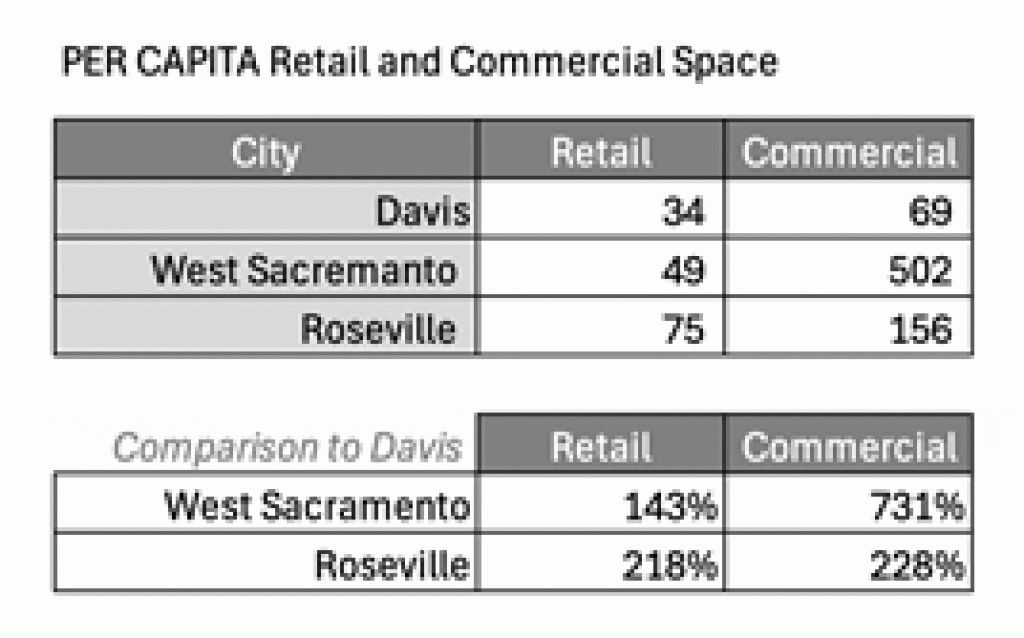
For every person in Davis we have 34 square feet of retail stores, and 69 square feet of office and industrial space.
West Sacramento has 43% more retail space per person, and 7 times more commercial space. Roseville, a regional shopping hub, has more than twice retail AND commercial space per capita.
You, of course, do not see UC Davis’ footprint on Davis’s totals because the university isn’t even legally IN our city, and even if it were, we wouldn’t be able to charge property tax against its buildings, or levy a sales tax against the billion dollar’s worth of research funding it receives every year.
These numbers at the most basic level, suggest that our city is not built with appropriate economic balance: We have too little revenue producing retail and commercial space relative to our population
Sitting on a Lottery Ticket
And that is where this conversation gets interesting, because even though the university doesn’t pay taxes in the traditional way, it DOES offer us other kinds of value.
Consider the following two facts:
- Food & Agriculture is the worlds #1 industry, at fully 10% of global GDP ( Over $10 Trillion Dollars total market value) and employing over a billion people.
- UC Davis is the world’s leading Agricultural research university with over a Billion in research funding, and multiple internationally recognized programs as well.
Does that sound like an opportunity to you? It should.
Yet it is strange how difficult it has been for our city to recognize and react to this reality.
I have written before in these pages that when it comes to Economic Development, Davis is sitting on a winning lottery ticket, but is too scared to cash it in.
Most cities’ economic development agencies are focused on trying to develop excuses and incentives to bring companies to town and increase that “primary industry” part of the economy, bringing money into the economy and creating jobs.
In Davis, we are constantly turning them away.
UC Davis is in fact the crown jewel of economic competitive advantages. The leading source of innovation in the world’s largest industry. It literally doesn’t get better than that.
Davis has no excuses for being as financially perilous as it is. Our situation is largely a self-inflicted wound.
Our Complimentary Asset
Now, let’s be clear. I’m not saying that we don’t have food and AgTech companies here. Quite the opposite. What I’m saying is that we have been at capacity and unable to bring in MORE of this kind of business for some time.
In fact, the extent to which we already have a number of successful AgTech and Crop Science operations here, conveys another strategic asset for our economy: A specialist workforce.
There IS already a strong of AgTech sector here in Davis:
- Have you seen the names “BASF” and “ADM” or “Mars / Wrigley” on buildings around town? These are giant international food and Ag companies and their presence here isn’t an accident. They may even employ some of your friends and neighbors.
- In the fields between here in Woodland, you will see some other names: Bayer / Syngenta / Corteva / HM Clause / Gro Alliance… these are seed companies (crop breeders) and crop protection companies as well, and those companies are also not here by accident.
- Did you know that there are multiple publicly traded AgTech companies that started here? Two of them started by one woman ( Pam Marrone ) who is currently busy starting yet ANOTHER company!
- We have a breakout soon-to-be billion dollar company here in town called BioConsortia that makes a seed coating that introduces microbes that fix nitrogen into the soil to fertilize plants without the synthetic fertilizer that has large climate impacts… Lower cost, lower environmental impact, higher crop yields… Win. Win. Win.
Most Davisites likely do not see all of this work being done, as these companies do not advertise locally, but this existing industry gives us a secondary competitive advantage: A population of veteran AgTech talent that is in critical demand.
I have seen companies come to town specifically so they can hire these kinds of talented researchers. Inventopia’s largest graduate company Innerplant is one of them. These key employees are no longer part of the university, but they are a very real economic advantage for us nonetheless. (And they are a reason why “housing” is a critical part of economic development as well.)
“Grown Here vs Imported”
In light of all of the above, I think you can see why I was critical of the city’s economic development approach in the past that simply focused on “lets build an innovation park”
Building more commercial space without understanding the industry we want to build for is short-sighted.
If you look at the AgTech companies I pointed out earlier, there is a large difference in terms of impact on our city’s finances:
- The big AgTech companies that are here have setup research divisions. They bring jobs to our economy, but those companies aren’t headquartered here, and they don’t pay their sales taxes here.
- By contrast, the homegrown companies that ARE headquartered here, who do production here, and who pay their sales taxes here, stand to have a much larger contribution to our city’s taxbase.
But here is the catch: Commercial landlords generally do NOT want to work with our homegrown startups. They are happy to cater to the large international companies who have research operations, but they will often prefer to have a property sit vacant rather than build it out for a startup that is less secure financially — and I don’t blame them.
Startup companies tend to have a 1-in-10 chance of success, they need lots of expensive lab space, pilot production facilities, that are expensive to build out… and if that startup fails, the landlord gets left holding the bag.
This is why places like Inventopia exist — we create a stable place where these high-risk ventures can come and go — yet the facility itself remains to serve other companies over the long-term. The ones that are successful end up getting enough traction and stability and at some point, can graduate into spaces owned by more traditional landlords.
If we “just build an innovation park” and don’t ask ourselves how exactly we are going to support the needs of these homegrown companies during their development phases then we will only see occupancy by the larger ( but lower value) corporate tenants.
This is not a trivial distinction.
A “Pipeline,” not a “Park”
Finally, its important to realize that none of this is work that can be done quickly.
AgTech companies take 6-10 years to get a product to market, if not more. When they fail, it is often NOT because of their technology not working — it is because they cannot sustain the massive resource investment in facilities and overhead over the long timeframes involved.
We cannot expect to develop more commercial space under the standard model and then expect it to be filled up immediately and contributing to our taxbase. That isn’t how this works. Davis has 2 or 3 billion dollar companies every decade that we want to hold on to, and a wide variety of very valuable smaller ones that happen more frequently. But all of them come along on their own timelines
Righting our economic ship and intentionally building the kind of economy where we can truly engage our City’s biggest economic opportunity thus simply takes time.
To me, especially in light of our city’s looming financial shortfalls, that means a sense of urgency is entirely appropriate towards opening this pipeline for innovation and making that pipe as wide as possible.
We do not need a massive innovation park built out next year, but we could certainly use some developable real estate with clear entitlements and an easy-to-navigate city permitting process that makes it easy for our companies already in the pipeline to build their own “forever homes” here.
This is difficult for the city to do as our capacity for investing cash into this pipeline is limited by our own strained general fund. But the city does have other assets ( like measure O farmland we own outside the city limits) which can play a role, and there is a lot that can be gained by engaging regional / state / federal / corporate partners in doing this development work.
This should be a priority not just for the City of Davis, but for Yolo County — since companies founded in Davis has been spilling over into Woodland and West Sac for decades already.
Do we need more commercial / industrial real estate? Yes, absolutely. Our economic engine doesn’t work without it, and I think the numbers shown above don’t leave that in any doubt.
But simply focusing on the real estate side of the equation without paying attention to how we build the pipeline of companies that are going to fill that space severely undercuts the potential success of such an effort.
We can turn on the “open for business” sign in Davis by simply focusing on the input side of the pipeline:
- Incentivizing the creation more smaller commercial / industrial spaces on the handful of infill properties that exist,
- Create larger incubator space like Inventopia — but also intentionally building pilot facilities, commercial kitchen space and the kinds of specialist resources desperately needed by our target industries
- Leveraging city-owned farmland for crop science / ag-automation startups to do real R&D and product trials in the field.
- Creating intentional relationship networks for startups and connecting them to growers, corporates, investors and each-other.
All of this costs very little in terms of real dollars, and can make a large difference in attracting and retaining the most valuable early stage companies.
Let’s get THAT pipeline going and then start taking seriously how we develop the additional commercial real estate that is needed to retain them.
Why I’m optimistic
I have been involved in economic development in this city since 2016 — back when the first business parks were being proposed. Back then, (and for many years since in fact) both developers and regional economic development were still talking in terms of “attracting business here from the Bay Area.”
But that has changed. I have not been the only one advocating for us focusing on our natural strengths in Food and AgTech, and both the city and our regional economic development groups have come around to this position as well: We need to focus on OUR strategic strengths, and for Davis, that means Agriculture / Food Science / Sustainability
In addition, after 8 years, Inventopia is no a crazy idea. It is an established part of our economy and we have data that has shown it has paid dividends for the community.
I think it also helps that the city now is also motivated by the specter of our own looming fiscal insolvency. Economic development is no longer optional — we need to start focusing on the revenue side of the ledger, or summon the will to make deep cuts on the expense side — something that is not likely to be popular.
Finally, I’m encouraged by the leadership we currently have in City Hall. Not only do we have an very capable economic development director in Katie Yancey, but I have had a chance to speak with every councilmember on these topics, as well as the new city manager, and it seems that ALL the above understand the work before us and the urgency that is required in bringing this kind of focus for our city.
If we can’t do this right NOW, then we never will.
Tim Keller, Founder and Executive Director, Inventopia, www.inventopia.org

This is an excellent vision of how Davis can become sustainable in more ways than one. My wife Anya and I wrote about how focusing on developing an economy centered on sustainable food production could revitalize our town. This all fits together in the puzzle with the recently announced City economic development plan. https://davisvanguard.org/2018/10/guest-commentary-make-sustainable-food-economic-engine-downtown-davis/
I agree Richard that it is a well thought out logical vision. As such it is one alternative vision, but it is not the only alternative. Other alternatives need to be articulated and considered by the community.
If the public isn’t involved then all of what has been described here will be by executive fiat … just like a Trump pronouncement … and inevitable resistance at the ballot box will follow.
Bottom-line, my personal support for this vision, and I do personally support it is only valuable if the rest of the community selects this vision after considering the alternatives.
This article, coupled with tomorrow nights discussion of Economic Development by the City Council, is a very positive sign. I’m very impressed and pleased at the quality of work that Katie Yancy is currently doing, and has done since her arrival here in Davis.
However, there is a significant omission in the information Katie has assembled for City Council, as well as in this Vanguard article. In each case there is no tangible evidence of any buy-in by the residents and/or voters of Davis that they believe in and support this direction for Davis. Why is that? Because no one has asked them what their opinion is about what Davis’ future as a community should be. As a result there is no plan that any efforts ( like the excellent efforts described in both this article and tomorrow’s Staff Report) can be measured against. Both the article and the Staff Report make significant assumptions about what Davis residents want. In effect they are emulating our beloved POTUS and proceeding by executive fiat. I have to wonder why that is the case here, when honestly and forthrightly presenting the scope of the City’s financial problem, how we got to this point, and (several) alternatives for dealing with it can, and should, be easy to present to the community for its consideration, selection of a preferred alternative, and support of that chosen alternative.
The value of going that route is that it takes the assumptions and the executive fiat out of the equation, and when proposals are received (and eventually voted upon) they can be assessed in the context of (and against the goals and objectives of) that mutually agreed upon guide.
Said another way, it brings accountability to the fore and simultaneously reduces uncertainty for all parties.
It is important to note that Davis has never had a robust retail economy. It has always been below average. The reason is simple, that economy is based on serving local demand for goods and services, and not trying to bring “other people’s money” to Davis to be spent here. The one exception is to that pattern are the automobile dealerships, and the sales tax laws in that sector make capturing the sales tax of a non-Davis resident buying a vehicle very difficult. So our Downtown is mostly a food and beverage court. Until and unless we agree that capturing “other people’s money” is a desirable outcome, the statistics Tim has shared will not change.
So, to avoid having a “fatal flaw” effectively rip the heart out of the good work Katie Yancy and others have done, the community needs to be brought into the discussion of alternatives for Davis being able to pay its bills.
I think that the decision for us to not attempt to be a “retail destination” in the same way that roseville and vacaville have was a good call… especially if you look at the streetscapes of those cities around their huge off-freeway centers… its borderline dystopian, not bike or pedestrian friendly at all… I would take our walkable downtown over those kinds of cityscapes every day of the week. Not only that, but Im pretty sure that our downtown brings in significatnly more per acre in terms of sales tax than any strip mall anywhere.
But to re-iterate a point you made in a comment a couple weeks ago Matt: If we want to enjoy city services we need to figure out how to pay for them. If becoming a retail destination isnt the strategy we want to go in, then commercial / industrial is pretty much our only other option.
Which IS the right call because of the massive opportunity given to us via our proximity to the university. In fact, it would be a little bit wierd for us to ignore our opportunities in food and agtech in order to build a shopping mall… something that any other community on I-80 can do equally well… if not better
But to re-iterate a point you made in a comment a couple weeks ago Matt: If we want to enjoy city services we need to figure out how to pay for them. If becoming a retail destination isn’t the strategy we want to go in, then commercial / industrial is pretty much our only other option.
Not true Tim. If this were an EIR there are at least three other “alternatives.”
(1) we can do nothing and let the city continue to deteriorate … the “no project” alternative …
(2) we can fully commit to the “bedroom community for (a) retirees and (b) people who commute to jobs beyond the City limits … and come up with the needed additional revenue by implementing (i) a per bed/head tax of $300 per each bed in a residence whether occupied by a person or not, and (ii) an annual business tax levied on all businesses and individuals who derive rent revenue from housing. (i) is a value relinquished for the value received by residency here, and (ii) is a barrier to entry for all the investors who are displacing owner-occupants buy purchasing residential properties to turn a profit from the rental payments.
(3) we can collaborate with UCD to capitalize on the 110,000 plus student applicants each year, half of which come for a campus visit, almost always with their families. Getting half of those visits to stay for one night at a local hotel to more thoroughly sample the things their child will have at their disposal would be a big boost to the local economy. Dinners at local restaurants, hotel room charges, “other people’s money” being spent for Davis goods and services. And the beauty of that “alternative” is it can be started tomorrow, with very minimal startup costs.
(4) various combinations of the different “alternatives”. With the exception of (1) above, none of them are mutually exclusive.
I’d suggest that Davis look at other “retirement communities”, to see how they’re funded.
The existing population of Davis doesn’t personally need jobs (and less so each/every year). For that matter, old-timers probably use the bike paths, sports parks, libraries (and certainly the school system) less than they used to.
Also, any “economic development” will increase pressure (including that from the state) to build more money-losing housing, which may very well result in creating a larger fiscal challenge.
Apparently, even cities with substantial “economic development” haven’t figured out how to get spending under control:
“Twelve Out of Fifteen Largest California Cities Don’t Have Money to Pay their Bills According to Accounting Study”
https://californiapolicycenter.org/twelve-out-of-fifteen-california-cities-dont-have-money-to-pay-their-bills-according-to-accounting-study/
This sounds like a better economic proposal for the Davis “primary industry” than most I’ve heard, other than I have a personal issue with promoting the biotech agricultural industry. What I don’t understand is why we are the ONLY blue state that doesn’t use the Community Wealth Building (CWB) formula for the “service economy” part of local economic development. I’ve spent the better part of 8 years at UCD as a graduate student studying community economic development, I am a local business owner, I’ve sat on the Lake County Economic Development Blue Ribbon Committee, I was on the Yolo County executive committee for our Basic Income pilot, and done international development work too. Like Matt said in the above comments, there is “no tangible evidence of any buy-in by the residents and/or voters of Davis that they believe in and support this direction for Davis.”
What I do know from the work I have done to understand what local residents/voters do want is sustainable, affordable, ethical basic needs. The Yolo county general plan has been pushing bringing in wealthier in-migrants to “solve” poverty for decades… but that just makes the “K-shaped” recovery worse. In-migrants have enough money to buy their basic needs without too much of a problem. The people who are living here for decades are struggling. CWB is a globally proven approach to stabilizing basic needs and the commercial determinants of health, reducing inequality, increasing the local multiplier effect, deepening economic democracy, and doing it all while becoming more ecologically sustainable. It has been the cornerstone of recovery for the Rust Belt here in the US, and is the cornerstone for sustainable economic development in Scotland on a national scale. Almost everything we love about Davis that is unique to this town is due to the CWB-like policies we put into place in the 1970s. It WAS the cornerstone to making Davis the sustainable, progressive city it has become famous for. If we don’t want to lose that to gentrification, then you cannot consider implementing innovation parks (no matter how carefully curated to our development strengths) without anchoring the city in economic fundamentals.