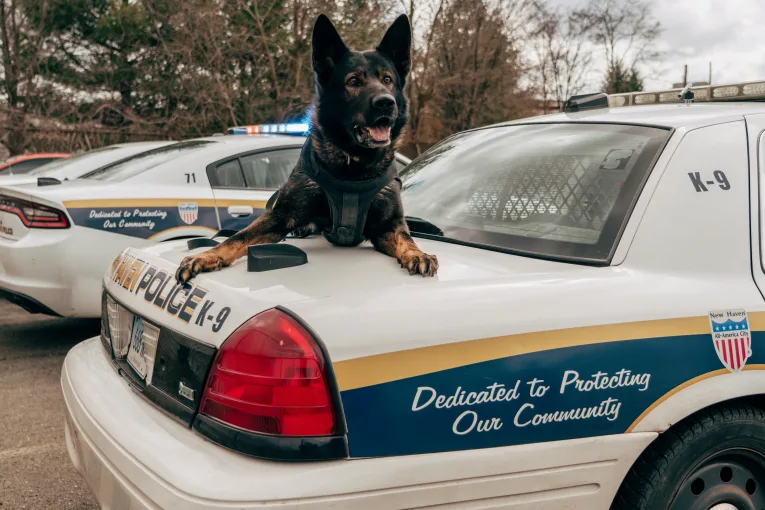
The dog only gets paid when it says yes.
Think about that for a moment. The animal is trained to perform a specific behavior. Sit. Bark. Scratch. When it performs that behavior, it gets a toy. It gets a treat. It gets praise from the handler it loves. If the dog walks around a car and finds nothing, it gets nothing. The dog learns very quickly that “sit” is the lever that makes the treat appear.
This is not a detection system. This is a slot machine where the only winning move is to pull the lever. The dog is not searching for drugs. The dog is searching for permission to get its reward. If the dog goes long enough without a find, it gets frustrated. It gets confused. It learns to alert because alerting is the only way to end the game with a prize. The system is designed so that the dog must be wrong to get paid. An 80% false positive rate is not a malfunction. It is the predictable outcome of training an animal to beg.
Now follow the money.
The dog alerts. The officer searches. If the officer finds drugs, the driver goes to jail. But if the officer finds cash, the department keeps the money. This is civil asset forfeiture. The government can seize your property without charging you with a crime. They do not need to prove you are a drug dealer. They only need to prove that the money is suspicious. And a dog alert is the proof they use.
The dog is not finding drugs. It is finding revenue. An 80% failure rate is not a problem for the department if the 20% of hits generate enough cash. The dog is an ATM with a nose. The officer pulls you over. He calls the dog. The dog sits. He opens your trunk. He finds nothing. But he sees an envelope with $2,000 in it. You explain that you are driving to buy a car. You show the listing on your phone. It does not matter. The money is seized. You are not charged with a crime. You are free to go. But your money stays with the police.
You can try to get it back. You will need a lawyer. You will need to file a lawsuit. You will need to prove that the money was not involved in criminal activity. The burden is on you. The department counts on you giving up. Most people do. The dog was wrong. But the department still got paid. The inaccuracy is profitable. The lie is a business model.
The courts have agreed to play along. In 2005, the Supreme Court ruled in Illinois v. Caballes that a dog alert during a lawful traffic stop provides probable cause to search. The Court did not require the dog to be accurate. It did not require the dog to pass a reliability test. It only required the alert. In 2013, Florida v. Harris went further. The Court ruled that the dog’s alert is sufficient even if the dog has a poor record in the field. The training records do not matter. The accuracy rate does not matter. The alert is enough.
Who certifies these dogs? The police do. There is no independent federal standard. No regulatory body outside law enforcement. Police agencies certify their own dogs using standards they create. The “expert” who testifies in court about the dog’s reliability is often the person who trained the dog or a colleague from a neighboring department. The courts treat this certification as scientific fact. A police officer vouches for a police dog trained by police standards, and the Constitution steps aside. It is a closed loop. A circle of friends agreeing to call a game fair because they are the ones running it.
The system has a built-in defense for when the dog is wrong. The handler does not say the dog made a mistake. The handler says the dog detected “residual odor.” The dog smelled where drugs used to be. This makes the animal infallible. If drugs are found, the dog was right. If drugs are not found, the dog was still right because drugs were there at some point in history. Maybe yesterday. Maybe last week. Maybe when the car was owned by someone else. The dog can never be wrong. The science is rigged to prevent the very possibility of error. A test that cannot fail is not a test. It is a ritual.
The numbers are not hidden. They are simply ignored. A study from the University of Missouri found that drug dogs were wrong more than half the time. The Department of Transportation tested 60 dogs across 29 studies and found hit rates often below 33 percent. In California, data from the Racial and Identity Profiling Act showed that drug dogs alerted in approximately 82 percent of stops involving Black drivers. Those alerts led to actual evidence only about 9 percent of the time. The dogs were wrong nine times out of ten when the driver was Black. But the searches happened anyway.
The racial disparity is not accidental. The dog is a tool. The tool is deployed more often against Black and Brown drivers. The handler brings his bias to the car. The dog reads the handler. The dog confirms the bias. The search is legal because the dog said so. The Supreme Court has agreed that this is enough. The Court did not ask whether the dog is racist. It did not ask whether the handler is racist. It asked only whether the dog alerted. The alert is the law.
The dog is protected by something stronger than legal precedent. The dog is protected by emotion. The dog is a “partner.” The dog wears a vest. The dog gets a funeral when it dies. Departments post photos of their dogs on social media. They talk about the bond between handler and animal. They show the dog visiting schools. They show the dog getting petted by children. This emotional shield makes the civil rights argument feel cold. You are not questioning a legal tool. You are questioning a beloved animal. You are attacking a living creature that just wants to play. The police know this. They use it. They put the dog on the stand without putting the dog on the stand. How do you argue against a golden retriever?
But the dog is not a golden retriever. It is a German Shepherd or a Belgian Malinois. It is trained to bite. It is trained to attack on command. The same animal that sniffs for drugs is the animal that tears flesh from a suspect’s arm. The cute photos on Facebook do not show the puncture wounds. They do not show the surgeries. They do not show the lawsuits from people who were bitten after the dog was released. The emotional shield hides the weapon.
The Constitution was written to protect you from unreasonable searches. The Fourth Amendment exists because British soldiers could search any home without cause. The Founders wanted to require evidence before the government could invade your privacy. The dog alert has become the modern equivalent of the British warrant. It is a permission slip written by an animal that is wrong most of the time, trained by people with a financial incentive to be wrong, protected by courts that do not care about accuracy, and shielded by an emotional narrative that makes questioning it feel cruel.
If a breathalyzer was wrong 80 percent of the time, it would be thrown out. If a fingerprint scanner failed four times out of five, courts would refuse to admit it. But the dog remains. The dog remains because it serves a purpose that has nothing to do with finding drugs. It serves as a bypass for the Fourth Amendment. It serves as a revenue generator for departments that need cash. It serves as a way to search the people the police want to search without having to justify the search on its own merits.
You have no recourse. If the dog is wrong, you do not get your time back. You do not get your dignity back. You do not get the cash the department seized. You do not get to sue the dog. You do not get to sue the handler. The courts have said the search was legal because the dog said so.
The dog said so. The dog that is wrong four times out of five. The dog that only gets paid when it says yes. The dog that smells its handler’s bias. The dog that generates revenue for its department. The dog that can never be wrong because “residual odor” explains everything.
That is the system. That is what waits on the side of the road. Not a hero. Not a machine. A tool for manufacturing consent. A way around the Constitution. A lie that the courts have agreed to tell.
The dog is not lying. The dog is doing exactly what it was trained to do.
The system is lying. And it is getting rich while it does.
Follow the Vanguard on Social Media – X, Instagram and Facebook. Subscribe the Vanguard News letters. To make a tax-deductible donation, please visit davisvanguard.org/donate or give directly through ActBlue. Your support will ensure that the vital work of the Vanguard continues.