
- “Our view is that the judge’s order is unconstitutional and illegal.” – Public Defender Mano Raju
SAN FRANCISCO — After months of hearings and legal filings, a San Francisco judge found Public Defender Mano Raju in contempt two weeks ago and on Tuesday imposed a $26,000 fine, escalating a high-stakes conflict over whether courts can compel representation when public defense offices say they lack the capacity to provide it.
The ruling by Superior Court Judge Harry Dorfman stems from Raju’s decision to decline a limited number of new cases, a move he has argued was necessary to protect the constitutional right to effective counsel for existing clients. Dorfman rejected that justification, concluding that the Public Defender’s Office had sufficient resources to accept the cases and that its refusal constituted defiance of a lawful court order.
The refusal was not, Raju has insisted, an act of defiance for its own sake, but a calculated attempt to preserve what he argues is the core constitutional guarantee of effective counsel.
Dorfman disagreed. Having previously found Raju in contempt, the judge imposed the fine—$1,000 for each of 26 cases the office declined to take—while rejecting the argument that the public defender could unilaterally determine when his office had reached its limits.
“The court is not a bystander in this,” Dorfman said, asserting that judicial authority extends to ensuring that representation is provided when required.
He added that “the law compels the court to appoint a public defender when necessary,” and concluded that the office “had enough attorneys available to take the cases assigned to it.”
For Raju, the court’s order violates ethical and constitutional obligations because taking on additional cases under current conditions would dilute representation to the point of inadequacy.
“Our view is that the judge’s order is unconstitutional and illegal,” Raju said outside the courtroom, signaling plans to appeal.
The dispute hinges on a deceptively simple question: when does too much work become unconstitutional?
Public defenders have long operated under resource constraints, but the current moment reflects a convergence of pressures that has pushed some offices to what they describe as a breaking point.
In San Francisco, the Public Defender’s Office reports that active cases have increased by roughly 65 percent since 2019, a surge attributed to longer case timelines, expanded discovery obligations, and a rise in filings.
“The San Francisco Public Defender’s Office remains unwavering in our constitutional duty to provide effective assistance of counsel to every person we represent,” Raju said in a written statement following the ruling. “Having excessive caseloads is a conflict of interest for our existing clients.”
That language—“conflict of interest”—reflects a body of legal and professional standards holding that overburdened defenders cannot meet Sixth Amendment requirements.
Advocates argue the result is not just diminished quality of representation but a systemic erosion of constitutional rights.
“Sanctions cannot change the reality that more cases are being filed and they are taking significantly longer to resolve,” Raju said.
The judge’s ruling represents a direct challenge to the premise that public defenders can refuse cases on ethical grounds. Judge Dorfman ruled that the court retains ultimate authority over case assignments, even when defense attorneys claim they cannot meet their obligations.
The implications of that ruling may have implications across California.
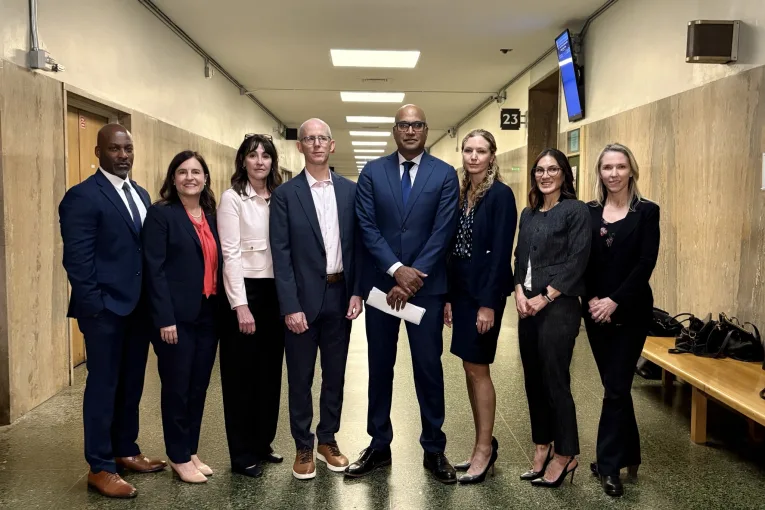
In the hallway outside the courtroom, Raju was joined by chief public defenders from multiple counties, a show of solidarity that underscored how widely shared the underlying concerns have become.
“Everyone knows that public defenders are systemically underfunded,” Raju said. “This is a real human rights issue. Families get hurt badly when we don’t provide the representation that we’re supposed to.”
The imbalance, he argued, is not incidental but structural. In San Francisco, the district attorney’s office operates with substantially greater funding, a disparity that shapes how cases are prosecuted and defended.
“The district attorney’s office has $39 million more than the public defender’s office in San Francisco,” Raju said.
He noted that the comparison understates the gap because his office’s responsibilities extend beyond criminal defense to include immigration representation and mental health advocacy, adding layers of complexity to an already demanding workload.
Raju’s office currently represents about 84 percent of people charged with crimes in San Francisco, he said, while continuing to accept the vast majority of new cases even as it declines a limited number each week.
The refusal, he has argued, is not about limiting access but preserving its integrity of their representation and their constitutional commitments to their clients.
“If we take on too many cases, we can’t provide the constitutionally effective representation we’re required to our current clients,” Raju said.
That argument has found resonance among other public defenders, many of whom describe similar pressures in their own jurisdictions.
“We’re all in the same position,” said Alameda County Public Defender Brendon Woods. “Nearly every single public defender’s office has a fraction of the funding of the prosecutors.”
Woods characterized Dorfman’s ruling as extraordinary, not only for its immediate impact but for what it signals about the role of the judiciary.
“To hold a public defender in contempt for doing his job,” Woods said. “He’s fighting for the people he represents.”
In San Joaquin County, Public Defender Judy Anne Vallado described a recent period in which her office was forced to declare itself unavailable for certain categories of cases after staff burnout reached unsustainable levels.
“We did declare unavailable for all homicide cases and for any life sex cases,” Vallado said, describing a cycle in which overwork led to attrition, which in turn intensified the workload for remaining staff.
The decision, she said, had a counterintuitive effect: it helped stabilize the system.
“Declaring unavailable isn’t just about helping the public defender’s office. It’s helping the entire court justice system,” Vallado said, noting that it allowed attorneys to complete investigations, resolve cases and reduce backlog.
Her critique went further, challenging a foundational assumption in the debate.
“An attorney who doesn’t have the time to work on your case isn’t an attorney,” she said. “You’re just having a name next to your paper, but that doesn’t give you representation.”
Judge Dorfman’s ruling implicitly treats representation as a threshold obligation that must be met, while Raju and his allies argue that the Constitution demands more than a formal assignment of counsel.
Ellen McDonald, chief public defender in Contra Costa County, sees the issue in terms of professional duty.
“The moment we’re unable to continue providing adequate and appropriate assistance of counsel … we’re required to say we cannot accept more cases,” she said.
She warned that allowing courts to override that judgment risks undermining the very standards that define effective defense.
“For a court to substitute their own judgment for the judgment of a chief public defender … is deeply concerning and deeply problematic,” McDonald said.
The pressures driving the conflict are not limited to defense offices.
In recent years, many jurisdictions have seen increases in case filings, often tied to shifts in prosecutorial policy. In Alameda County, Woods said his office has experienced a sharp rise in both felony and misdemeanor cases.
“Over the year from the previous year, we’ve received about 700 new felonies and 700 new misdemeanors,” he said.
Those increases, he added, have had disproportionate effects on communities of color, raising concerns about equity and systemic bias.
“83% of the people we represent … are people of color,” Woods said, noting that Black residents make up a much smaller share of the county’s population.
For Raju, the solution is not judicial enforcement but structural reform.
“The fastest solution is to fund public defense,” he said.
He has called for additional staffing—dozens of attorneys along with investigators, social workers and support personnel—based on national workload studies that attempt to define sustainable caseloads.
“We need many more attorneys and other staff members in order to effectively represent our clients,” Raju said.
Those studies have become a central point of contention in the case. While Raju argues they should guide decisions about capacity, the court has treated them as advisory rather than binding.
The immediate question, however, is more practical: what happens to the cases the public defender declines?
Raju has said his office is coordinating with private attorneys to ensure representation continues.
“We are working with the private panel to make sure they have representation on the same day,” he said.
But that solution, like many stopgaps in the system, depends on resources that are themselves finite.
Vallado noted that in her county, courts have sometimes had to reach beyond local attorneys, contracting with lawyers in neighboring jurisdictions to fill gaps.
As the case moves toward appeal, it is poised to test not only the scope of judicial authority to compel representation but also the substantive meaning of the Sixth Amendment in a system constrained by limited resources.
“This is a fight that absolutely needs to happen,” Raju said. “It’s a constitutional fight that needs to happen for equity in our city and in our country.”
The outcome may determine whether the right to counsel is measured by the presence of an attorney—or by the quality of the defense that attorney can provide.
Follow the Vanguard on Social Media – X, Instagram and Facebook. Subscribe the Vanguard News letters. To make a tax-deductible donation, please visit davisvanguard.org/donate or give directly through ActBlue. Your support will ensure that the vital work of the Vanguard continues.
