
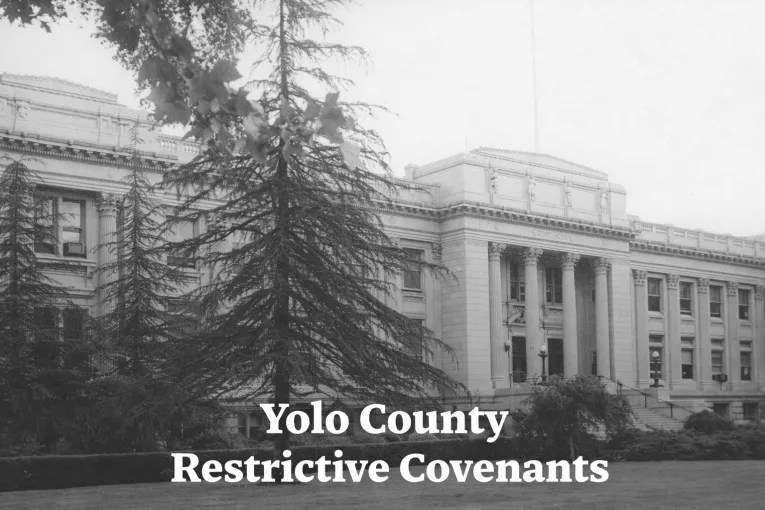
In a quiet office inside the Yolo County administration building, a routine request from a staff member led to the discovery of something unsettling buried deep in the county’s property records: language from another era, written into deeds decades ago, that explicitly barred certain racial and ethnic groups from owning homes.
The document had been brought to Yolo County Assessor-Clerk/Recorder Jesse Salinas before the pandemic, sometime around 2018 or 2019. A resident had asked whether the language could be removed.
“Somebody would like to have it redacted. There’s language in here that they find repulsive and they want it to be gone,” Salinas recalled in a recent interview with the Davis Vanguard.
For Salinas, the moment was jarring.
“And when I saw that, I’m like, ‘Oh yeah, that’s terrible. It should not be in there.’ And then I started asking staff, ‘Was this just a one-off or does it exist?’ And the reality is they go, ‘No, it’s in there.’”
What Salinas had stumbled upon was not a single historical anomaly but part of a broader pattern embedded in millions of property records across the United States.
For decades in the early and mid-20th century, racially restrictive covenants were commonly written into deeds to prevent Black families, Asian Americans, Latinos, Jews and other groups from buying homes in certain neighborhoods.
Although the U.S. Supreme Court ruled in 1948 that such covenants could not be enforced and the Fair Housing Act of 1968 made housing discrimination illegal, the language itself often remained buried in property documents.
Many homeowners had no idea it was still there.
For Salinas, the discovery raised two immediate concerns. First, the language itself was offensive and legally meaningless. Second, the process to remove it required property owners to pay fees.
“I said, ‘On top of it, we should not be charging to redact it,’” he said.
At the time, homeowners who wanted discriminatory language removed from their property records had to pay multiple fees, including those charged by the county recorder’s office and a fraud prevention fee administered through the district attorney’s office. Salinas moved quickly to eliminate those costs where he could.
He contacted District Attorney Jeff Reisig about waiving the fraud fee and brought the issue before the Yolo County Board of Supervisors to waive county fees as well.
But one major obstacle remained: a $75 fee mandated by state law.
That led to a suggestion from then–Board Chair Jim Provenza.
“And it was Jim Provenza that said, ‘Well, why don’t you introduce legislation to get that one waived?’”
The idea set off a chain of events that would ultimately reshape how counties across California deal with racially restrictive covenants.
Salinas soon connected with then-Assemblymember Kevin McCarty (now Sacramento Mayor), who represented part of West Sacramento at the time and had already shown interest in addressing discriminatory language in property records. The two discussed the possibility of legislation while McCarty was visiting the elections office.
“As we were walking in the building, I shared with them the interests of wanting to have legislation on this topic to waive that $75 fee,” Salinas said.
McCarty responded that he was already planning to introduce legislation addressing the issue.
“Well, I’m actually planning to introduce legislation on this topic. So yeah, let’s definitely see about working together.”
The collaboration eventually produced Assembly Bill 1466, introduced during the 2021 legislative session and signed into law the following year. The legislation required counties throughout California to develop plans for identifying and modifying racially restrictive language in property records.
The law recognized that counties were starting from very different places.
“Part of what we had designed is we just wanted people to develop a plan because every county was in a different place,” Salinas said.
Some counties had already digitized their historical property records, making them easier to search. Others still relied on paper files and microfiche archives stretching back more than a century.
Yolo County itself faced a massive undertaking. Its archives contained roughly 2.3 million property-related documents dating back to the county’s founding.
“2.3 million documents that we had to digitize, scan, and prepare for this,” Salinas said.
The process required far more than simply scanning pages. Many older records existed only on microfiche, a format widely used by libraries and government archives before digital recordkeeping became standard. Some documents dated back to the 19th century and were handwritten.
The county ultimately implemented a four-year, multi-phase plan to digitize the records and make them searchable. The first phase involved documents from 1985 to the present, about 1.5 million records that had already been digitized but required additional processing to enable full text search.
Later phases focused on older documents, including records from the 1970s and earlier, which had to be converted from microfiche into digital files before they could be analyzed.
One of the biggest challenges was identifying the discriminatory language hidden within those millions of pages.
This is where technology—and an unexpected partnership—became crucial.
As the county began completing its scanning work, advances in artificial intelligence made it possible to use language models to search large collections of documents for specific phrases and patterns.
Salinas reached out to researchers at Stanford University who had been developing tools to identify discriminatory language in historical records. The partnership proved transformative.
“They did it at no cost for us,” Salinas said.
The Stanford researchers helped create a system capable of analyzing the digitized records and identifying potentially discriminatory language embedded in deeds and covenants.
“Vendors were offering to do it, but let me tell you, it would’ve been very expensive if vendors said, if we had turned to a vendor,” Salinas said.
The collaboration allowed the county to move forward without dramatically increasing the cost of the project.
Even so, the overall effort required a significant financial investment. Salinas said the project ultimately cost close to $1 million.
“No, the project costs nearly a million dollars because you’re digitizing 2.3 million documents, but you’re also preserving them,” he said.
That preservation element was important. One of the core responsibilities of county recorder offices is to maintain historical property records. Digitizing the documents not only made them searchable but also protected them from potential loss.
Wildfires in recent years have destroyed or threatened government archives in several California counties, highlighting the vulnerability of paper records.
Digitization, Salinas said, was both a modernization effort and a safeguard.
The scale of the project surprised even some county officials.
“I had department heads come up to me and said, ‘Oh my gosh, Jesse, I had no idea that in addition to all the other stuff you do, you had this project going on and on and on, and you got it across a finish line,’” he said.
Yet for Salinas, the effort was never simply about technology or recordkeeping. It was also about confronting a history that still shapes housing inequality today.
In conversations about the project, he said, some people initially struggled to understand the deeper implications of restrictive covenants.
“I had a staff person [who] was like, ‘But Jesse, my grandparents were not racist and they rented to the Gonzalezes and the Gomezes,’” he said.
But renting and ownership are not the same thing.
“The keyword is you said they rented because the Gonzalez and the Gomez were not allowed to buy that property.”
Homeownership has long been one of the primary ways families build generational wealth in the United States. Restrictive covenants prevented many families of color from accessing that opportunity.
For Salinas, understanding that historical context is crucial.
At the same time, he was determined that the process of removing discriminatory language would not erase the historical record itself.
“I didn’t want the redacted to do away with the original language,” he said.
Instead, the county designed the system so that the original documents remain preserved. The modified record places a redaction over the discriminatory language while still allowing researchers and historians to see the original text if needed.
The approach was meant to balance two goals: removing offensive language from official property records while ensuring the history behind it is not forgotten.
“If we don’t learn from history… l look at what’s happening now,” Salinas said.
That historical awareness, he believes, is one of the most important outcomes of the project.
Salinas hopes the digitized records will become a resource for educators, researchers and community members seeking to understand how housing discrimination shaped local communities.
“We’ve put together an amazing resource that not only will researchers be able to use in the community, but for educators to be able to have just a really, I think, important conversation with folks in our community about what was here and used to exist,” he said.
For students learning about redlining and housing segregation, the records provide a concrete example of how discrimination was embedded in everyday legal documents.
It is one thing to read about discriminatory housing practices in a textbook. It is another to see the language itself written into property deeds.
Salinas believes those conversations are essential as communities continue grappling with the legacy of housing discrimination.
“This is an opportunity for us to be reflective,” he said. “And I want folks to use this as an incredible opportunity for us to reflect on our past and always strive for an improved future.”
Follow the Vanguard on Social Media – X, Instagram and Facebook. Subscribe the Vanguard News letters. To make a tax-deductible donation, please visit davisvanguard.org/donate or give directly through ActBlue. Your support will ensure that the vital work of the Vanguard continues.
