
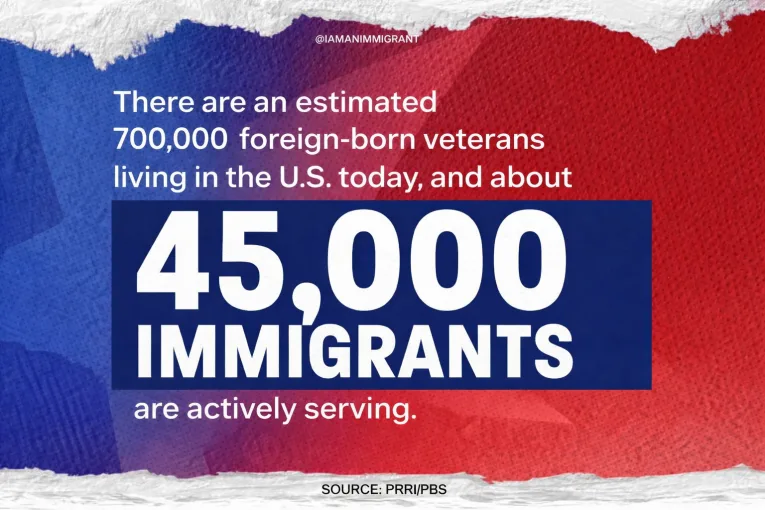
LOS ANGELES — A new report from the American Civil Liberties Union underscores the ongoing challenges faced by deported veterans and calls for improvements to a federal initiative designed to assist them, warning that recent policy changes threaten to undermine limited progress made in recent years.
The ACLU published a detailed report highlighting the reality of deported veterans and the need for improvements to the Immigrant Military Members and Veterans Initiative, or IMMVI, an initiative established in 2021 by the Biden administration that has been recently undermined by the Trump administration.
The report, titled “Fighting For What Was Promised: Honoring Noncitizen Service Members through Permanent Immigration Relief,” examines a category of military service members that is often overlooked in public discourse—immigrant veterans.
As the ACLU notes, immigrants have served in the U.S. military since its founding. Noncitizens made up 20% of the 1.5 million service members in the Union Army during the Civil War and 10% of U.S. armed forces in World War I. Since then, Congress has provided a swifter path to naturalization for service members and veterans, with requirements varying depending on whether the nation is at a time of peace or war.
According to the report, many of these immigrant service members and veterans are deported before they can become full citizens. Studies cited in the report show that veterans are generally more likely to have contact with the legal system, with one in three jailed during their lifetime, often linked to trauma from military service.
The report explains that immigrant veterans are particularly affected by this trend due to laws passed in the 1990s mandating deportation following a single “aggravated felony,” a broad category that includes nonviolent offenses such as wire fraud or drug charges. Deported veterans are often left to seek repatriation through an ad hoc process that does not account for their military service.
The report notes that conditions shifted in 2021 when the Department of Homeland Security and Department of Veterans Affairs launched the IMMVI, a joint initiative to “identify and prioritize the return of current and former U.S. military service members and their immediate family members who were removed from the United States to ensure they receive any benefits to which they are entitled or eligible.”
The IMMVI created an interagency team known as ImmVets, which coordinated a special deported veteran parole process. That collaboration resulted in approximately 138 veterans returning to the United States under humanitarian parole, allowing temporary repatriation for up to one year while they seek to reunite with family members and pursue lawful status.
However, the ACLU report finds that the IMMVI requires significant updates to achieve its stated goals. While the initiative facilitates temporary return, it provides limited support once veterans arrive. Of the 138 veterans who returned under humanitarian parole, only about half were able to obtain lawful permanent resident status or naturalize, enabling them to remain in the country permanently.
The report details numerous barriers to obtaining lawful permanent residency or citizenship. Prior convictions, including those that led to deportation, continue to block eligibility unless individuals can secure post-conviction relief, which remains difficult due to restrictions in courts, the Board of Immigration Appeals and DHS.
Additional obstacles include the process for reopening and terminating prior deportation proceedings. These motions are left to the discretion of local Immigration and Customs Enforcement offices, resulting in a roughly 50% denial rate and inconsistent outcomes across jurisdictions. Without uniform standards, decisions often vary widely depending on location.
The report also highlights recent policy changes by the Trump administration that may further hinder immigrant veterans. Among them is a change stating that “uncategorized discharges” no longer qualify as separation under “honorable conditions,” as well as broader changes that make repatriation more difficult by shifting applicants toward visa or parole pathways.
The ACLU concludes that although some progress has been made, deported veterans continue to face significant barriers to securing permanent legal status. The report argues that these challenges could be addressed by federal agencies but warns that recent policy shifts may instead make relief more difficult to obtain.
Follow the Vanguard on Social Media – X, Instagram and Facebook. Subscribe the Vanguard News letters. To make a tax-deductible donation, please visit davisvanguard.org/donate or give directly through ActBlue. Your support will ensure that the vital work of the Vanguard continues.
