
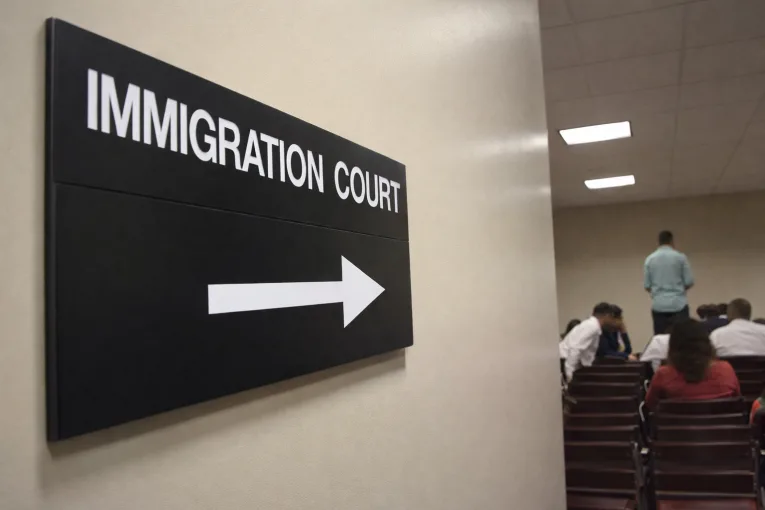
Federal judges appointed during the Trump administration have ordered the release of four immigrants after finding they were being held unlawfully in immigration detention despite prior deportation orders from U.S. Immigration and Customs Enforcement.
One case involved a Cambodian national convicted of aggravated robbery in 1993. The second involved a Palestinian man who pleaded guilty to driving under the influence and drug crimes in 2018. The third involved a Ukrainian man who left the war with Russia in 2022 and later lost lawful status after accidentally crossing the Mexican border while making an UberEats delivery. The fourth involved a Cuban man convicted of child abuse in 2020.
ICE had previously arrested all four individuals. However, because the circumstances of their continued detention were found to violate constitutional limits, judges ordered their release.
“They are among hundreds of immigrants targeted amid the Trump administration’s mass deportation drive with murky histories.” People with prior criminal records may still be released when courts determine their detention is unlawful.
The Trump administration has faced criticism over the detention of undocumented immigrants with no criminal records and longstanding ties to the United States. Federal judges overseeing some of those cases have allowed individuals to remain in the country because of the manner in which they were detained.
POLITICO reported that judges have ordered additional bond hearings or granted release for more than 400 people who had been detained.
White House spokesperson Abigail Jackson said, “President Trump always prioritizes the safety and well-being of the American people. Certain activist judges, however, have purposefully sought to promote the interests of dangerous criminal aliens whom they have ordered released into American communities to victimize the public with impunity.”
She added that the Trump administration would continue to uphold the rule of law regarding unauthorized immigration.
The issue remains complex because some deportation orders cannot be carried out when other countries refuse to accept returnees. “China, Russia, Cuba, Syria, Iran has strained relations with the U.S. or generally resists accepting deportees.”
There is also a separate category of cases in which immigration judges do not order removal because they believe individuals may be tortured or otherwise harmed if returned to their home countries.
A Cameroonian woman was ordered released by U.S. District Judge John Hinderaker after receiving protection from removal because of concerns she would be tortured in her home country. Another U.S. District Judge, Dominic Lanza, ordered the release of “a Honduran woman, convicted of sex crimes in 2006 and incarcerated until 2022, who received similar protections from torture in her home country.” Both judges were appointed by Trump in Arizona.
The Supreme Court has agreed “that people in this category can be detained for roughly six months without constitutional concerns.” That period is intended to give ICE time to obtain travel documents and make removal arrangements.
There have also been cases in which the Justice Department has made claims in court that the administration renewed efforts to arrange long-stalled deportations. Some African countries, working with the Trump administration, have agreed to receive certain deportees who cannot be returned to their countries of origin.
U.S. District Judge Kyle Dudek wrote, “The Government offers no documents, no diplomatic agreement, and no concrete evidence. … Instead, the Government extends hope as a placeholder.”
Constitutional principles mean that people “even if they have committed crimes ranging from drug trafficking to burglary to rape to murder — may be released from federal custody so long as they’ve served their criminal sentences.”
Judges have addressed the issue by noting that immigration detention is part of a civil process leading to deportation, not punishment equivalent to criminal incarceration.
A U.S. ICE official, cited in court filings before U.S. District Judge James deGravelles, argued that “[n]o matter how Petitioners color it, each of them was a criminal.”
Many people targeted in recent months by ICE had already reached the six-month detention limit years or even decades ago and were previously released under supervision orders. The Trump administration has rearrested some of those individuals and detained them again for months before judges intervened.
There is also a legal dispute over whether a new six-month detention period begins after a rearrest, allowing ICE to hold people for longer periods.
Some countries, including Vietnam, do not accept certain returnees, especially those who left before 1995. Mexico also does not accept some deportees older than 60.
Follow the Vanguard on Social Media – X, Instagram and Facebook. Subscribe the Vanguard News letters. To make a tax-deductible donation, please visit davisvanguard.org/donate or give directly through ActBlue. Your support will ensure that the vital work of the Vanguard continues.
