
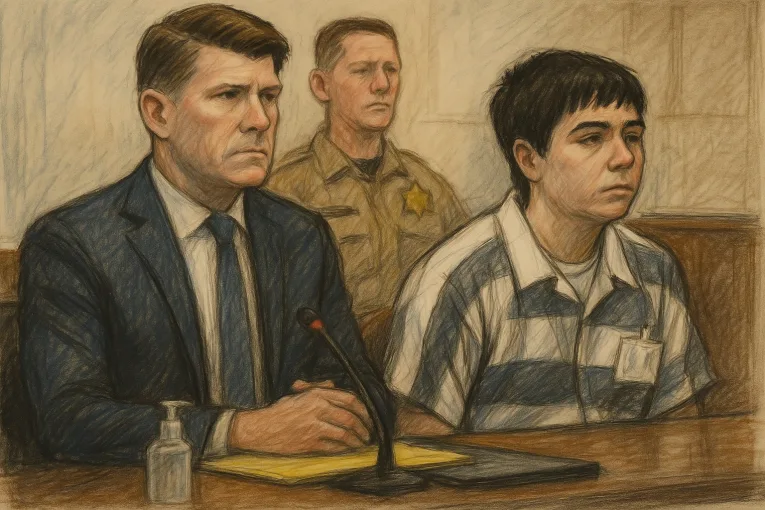
WOODLAND, Calif. — A Yolo County Superior Court judge on Thursday outlined evidentiary rules and trial guidelines ahead of the second trial of Carlos Reales Dominguez, the former University of California, Davis, student charged in a series of stabbings that shook the Davis community in 2023.
In a motions hearing before Judge Samuel T. McAdam, prosecutors and defense attorneys debated the admissibility of evidence related to cannabis-induced psychosis, mental competency, police conduct and expert testimony as the court prepared for a retrial set to begin May 18.
Dominguez is charged with two counts of second-degree murder with enhancements and one count of attempted murder with enhancements in connection with the fatal stabbings of a 50-year-old man and a 20-year-old UC Davis student, along with the stabbing of a 64-year-old woman. He initially pleaded not guilty by reason of insanity.
The retrial follows a hung jury in June 2025. Jurors reportedly split 10-2, with 10 jurors voting to acquit Dominguez on the second-degree murder count and two voting to convict.
Deputy District Attorney Matt DeMoura and Deputy Public Defender Dan Hutchinson argued a series of motions in limine concerning evidence and witness testimony. The court reiterated that the trial would proceed in two phases: a “guilt phase,” where jurors determine whether Dominguez committed the crimes, and a subsequent “mental health phase,” focused on his mental competency at the time of the attacks.
Because the case centers heavily on allegations of cannabis-induced psychosis and whether Dominguez was experiencing florid psychosis during the attacks, Judge McAdam established limits on questioning and evidence intended to avoid prejudicing jurors. The judge and counsel also reviewed proposed jury questionnaires to eliminate redundancy and clarify language.
Defense and prosecution attorneys disagreed over how cannabis use could be addressed at trial. Judge McAdam ruled prosecutors may question witnesses about Dominguez’s cannabis use only insofar as it relates to his conduct and possible psychosis at the time of the crimes, while barring questioning that would emphasize purchase history.
The judge emphasized that such questioning should not imply criminality but instead focus on the potential effects of the drug on Dominguez’s mental state. However, he allowed questioning regarding cannabis potency and blood-test results obtained after Dominguez’s arrest.
Judge McAdam granted a defense motion excluding evidence of Dominguez’s use of drugs other than cannabis. He also narrowed admissible evidence related to Dominguez’s internet searches to those involving the purchase of the knife allegedly used in the attacks and searches conducted between April 26 and May 1, 2023, when the stabbings occurred.
The judge denied a defense motion seeking to exclude a “sidewalk interview” conducted by police before Dominguez’s formal arrest, ruling the interview involved proper police conduct.
Hutchinson also sought to exclude an in-court statement Dominguez made during a suspended criminal hearing. Prosecutor DeMoura argued the spontaneous statement — in which Dominguez addressed the court as “Your Honor” and apologized — demonstrated awareness of his actions and competency despite what the prosecution described as “odd conduct.”
Although Judge McAdam allowed photographs taken after Dominguez’s arrest and statements made to mental health experts to be introduced, he excluded the courtroom statement, finding its prejudicial effect could outweigh its relevance. The judge also expressed concern that further discussion of competency rules could confuse jurors.
Another major issue involved whether jurors should receive instructions on involuntary manslaughter. Prosecutors argued such instructions would only apply if evidence suggested the attacks were unintentional, while implied malice murder would require evidence of premeditation.
According to the hearing, Hutchinson conceded that some of Dominguez’s actions aligned with involuntary manslaughter. Judge McAdam stated that if the defense pursued a theory that the attacks constituted assault without intent to kill, that could support an involuntary manslaughter instruction.
The judge referenced Dominguez’s prior statement that he “did not intend to kill the shadow figure” he believed he was attacking, saying the statement potentially mitigated implied malice.
Judge McAdam questioned whether prosecutors appreciated how close the previous trial came to acquittal, noting that Dominguez had been “2 votes from walking out of the courtroom in the last trial.”
DeMoura responded that if jurors in the first trial had received instructions on involuntary manslaughter, all 12 jurors would have voted to convict because of what he described as substantial evidence. Judge McAdam countered that substantial evidence also supported second-degree murder and emphasized that prosecutors must still prove implied malice beyond a reasonable doubt.
The hearing also revisited questions surrounding Davis Police Sgt. Stephen Ramos, who testified during the first trial. Hutchinson argued Ramos’ prior demotion from sergeant to officer in 2021, later reversed in 2024, reflected poor judgment and bore on the reliability of the investigation.
Judge McAdam stated the demotion would only be relevant if it related to dishonesty affecting witness credibility. Hutchinson countered that Ramos had testified in the first trial while referring to himself as “Sergeant” even during the period after his demotion.
The judge ultimately allowed limited use of evidence concerning Ramos’ professional history but cautioned the defense against creating speculation and instructed counsel to ensure the information was publicly available.
Another unresolved issue involved a prosecution expert witness who provided psychiatric and neurobiology testimony during the first trial. The defense challenged the witness’s qualifications, arguing his curriculum vitae did not demonstrate prior clinical work in those fields. Judge McAdam said prosecutors could hold an Evidence Code Section 802 hearing to establish the expert’s qualifications.
The court also postponed ruling on a prosecution motion seeking to shield the identity of an undercover officer who spoke with Dominguez following his arrest. Prosecutors requested that the courtroom be closed to the public and media during presentation of the video and proposed having another officer testify instead.
Hutchinson objected, arguing the poor audio and video quality made it essential that the undercover officer testify directly rather than through hearsay from another officer. Judge McAdam said the video appeared highly relevant because it captured Dominguez’s conduct and state of mind shortly after his arrest but postponed a final ruling on admissibility.
Before the hearing concluded, Hutchinson requested a court order allowing Dominguez to shower and shave daily during trial proceedings. The defense argued Dominguez would otherwise miss his allotted “Out Time” at Monroe Detention Center because of the lengthy court schedule. Despite initial hesitation, Judge McAdam granted the request.
As the hearing ended, Judge McAdam acknowledged the complicated nature of the case and urged counsel to “think deeply on how the cannabis evidence is used, and how jury instruction will vary based on second-degree, attempted murder, and premeditation considerations.”
Jury selection is scheduled to begin May 18 at Yolo County Superior Court. The retrial is expected to last approximately 12 weeks. Dominguez remains in custody without bail.
Follow the Vanguard on Social Media – X, Instagram and Facebook. Subscribe the Vanguard News letters. To make a tax-deductible donation, please visit davisvanguard.org/donate or give directly through ActBlue. Your support will ensure that the vital work of the Vanguard continues.
