
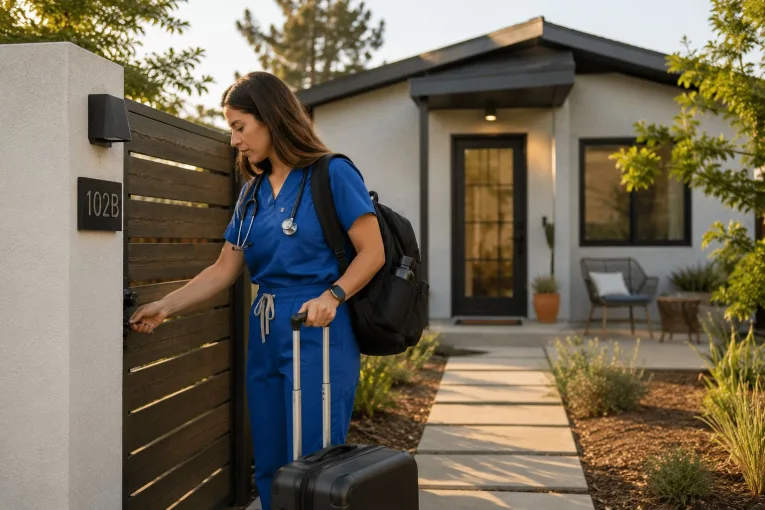
As the United States faces a housing shortage estimated at nearly 10 million homes and existing home sales slump to a nine-month low, mid-term furnished rentals are rapidly emerging as a flexible housing alternative for workers, relocating families, and people priced out of traditional housing options.
The growing market for furnished rentals lasting between 30 days and one year sits between short-term vacation rentals and traditional year-long leases. Industry leaders say the category is expanding because it addresses a widening mismatch between how Americans live and the type of housing the market currently provides.
“We still have a housing shortage, but we do not have a shortage of rooms,” said Jeff Hurst, CEO of Furnished Finder, operates one of the nation’s largest mid-term rental platforms. “The problem is that our housing system does not match how people actually live today.”
Hurst said the current housing stock increasingly fails to align with demographic realities. He noted that families are getting smaller while homes continue to get larger, creating a disconnect between available housing and actual need.
“There was an interesting article in the Times,” Hurst said. “I think people had three kids on average in 1970 and there were four million empty rooms in the US. People have less than two kids on average now, and there’s 34 million empty rooms in the US.”
He added that much of the existing housing stock is concentrated among older homeowners.
“Twenty-eight percent of all single family homes are owned by boomers, empty nest boomers, whereas 16% are owned by millennials of families,” Hurst said. “Housing is basically, that’s driving the empty room conundrum.”
According to Hurst, the combination of high mortgage rates, job mobility, and rising housing costs is pushing more Americans toward flexible rental arrangements instead of traditional homeownership.
“At today’s rates, the indifference point between buying and renting is probably around five to seven years,” Hurst said. “Generation Z switches jobs every one to three years, millennials every three to five years, whereas Gen X was five to 10 years and Boomers were 10 to 15. There’s not as much certainty you’re going to be in a house long enough to actually make it make sense to own it.”
Hurst said the rise of mid-term rentals reflects a long-term shift in housing and workforce patterns rather than a short-lived market trend.
“It’s anything over 28 days,” Hurst explained. “Our platform is only a month and longer and everything’s furnished.”
He estimated that the broader mid-term rental economy now represents between $20 billion and $30 billion in annual rent activity nationwide.
The largest category of renters using the platform are workers traveling temporarily for employment assignments.
“When you think about our tenant types, the top tenant type is what we’d say is traveling for work. It’s 35%,” Hurst said. “The fastest growing part of that is skilled trades.”
He pointed to the rapid growth of data centers, commercial construction projects, and infrastructure development as major drivers of temporary housing demand.
“There are a lot of people moving to build shopping centers, to build the local Chick-fil-A, the local whatever it is, hotel, commercial,” Hurst said.
Healthcare workers remain another major source of demand, particularly travel nurses and temporary medical staff.
“That’s about 25% of our total tenants,” Hurst said.
He said healthcare demand often fluctuates seasonally, creating the need for a mobile workforce that follows staffing shortages around the country.
“There are a lot of places where there might be more migrant workers in some parts of the US in the spring and summer than there are in the fall and winter,” Hurst said. “And so capacity for healthcare shifts based on how many residents are nearby.”
Hurst argued that mid-term rentals can help expand housing availability by encouraging homeowners to rent unused space or build accessory dwelling units.
“I think it helps because I think the more economic opportunity there are for landlords to invest in more of this type of housing, you’ll see more come online,” Hurst said.
He said many homeowners are converting unused rooms, garages, or properties into rentable furnished units because shorter-term furnished rentals create a more attractive financial model.
“If more landlords are helping to, when they see an empty house, turn it into a co-living space or add an ADU or build a footprint that might be two townhomes on a single family lot, because they know that midterm’s a way for them to get the investment period to pay back faster, then I think you’ll start to see us chip away at the housing crisis,” Hurst said.
He also pushed back against comparisons between mid-term rentals and traditional short-term vacation rentals.
“The traditional Airbnb is like neon everywhere and has a pickleball court and has amenities that don’t make as much sense,” Hurst said. “The majority don’t feel like Airbnb.”
One of the fastest-growing categories on the platform involves families relocating between cities who want to rent before buying a home.
“Twenty percent are actually relocating families,” Hurst said. “You want to try before you buy and increasingly we’re seeing that dynamic.”
He added that furnished rentals allow families to avoid large upfront expenses while exploring new communities.
“Furniture is a bad investment just historically,” Hurst said. “The ability to not spend tens of thousands of dollars on furniture and move into a furnished place allows you to also not make a mistake on furniture.”
Hurst emphasized that most landlords participating in the market are not large corporations but individual property owners.
“Eighty-five percent of the landlords on Furnished Finder … have a single rental property,” Hurst said. “This is overwhelmingly a thing that a local family is choosing to do as a side hustle to help them make ends meet or get ahead in life.”
Pricing for furnished mid-term rentals typically falls between traditional leases and short-term hotel stays.
“I think it’s probably, we estimate it’s usually about 30 to 50% more expensive than a long-term unfurnished, and probably 25-ish percent cheaper than something short-term,” Hurst said.
During the interview, Hurst pointed to communities like Davis and Sacramento as examples of places where flexible housing can serve university affiliates, healthcare workers, and temporary residents.
“There are people that come to Davis that they need to do something for four months,” Hurst said. “What do you do? All the time.”
He contrasted mid-term rentals with extended-stay hotels, which often cost more while offering fewer amenities.
“That type of long-term hotel typically would be about $3,000 a month, and you’re getting 400 square feet, you don’t have a real oven, you might have a stove,” Hurst said. “It’s a very Spartan experience compared to paying $2,000 a month for a real studio apartment or even an ADU.”
Follow the Vanguard on Social Media – X, Instagram and Facebook. Subscribe the Vanguard News letters. To make a tax-deductible donation, please visit davisvanguard.org/donate or give directly through ActBlue. Your support will ensure that the vital work of the Vanguard continues.

“The inventory of homes for sale across the country in July 2025 rose 24.8% year over year—marking the 21st consecutive month of inventory growth and the third consecutive month with over 1 million active listings, according to Realtor.com data.”
“Compared with the same time last year, Nevada has seen a 52.9% increase in the number of homes on the market—the biggest increase of any state. Maryland followed with a 48.2% increase in listings.”
(Doesn’t sound like a “housing shortage”.)
https://www.realtor.com/news/trends/homes-for-sale-inventory-july-2025/?CID=soc_facebook_fy26_realtor.com_social_soc_fy26_consumer&fbclid=IwY2xjawRpk8JleHRuA2FlbQIxMABicmlkETFFTmx2akJvQXExMGJnZlpSc3J0YwZhcHBfaWQQMjIyMDM5MTc4ODIwMDg5MgABHqTdEscmjzDxmfFNF70ihPwYC-ztLZyjY8aTiMwA3tOdDfZW4Y5i3XaOiTxF_aem_U5boEYYCyiNBUTBomziaXw
From Vanguard article: “Generation Z switches jobs every one to three years, millennials every three to five years, whereas Gen X was five to 10 years and Boomers were 10 to 15. There’s not as much certainty you’re going to be in a house long enough to actually make it make sense to own it.”
(Selling and buying houses is an excellent way to LOSE money, unless you’re one of the “professionals” who facilitates that.)
“We still have a housing shortage, but we do not have a shortage of rooms,” said Jeff Hurst, whose company operates one of the nation’s largest mid-term rental platforms. “The problem is that our housing system does not match how people actually live today.”
Well, sure – the guy who runs that business is going to say that.
Do you suppose those rooms exist somewhere “outside” of housing? And that there’s somehow a housing shortage, but not a room shortage?
Sort of like saying that there’s a shortage of cars, but not a shortage of all of the components which make up a car.
There is no basis for claiming a housing shortage. They made those wildly-varying numbers up – like the bogeyman. It’s based primarily on what’s occurred in the past.
They actually “overbuilt” in a previous decade, per the university study I’ve posted several times.
Seems more likely that technology is what has allowed a new type of market to emerge (e.g., AirBnBs). Of course, a lot of locales are restricting those type of businesses.
How closely did you read the article – ask yourself what is a mid-term rental and how does that differ from “housing”
I understand what the claim is, but is “grandma” suddenly renting out a room to strangers in the house she’s living in?
Also, what percentage of this guy’s business consists of entire units?
Although this guy doesn’t like the comparison – these are no different than AirBnBs. “Not that there’s anything wrong with that”, to quote Seinfeld.