
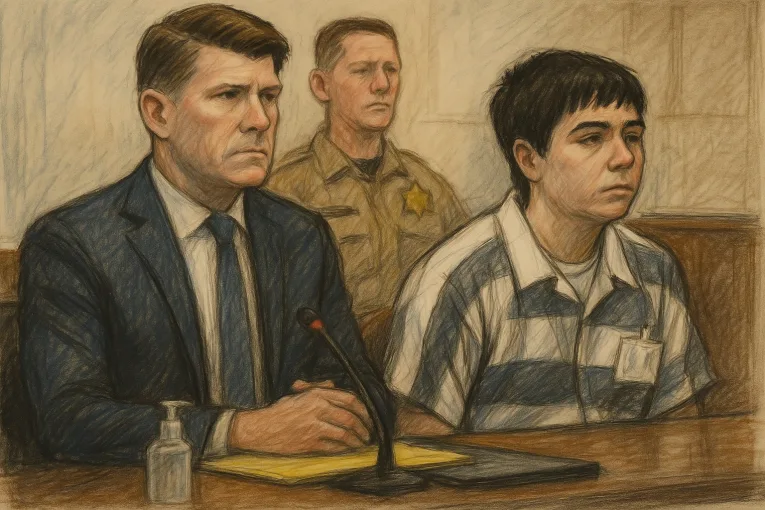
WOODLAND, Calif. — Jurors in the Carlos Reales Dominguez retrial heard testimony Wednesday from a California Department of Justice investigator and two Davis police officers who described how evidence was identified, collected and processed during the May 2023 search of the accused’s Hawthorne residence.
Dominguez, a former UC Davis student, is accused of fatally stabbing two men and injuring one woman in April 2023. Following a mistrial declared last June, Dominguez is back in court facing two counts of second-degree murder and one count of attempted murder.
Deputy District Attorney Matthew De Moura called a special investigator for the California Department of Justice to the stand during the afternoon portion of Wednesday’s trial. The investigator, who led the Hawthorne Evidence Response Team on May 4, described the search through photographs presented by the prosecution.
According to the witness, members of the relatively new Evidence Response Team were divided into “finders,” “observers” and “seizers.” The investigator acted as a seizer; he inspected items identified by the finders and seized them as evidence.
The witness said his team marked each room with a letter as they moved through the house. Dominguez’s suspected room — a conclusion they reached after finding four items of indicia — was marked Room D.
The DDA presented a photo of Room D to the courtroom and asked the investigator what electronics, if any, he found. The witness stated that he found one phone, one laptop and a computer monitor.
The DDA then presented a photo of the phone with a cracked screen, asking the investigator whether it “looked like it had been dropped.” He responded in the affirmative, noting that it was likely dropped several times based on the cracks.
The prosecution showed the witness a photo of the closet in Room D, which included a hamper, clothes and shoes. Close-up photos showed the contents of the hamper — a green T-shirt and white athletic shorts — covered in a red substance.
When asked whether he thought the red substance was blood, the investigator responded that it “appeared to be suspected blood.” He stated that they could not be sure until it was tested by the Davis Police Department.
The DDA asked the witness whether he found any cannabis paraphernalia in Room D, showing an image of a desk. He said yes, noting that the image showed “glassware, typically described as a ‘bong,’ used for consumption of marijuana.”
The investigator was then asked about the bathroom next to Room D — marked Room C — and whether he recalled the toilet being broken. He replied that the toilet bowl was cracked, noting that it “must have taken a lot of force” to break it.
Deputy Public Defender Daniel Hutchinson zeroed in on the process the witness and the Evidence Response Team used in identifying evidence. Presenting another photo of the hamper in Room D, he asked the investigator whether he knew the search was connected to a suspected murder.
He replied that he had been given the details of the case beforehand to inform his search.
The defense asked about the smell of the clothes. The witness responded that it was unpleasant, stating that it “smelled like decomposition.”
He described the smell as “moderate” — noticeable, but not overwhelming.
The DPD showed the courtroom an image of the bed in Room D covered in yellow placards. The investigator stated that the placards marked potential evidence.
The next image showed the bed stripped of everything but its fitted sheet, which was covered in stains. The witness stated that he believed it was suspected blood and that it “clearly hadn’t been washed in a long time.”
He was then shown a photo of the bare mattress, which had a prominent stain of “ambiguous coloration.”
The last image the DPD presented was of the residence’s in-unit washer and dryer, alongside two large containers of laundry detergent and one large container of bleach. The witness questioned whether the residents of the house had ever used them, remarking that cleanliness was “not a virtue” they seemed to possess.
The defense asked the investigator whether it would be easy for someone who got blood on their clothes or bedding to wash it out using the products in the photo. The witness said that it would be easy.
The DPD pushed further, asking whether someone who was trying to cover something up would use bleach or detergent to wash blood-stained items. The witness said that they likely would.
After the attorneys finished questioning the investigator, the DDA called a lieutenant with the Davis Police Department.
The lieutenant stated that she arrived at the Hawthorne residence on May 3, 2023. She said her role was to assist a police sergeant in collecting evidence.
The witness stated that she reviewed footage of the attempted murder of Kimberlee Guillory and that she was at the Davis Police Department before the search. She said she was present when officers brought Dominguez into the building.
After Dominguez was apprehended, a detective gave the witness a bag filled with grocery items and a knife. The DDA presented photos of the bag and approached her with the sealed evidence.
The prosecution asked the lieutenant whether it appeared that the bag’s handles had been removed. She said yes, and that it seemed as though someone had cut them off using a sharp object.
The DDA’s final witness was an officer with the Davis Police Department. The prosecution focused on the day Dominguez was arrested.
The DDA explained that the court viewed footage of Dominguez’s police interview at the end of last week and the beginning of this week. The officer entered the room at one point to collect “physical evidence” from Dominguez’s person.
The witness stated that he collected clothing items, a buccal swab from both cheeks, fingernail clippings, fingernail scrapings and hair samples from Dominguez.
The DDA asked the witness whether he collected a sweatshirt from Dominguez. The officer confirmed that he had, noting that one of the drawstrings was stained with a red liquid.
He submitted the sweatshirt into evidence and swabbed it for DNA.
The witness stated that his role in the Hawthorne search was to act as an Evidence Response Team liaison for the team leader. He would receive information from the investigator, confirm that the evidence being collected was within the warrant and observe the team inside the house.
The officer confirmed that he saw the hamper in Room D, as well as the green T-shirt and white athletic shorts. He stated that both items were tested for hemoglobin — a protein found in red blood cells — and that the test resulted in a “positive color reaction.”
The DDA asked the witness whether the reaction meant the red substance was blood. He replied that it meant it was “likely mammalian blood.”
The witness stated that he observed the desk in Room D and found drops of a dried red liquid. The prosecution asked whether he saw any cannabis paraphernalia, and he replied that he could not recall seeing anything like that.
The DDA pressed Torres for an answer, to which he stated that he did not believe drugs or drug-related items were included in the warrant.
Proceedings resumed today, June 18, at 9:30 a.m. in Yolo County Superior Court before Judge Samuel T. McAdam. The trial was scheduled to reconvene on June 19, at 9:30 a.m.
