
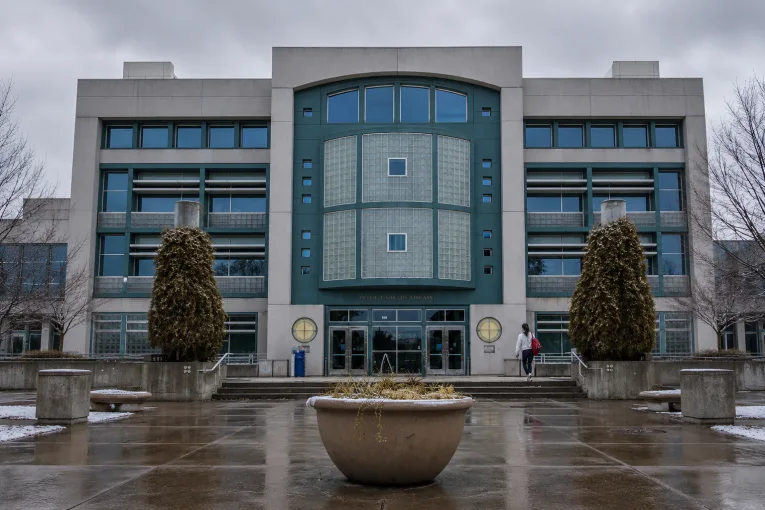
An era of library budget cuts leaves K-12 schools and higher education students without online research materials
Across California, budget cuts are primarily affecting school libraries, and students at University of California, Davis are already experiencing the loss of library resources. On July 1, 2026, all UC Davis students lost their free subscription to The New York Times online and will soon lose The Economist on Nov. 1, 2027. This institutional change is one of many slashes to the library’s budget, with students also losing their free access to nearly 320 scholarly journals for the upcoming school year.
The UC Davis Library announced that as part of their 2025-2026 and 2026-2027 budget, the library was required to cut 8%, nearly $2 million, of their annual budget. A large portion of the cut — at least $700,000 — must come from collections and online resources that fund news media, scholarly journals, ebooks and databases. Subscription cuts are determined by usage, cost, availability of alternate resources and uniqueness, according to their website.
The decision not to renew the NYT’s academic license stemmed directly from a $40,000 funding gap and a growing student body that continues to raise the subscription costs, according to the university’s website. Instead, students are provided with access to New York Times articles through ProQuest.
William Garrity, University Librarian and Vice Provost of Digital Scholarship at UC Davis, describes the reasoning behind their decision to cancel news source subscriptions as an unsustainable investment for the university, despite their claims to uphold the needs and services of its students and faculty.
“Given that the news content is still available in another format [ProQuest], albeit less convenient, that cost for a single outlet was simply too high when weighing difficult tradeoffs in the current budget environment,” Garrity said.
This radical reduction in budgetary funds reflects a larger trend emerging in California. As part of his last budget, Gov. Gavin Newsom recently approved the 2026-2027 state budget, which cut $5.5 million from school libraries. These changes will take effect on July 1, 2027.
Newsom’s decision has left school districts across California shocked and seeking a solution. In particular, library administrators and staff are perplexed by the Legislature’s decision to cancel subscriptions to resources used by thousands of students in California’s K-12 public schools.
Newsom’s last-minute change halts payment for online research resources such as Encyclopedia Britannica, PBS videos, scientific journals and other reputable online resources used by students and teachers. The most concerning loss seems to be student access to Compass, which provides research materials on all subjects. Along with these sweeping changes, K-12 public schools will also lose access to The New York Times.
Kate MacMillan, Napa Valley Unified School District’s Coordinator of Library Services, finds Newsom’s decision to be an unintended consequence of greater budget pressures. However, she also states that his decision will leave California school libraries empty-handed.
“My concern is that COMPASS was viewed as just another budget item rather than the essential educational resource it is,” MacMillan said. “[…] From a district librarian’s perspective, COMPASS is one of the state’s best investments. For $5.5 million annually, it provides resources that would cost California school districts more than $216 million to purchase on their own.”
MacMillan, along with other school librarians, is worried that the outcome will affect underfunded schools the most, creating an imbalance across public schools. Many of these programs through Compass are offered in different languages, making this a vital source for students across California’s diverse population.
This cancellation of research sources, specifically subscriptions to reputable news sources such as the Times and trusted online research platforms, comes on the heels of a push for more media literacy in K-12 education. Media literacy advocacy groups want students to learn how to spot fake news and to use trusted sources for their research.
“As a result [of this cut], students will be pushed toward free internet sources that often lack the accuracy, reliability and educational supports found in vetted databases,” MacMillan said. “This is especially concerning for English learners, struggling readers and students conducting research.”
While the changes occurring at UC Davis are part of the University of California funding, the budget reduction for similar online research programs in K-12 public schools is tied to the budget decisions occurring at the state and federal levels. Their influence determines access to valuable educational resources across California’s public education system, including UC schools.
The California Legislature’s controversial decision seems to mark a tipping point in funding toward public education and its resources, or what MacMillan describes as the “economic divide of education.”
Follow the Vanguard on Social Media – X, Instagram and Facebook. Subscribe the Vanguard News letters. To make a tax-deductible donation, please visit davisvanguard.org/donate or give directly through ActBlue. Your support will ensure that the vital work of the Vanguard continues.
