
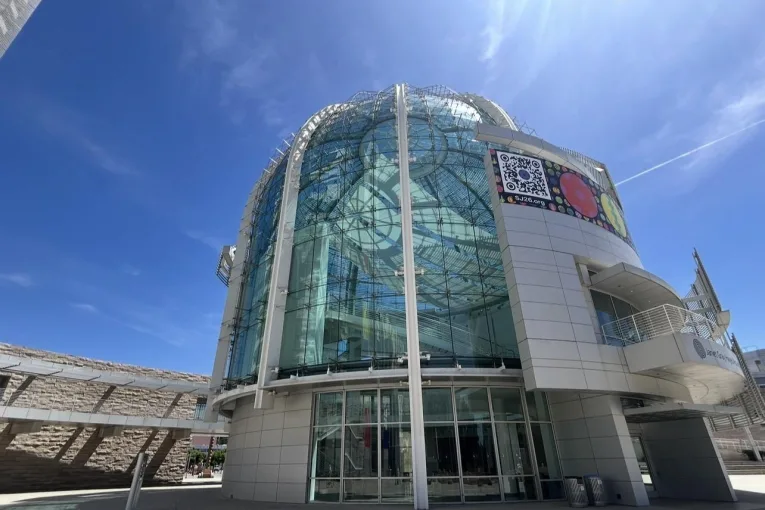
By Susan Bassi, Fred Johnson and Faith Strader
The notice told William he had until April 18 to move his belongings.
The city’s crew came on April 15.
By the time the crew finished clearing the property that day, William’s tools were gone. So were his air conditioner, his bike, the table he ate his meals on, and the tool case that held the equipment he used to earn a living.
The city’s own notice had promised that whatever William left behind, if it wasn’t soiled or contaminated, would be held in storage until mid-July. When William went looking for his things through that program, none of them were there.
This is a story about something much larger than one truckload of tools. It is a story about what happens when cities get to decide, on their own terms, what gets written down, what gets kept, and what gets destroyed before anyone outside city hall ever sees it.
WHAT THE RECORD ACTUALLY SAYS
A notice the city posted told William he was trespassing and had to clear out “by: 7:00 AM 4/14/25 — 4/18/25.”
Santa Clara County Superior Court Judge Shella Deen later found that language did not mean what the city argued it meant. The court ruled that “any reasonable person” reading that notice would have understood they had until April 18. If the city meant April 14, the court found, it should have said so.
Instead, the city’s crew arrived on April 15, a day the city itself believed was already past its deadline, but which fell squarely inside the window the court found a reasonable person would have relied on.
William testified that he kept his most valuable belongings, his tools among them, locked inside his truck. On the day the city crews arrived, William testified that he was instructed to leave the truck unlocked, doors open. He complied. When he went to retrieve what the city said would be stored, none of it turned up. Not the tools. Not the batteries. Not the air conditioner or the bike or the table.
Judge Deen’s written ruling does not mince words. The city’s removal notice was defective, and it cost William the chance to secure his own belongings before the city took them. The city’s storage promise failed completely.
Judgment: $7,500, against a city government with an operating budget in the billions.
A small claims court ruled for William, awarding him roughly $6,000. Rather than pay it, the city appealed, sending the case to a full second trial.
San Jose’s own attorney handled that appeal. The result of forcing William through a second trial was a bigger judgment, not a smaller one.
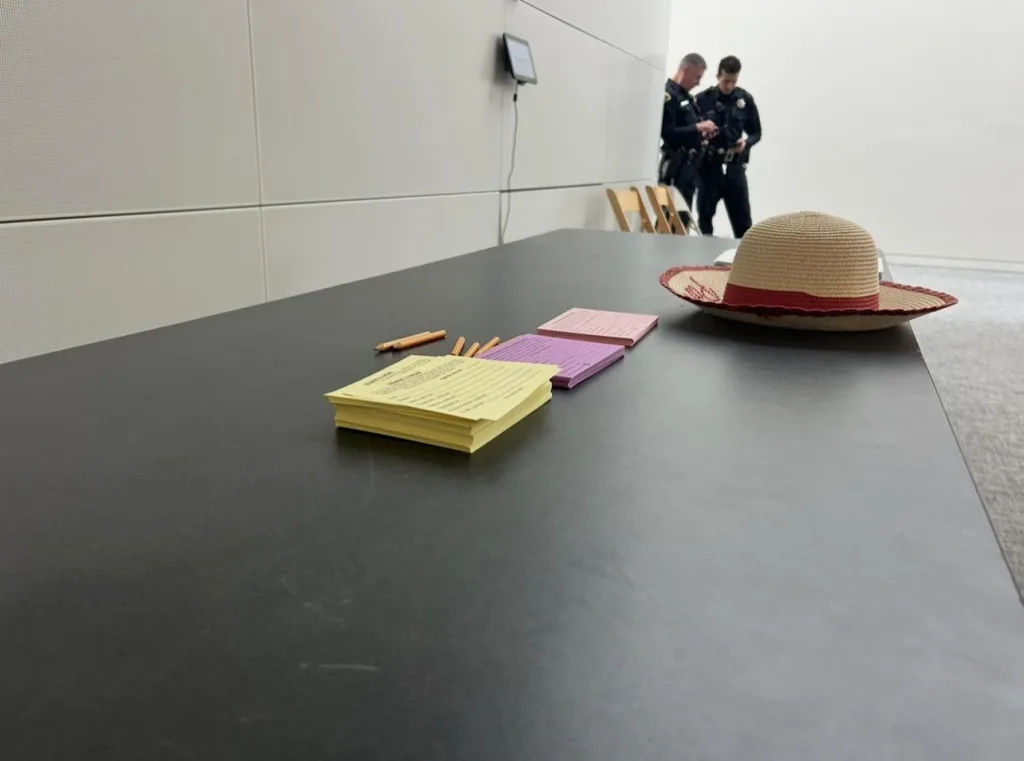
City of San Jose Public Meeting Chambers. Photo by Susan Bassi
A SISTER WHO WOULDN’T STOP
The court win didn’t happen because William had a lawyer on retainer or a firm working on the case for free. It happened because his sister, Elizabeth, refused to let the matter drop.
Elizabeth is not an attorney. She had no legal background. What she had was a brother who lost his livelihood, and his dignity, on a single afternoon, and a decision to make about whether that was going to be the end of the story.
A stranger handed her a flier for a legal clinic that helps San Jose residents who can’t afford a lawyer. She could have thrown it away. Instead, she went and sat through classes taught by people working toward law degrees, taking notes on unfamiliar terms and procedures that had nothing to do with her actual life.
“It wasn’t just a win in court. It is a win for my brother, and our family, it got William back on track.” — Elizabeth, William’s sister
She attended public meetings, marched down to city hall and sent complaints that city employees and elected officials simply ignored.
She filed the government claim against the city, the mandatory first step California law requires before anyone can sue a public agency.
Then she helped her brother take it to a judge.
She filed the fee waiver that let William pursue the case without money he didn’t have. She helped build the small claims case from nothing and watched her brother win it. When the city appealed instead of paying, she did it all again, this time in a courtroom built for a full trial, opposite a city attorney with a law degree, a paycheck, and an unlimited litigation budget.
Elizabeth said she was never chasing a windfall. What she wanted from the beginning was small and specific: an acknowledgment that the city made a mistake, and enough money for William to replace the tools that would get him back to work.
The city could have offered that early and closed the matter. Instead, it made her prove the same set of facts twice, in two separate trials, before it agreed to pay what a judge said it owed.
A FAMILY THAT HELPED BUILD THE REGION THAT FAILED THEM
William’s mother did not arrive in Silicon Valley looking for opportunity. She helped create it. She was one of the region’s early computer programmers, a mathematician who worked for Tandem, Compaq, and Hewlett-Packard in the years when the valley south of San Francisco was still becoming the place the rest of the world would come to know.
His father worked across town as a court reporter for the Santa Clara County Superior Court, spending a career inside the same court system that would, decades later, be where his son had to go to get his tools back.
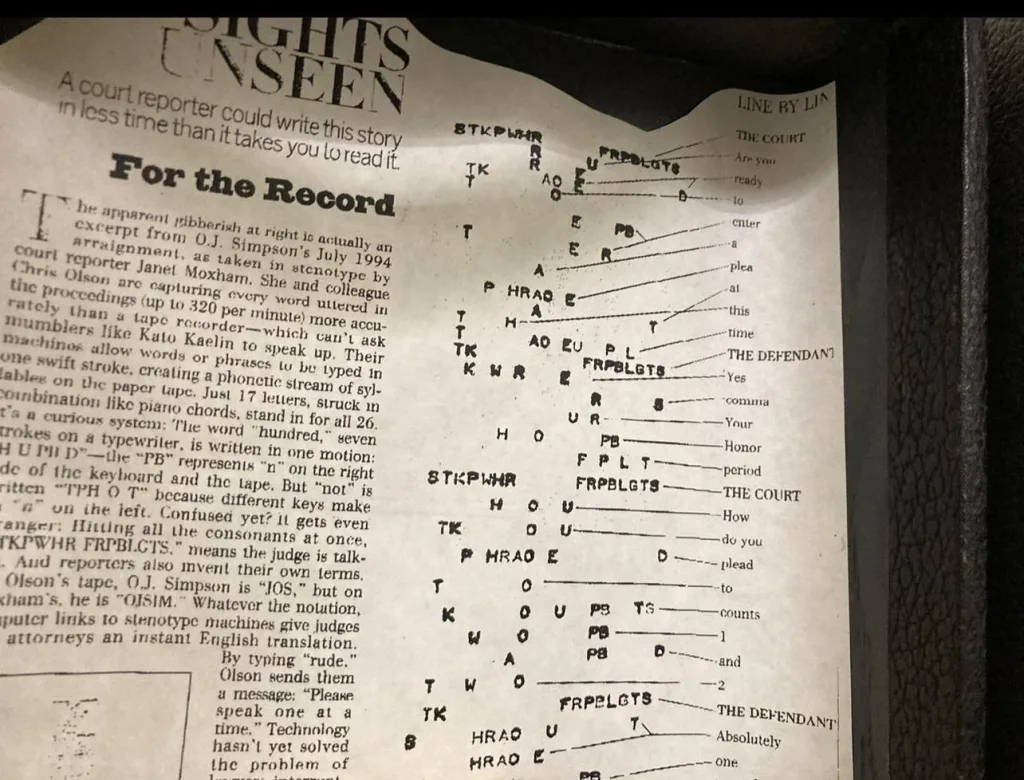
California Court Reporter Board Lobby Exhibit in Sacramento. Photo by Susan Bassi
They raised their family in Campbell. Solidly middle class, in a region that once had room for families like theirs to build something that lasted. For most of William’s adult life, that work paid off in the most basic way steady employment can pay off for a family: it gave him a home to return to when things got hard.
William was not idle. He was a skilled handyman who also repaired and resold collectibles, earning between $1,000 and $3,000 a month depending on the work he found. Whatever setbacks came up, the Campbell house was there. The floor under him meant he was never actually without shelter or people who would take him in. That floor did not disappear because anyone in the family failed at anything. It wore away the way these things wear away in real families, gradually, under costs nobody plans for.
As William’s parents aged, the bills arrived the way they arrive for almost every family eventually: medical needs that don’t wait for a convenient year, care that has to be paid for out of savings built over a working lifetime, decisions that have to be made about a house that was supposed to be passed down. A family’s safety net is not an infinite resource. It is something built over decades and spent down by the ordinary, unavoidable costs of growing old.
By the time William needed that safety net most, it had already gone toward keeping his parents cared for. This was not negligence, and it is not a story about a family that never had anything. It is the opposite. A family that spent a lifetime doing the kind of foundational skilled work that helped build wealth the region is now known for, still ran out of runway the way ordinary families do.
William’s tools were his income, his independence, and the thing that stood between him and needing anyone’s help at all. When the city’s crew took them and its storage program failed to produce them, it did not just cost him property. It cost him the ability to work.
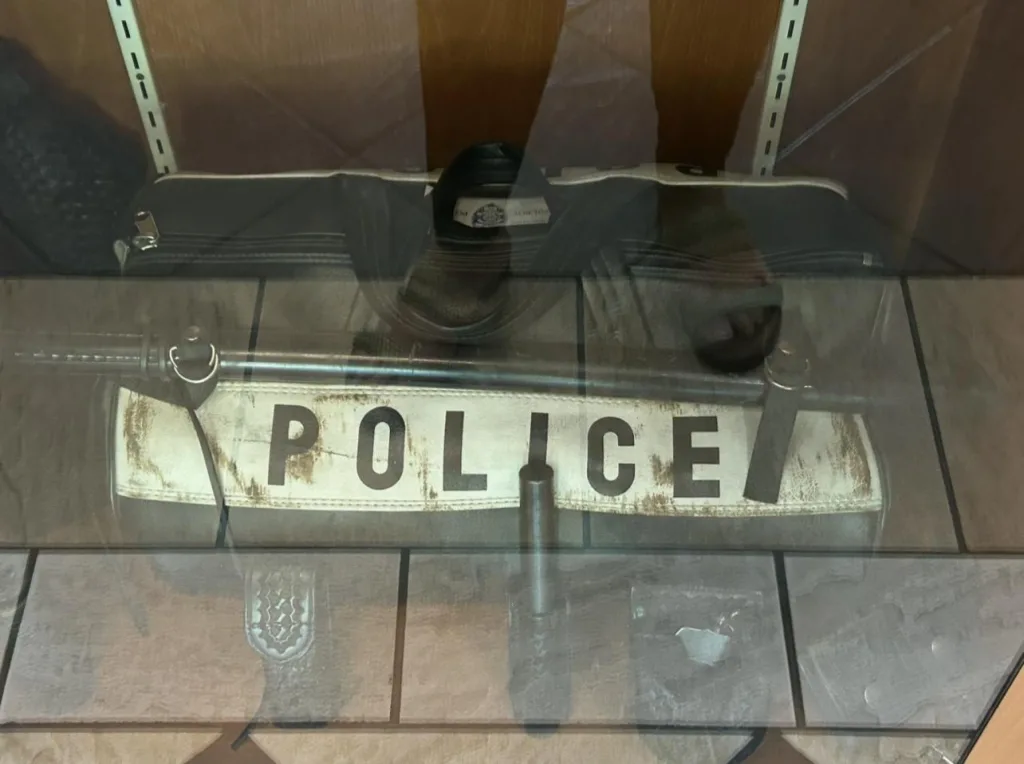
Gilroy Police Department Lobby Display. Photo by Susan Bassi
THE OTHER CASE, THE ONE ABOUT VIDEO THAT NO LONGER EXISTS
While Elizabeth was filing forms and sitting through legal clinic classes to get her brother’s tools back, a very different kind of fight over government accountability was working its way to the California Supreme Court, thirty miles south in Gilroy.
The Law Foundation of Silicon Valley, a nonprofit legal aid organization, spent years trying to get the Gilroy Police Department to hand over bodycam footage from its own encampment sweeps. The same kind of city operations that took William’s tools in San Jose. The Law Foundation’s interest wasn’t abstract. It came after complaints, raised directly to Gilroy’s police chief at a 2019 houseless task force meeting, that officers were discarding residents’ personal belongings and medications during cleanups.

Berliner Cohen, LLP San Jose Office. Photo by Susan Bassi
Gilroy’s response was prepared by contract attorneys at Berliner Cohen, LLP. According to the trial record, attorneys for the city claim video footage is categorically exempt from disclosure without ever watching it.
The police department did not search for the video. It did not review it to see whether any of it could legally be released. It sent the Law Foundation boilerplate, delayed responses. And while all of that was happening, the footage itself was being destroyed, on a routine schedule, without anyone telling the Law Foundation it still existed or that it was about to disappear.
By the time the Law Foundation found out, the video was gone. The city only acknowledged the destruction after the nonprofit filed suit.
Notably, neither Gilroy’s contract attorneys at Berliner Cohen, LLP, nor attorneys working on behalf of the Law Foundation of Silicon Valley, retained a court reporter to make a transcript, or complete record, of the legal proceedings.
Instead of transcripts, there were only settled statements, condensed written statements of the court hearings. An issue this news organization has been reporting on during the court reporter crisis in California.
The absence of a transcript requires attorneys who anticipate filing an appeal to agree on what happened through issuing settled statements approved by the judge. A process known to drive up attorneys fees and court costs. Especially concerning in a case where taxpayers are footing the bill, irrespective of who wins or loses.
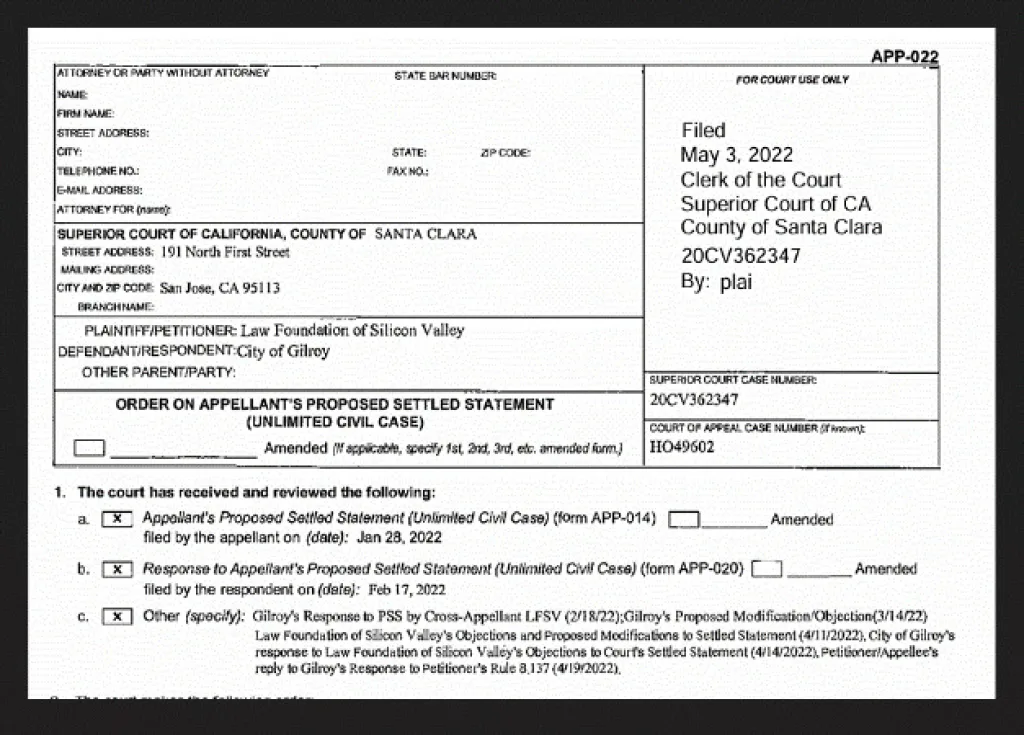
Settled Statement filed in the Law Foundation’s public records lawsuit against the City of Gilroy.
Initially a judge sided with the Law Foundation, ruling that Gilroy had conducted an unreasonable search and should never have withheld the footage the way it did.
Gilroy appealed.
An appellate court sided with the city, ruling that once the video was destroyed, there was nothing left for a court to declare unlawful, and the case was effectively over. The fight went all the way to the California Supreme Court.
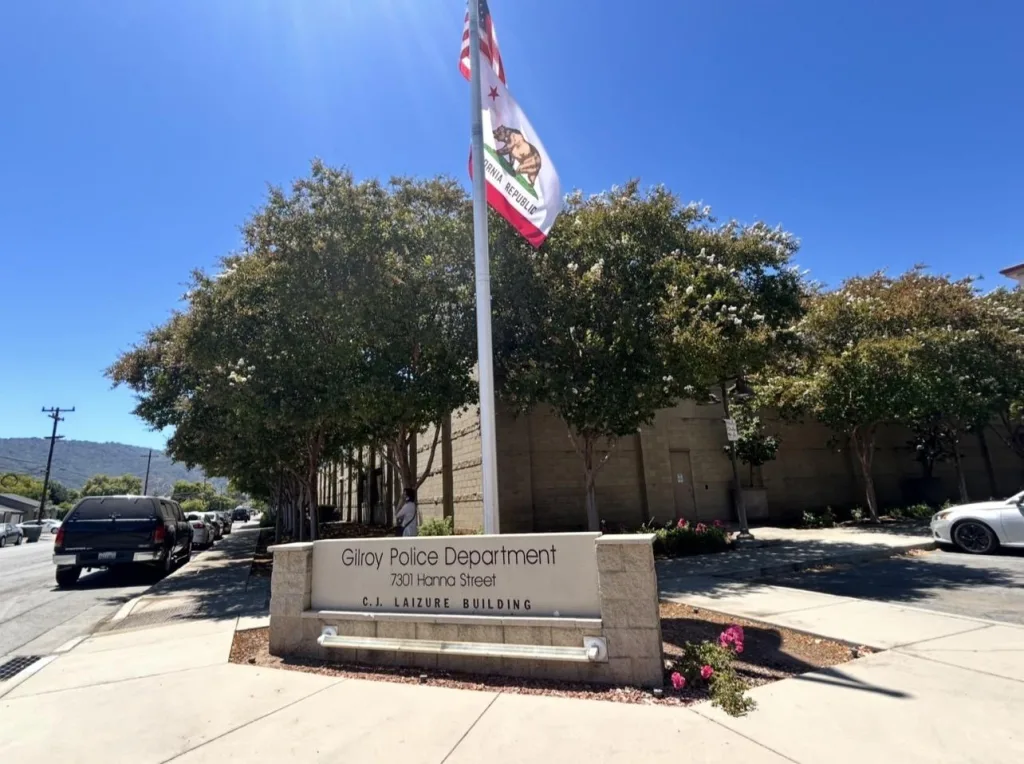
Gilroy Police Department. Photo by Susan Bassi
WHAT THE HIGHEST COURT IN THE STATE ACTUALLY DECIDED
In January, the California Supreme Court issued a mixed ruling. On one point, the court sided with the public. It held that people could get a court to formally declare a city violated the state’s public records law, even after the records at the center of the dispute are gone. Gilroy’s own conduct and an earlier finding that it ran an inadequate search and improperly withheld the footage stands as a matter of law.
On the second point, the court sided with the city. It ruled that nothing in California’s Public Records Act requires an agency to keep records once it has decided, on its own, that those records are exempt from release. The state Legislature, the court said, would have to write that requirement into law if lawmakers want it to exist. Until then, an agency’s own internal decision about what to withhold can also be the last word on what gets destroyed.
Put plainly: a city can be found, after the fact, to have broken the rules. But nothing currently stops that same city from making sure there’s nothing left to look at by the time anyone gets around to checking.
Deputy City Attorney Florence Mathews filed notice of appeal after William’s small claims court win.
ATTORNEY CHOICES, NOT THE CITIES’ MISTAKES
Neither of these cases started as a fight about principle. They started as ordinary mistakes: a confusing notice in San Jose, a records request in Gilroy. What turned each one into a drawn-out legal battle by a choice made afterward, by government attorneys, about how to respond.
San Jose’s crew arrived early, and its storage program failed. Rather than make that right when Elizabeth first raised it, the city’s attorney fought the small claims case, lost, and then filed an appeal that cost the city more money than settling would have.
Gilroy’s police department destroyed footage while a records request was still open, then, rather than acknowledge the gap, defended a legal position all the way to the state’s highest court, proving only that no city has any obligation to keep records it has decided, unilaterally, to withhold.
In both cases, the agency had the money and the staff to litigate as long as it wanted. The people on the other side did not. Elizabeth learned the law from scratch at a free clinic because she couldn’t afford a lawyer. The Law Foundation exists specifically because most people cannot afford to fight a well-resourced legal opponent.
That asymmetry is the story. In a region defined by extraordinary private wealth, the public agencies that answer to taxpayers, including taxpayers like William’s parents, who spent careers in courtrooms and computer labs building the institutions this region runs on, chose litigation over accountability, twice, in two different cities, over two very different kinds of records: a truckload of tools, and hours of police video.
WHY THIS IS A PUBLIC RECORDS STORY, NOT A HOMELESSNESS STORY
The reason William’s case has documents at all, an abatement notice, sworn testimony, a written ruling from a judge who compared the city’s actions against its own promises, is that Elizabeth forced it into a courtroom, without a court reporter, before anything could disappear. William had a witness. He had his sister. He had a paper trail the city couldn’t simply delete once it became inconvenient.
Gilroy shows what happens when that paper trail doesn’t survive. The public interest at stake in that case wasn’t really about any single piece of footage. It was about whether the public can ever verify how a government agency behaved when that agency also controls whether the evidence of its own conduct continues to exist. The California Supreme Court’s answer, for now, is that a court can say after the fact that an agency broke the law, but the agency itself still gets to decide what evidence survives long enough to be examined.
That is the throughline connecting a sister filing small claims paperwork in San Jose to a nonprofit’s brief before the state’s highest court: whether ordinary people, and the organizations built to help them, can ever get a straight, verifiable account of what government did, before that account is gone.
A free press depends on the same access. A reporter asking for bodycam footage of a sweep, or a public agency’s internal emails about a notice, is asking the same question Elizabeth was asking when she went looking for her brother’s tools in city storage: show me what actually happened.
WHAT WILLIAM GOT, AND WHAT HE DIDN’T
William has his $7,500 now. He does not have his tools. The equipment itself, the specific wrenches and drills and the truck-mounted toolbox that let him take handyman jobs and repair collectibles for resale, is gone for good. Money can replace some of that. It cannot replace the year he spent without the ability to earn what he used to earn, or the trust that his own government would keep a written promise.
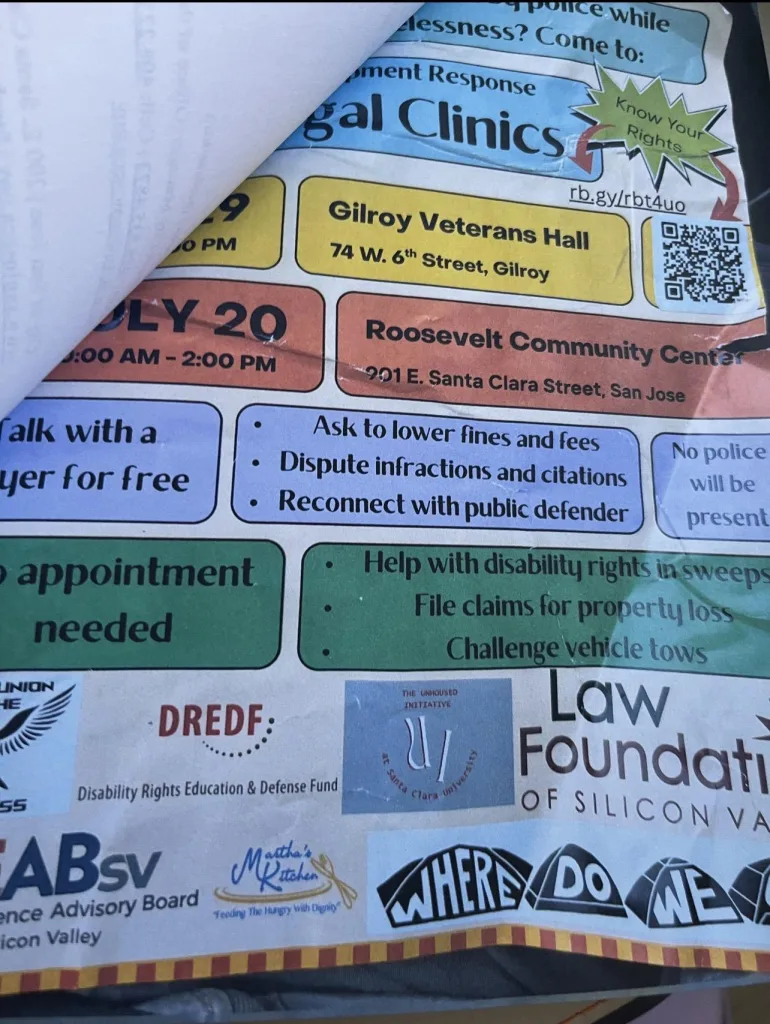
Flier William’s sister was given that directed her to free legal clinics presented by the Law Foundation of Silicon Valley.
Elizabeth said her brother finally feels believed. That is not a small thing, but it is also worth noting that it took a year, two trials, and a sister with no legal training teaching herself the law from a folding chair in a free clinic to get there.
San Jose’s crew took less than a day to clear the property. It took Elizabeth a year to make the city answer for it. Whether the next family, or the next nonprofit records request, gets that same chance depends on whether California’s public records laws require government to keep what it destroys, or whether they leave that decision, as they do today, in the hands of the very agencies being asked to account for themselves.
To comment please go to one of these social media platforms:
Facebook: https://www.facebook.com/DavisVanguard
LinkedIn: https://www.linkedin.com/company/peoples-vanguard-of-davis-inc/
Instagram: https://www.instagram.com/davisvanguard/
X: https://x.com/davisvanguard
Bluesky: https://bsky.app/profile/vanguardnewsgroup.bsky.social
Subscribe to the Vanguard News letters. To make a tax-deductible donation, please visit davisvanguard.org/donate or give directly through ActBlue. Your support will ensure that the vital work of the Vanguard continues.
