
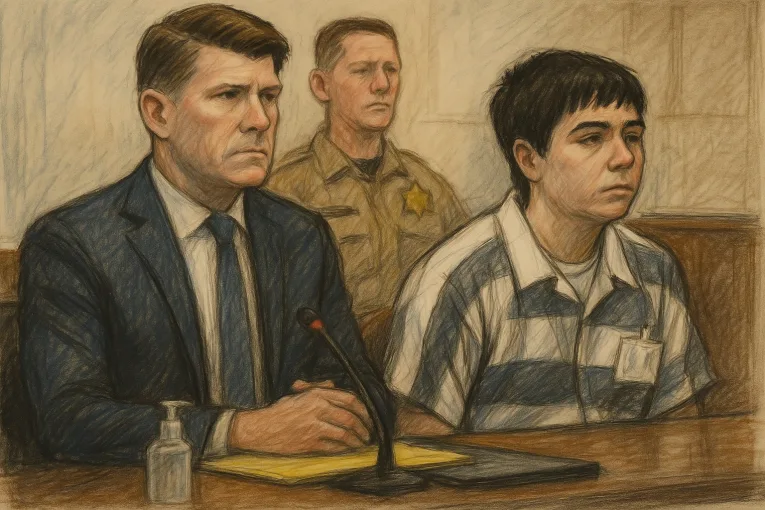
WOODLAND, Calif. — Testimony in the murder retrial of former UC Davis, student Carlos Reales Dominguez, reconvened Wednesday as jurors heard additional testimony from the defendant’s father, a former co-worker who described alarming behavioral changes, and a digital forensics expert who analyzed data extracted from Dominguez’s cellphone and computer.
The trial is being heard before Yolo County Superior Court Judge Samuel T. McAdam. Deputy District Attorneys Matt De Moura and Alex Kian are prosecuting the case, while Deputy Public Defender Dan Hutchinson represents Dominguez.
Dominguez is charged with two felony counts of murder, one felony count of attempted murder, and enhancements alleging the use of a deadly weapon, infliction of great bodily injury and circumstances in aggravation, stemming from a series of April 2023 stabbings in Davis.
Proceedings resumed with the cross-examination of the defendant’s father, who was questioned about his marriage and the family’s relationship with Dominguez.
The father testified that he and his wife never became physically abusive toward the defendant but disciplined him to teach him “right from wrong” without intending to cause harm.
He responded to questions regarding an incident in which, as a minor, Dominguez attended a party without permission, prompting the father to make Dominguez stand outside naked. According to the father’s testimony, after several minutes, Dominguez returned inside the residence and never again attended a party without permission.
Expressing his desire to provide a better life for his son, the father testified the family was proud when Dominguez became the first person in the family to attend college. He said Dominguez worked at a fast-food restaurant while in high school and paid for his own car.
The father explained that he was initially unaware of his son’s personal struggles or that he was failing classes. He testified that he discovered marijuana in Dominguez’s room during the summer after his freshman year, raising concerns about its potential effect on his son’s education.
As Dominguez entered his third year at UC Davis, the father testified that communication became less frequent, although Dominguez continued returning home during school breaks. It was during that period that he first noticed his son staring at walls inside the house, although he did not know whether Dominguez was seeing or hearing things.
The father described retrieving Dominguez’s belongings from Davis after his arrest as incredibly difficult for the family. When asked during redirect examination whether he regretted how he had raised his son, the father replied, “No.”
The defense next called a former co-worker of Dominguez, who now works as a behavioral therapist for children with autism.
She testified that she attended UC Davis from 2021 to 2024, majoring in psychology while working 20 to 25 hours each week at a Jack in the Box in downtown Davis.
The witness explained that she began working night shifts at the short-staffed restaurant in the fall of 2022, overlapping with Dominguez’s employment for approximately two months.
Recalling her first day on the job, she testified that she stood waiting at the counter for 10 to 15 minutes. She identified Dominguez as the employee in uniform who, after taking customer orders, turned to face the wall and failed to acknowledge her until a cook came out to assist her.
During the time they worked together, the witness testified that, while employees regularly communicated with one another, Dominguez rarely spoke to anyone. She said he would often “doze-off” and “stare blankly” at the wall with his arms hanging straight at his sides, demonstrating the posture for the jury.
She described one incident during a night shift when the drive-thru customer alert system beeped continuously for three to five minutes. After investigating, she found Dominguez standing motionless and staring at the wall.
The former co-worker testified she repeatedly called his name, but despite standing only a few feet away, he did not respond. When she reached for his headset, Dominguez quickly turned, flinched away and asked, “What are you doing?”
According to the witness, Dominguez appeared frightened and nervous. After she informed him that a customer was waiting, he handed her the headset and “fled” to the back of the restaurant before returning several minutes later.
After approximately 10 weeks of working together, the witness testified that Dominguez stopped reporting to work before eventually disappearing from the schedule altogether.
Describing his appearance, she testified Dominguez was thin with long, dark hair during late 2022. After reviewing a photograph from the first trial, she said he appeared even thinner at that time but observed that he looked “better” in court Wednesday, with shorter hair and regained weight.
During cross-examination, the witness acknowledged Dominguez may have been heading toward the back of the restaurant to take a required work break. She also acknowledged she was not wearing a uniform during their first encounter and may not have been immediately recognizable to him as a new employee.
The defense then called a digital forensics expert who serves as the managing director of digital forensics and e-discovery at ArcherHall.
Based in Tucson, Arizona, the licensed attorney testified he has analyzed digital device extractions more than 50 times as an expert witness in courts throughout the country.
Retained by the defense to analyze Dominguez’s cellphone and MacBook, the expert presented findings regarding “Power Events,” or records showing when electronic devices are powered on and off.
The expert testified that he identified extended periods between Dec. 31, 2022, and April 28, 2023, during which Dominguez’s cellphone remained powered off for longer than one hour.
He explained that no battery event records existed before April 17, 2023, making it impossible to determine whether earlier shutdowns resulted from the phone being manually turned off or from a depleted battery.
Beginning April 17, however, battery event records became available, and the expert testified that three of the five recorded shutdowns after that date resulted from a dead battery.
The expert also explained that software extraction tools can generate date and time error logs when a device remains powered off for extended periods. Because phones synchronize their clocks through network carriers, he testified that disconnecting a device during an arrest or seizure can prevent proper synchronization and produce those error logs.
The defense presentation concluded with video exhibits showing location data from various dates relevant to the case. According to the expert, the information was used to confirm Dominguez’s presence at locations on the UC Davis campus and in downtown Davis at various times.
Carlos Reales Dominguez remains in custody without bail. His retrial is scheduled to resume Thursday at 9:30 a.m. in Department 14 of Yolo County Superior Court.
Follow the Vanguard on Social Media – X, Instagram and Facebook. Subscribe the Vanguard News letters. To make a tax-deductible donation, please visit davisvanguard.org/donate or give directly through ActBlue. Your support will ensure that the vital work of the Vanguard continues.
