
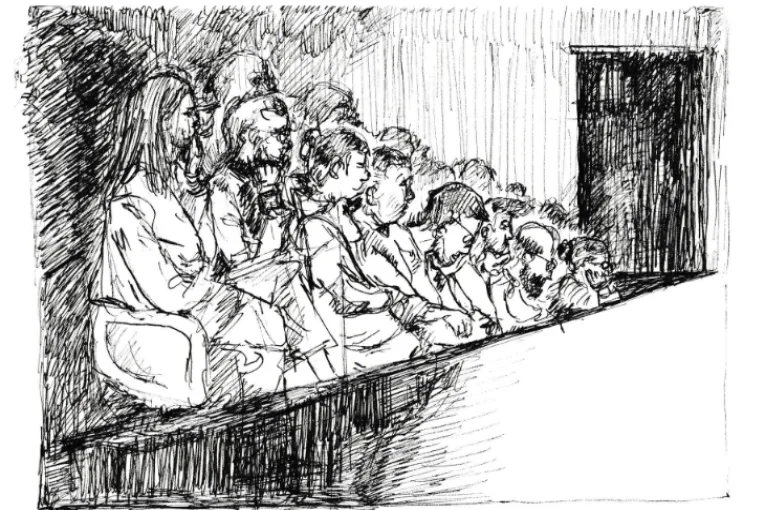
SAN FRANCISCO — Two weeks after a San Francisco jury deadlocked on felony conspiracy charges while convicting seven Golden Gate Bridge protesters on several misdemeanor offenses, protester Jordan Harger says the significance of the case extends far beyond the mixed verdict, arguing the prosecution represents a growing effort to criminalize political dissent and discourage activism in support of Palestine.
Speaking with the Vanguard following the conclusion of the trial, Jordan Harger described the Golden Gate 26 case as part of a broader shift in how Bay Area prosecutors have responded to political protest.
While prosecutors secured misdemeanor convictions, jurors were unable to reach a unanimous verdict on the felony conspiracy charge, leaving open the possibility that the San Francisco District Attorney’s Office could retry that count.
The jury also deadlocked on one misdemeanor trespassing charge. The verdict came after prosecutors had reduced the case from an original 1,144 charges filed in 2024 to 57 charges presented at trial.
For Harger, however, the more significant issue is what the prosecution represents.
“The Golden Gate 26 case began with a bridge shutdown on tax day,” Harger said. “And after the bridge shutdown, we were all arrested and brought to 850 Bryant, the San Francisco Jail, where some of us spent nearly 48 hours incarcerated.”
Harger said participants initially believed the legal consequences would be relatively limited.
“After we were released, we had a couple months of reprieve and then subsequently were ordered back to jail and charged with a egregious amount of offenses, including many counts of false imprisonment,” Harger said. “Some of us were given a charge of felony conspiracy because conspiracy is what they call a wobbler charge — it can either be charged as a misdemeanor or a felony and it’s at the discretion of the district attorney.”
The felony conspiracy allegation became one of the defining issues of the prosecution.
Although jurors could not unanimously agree on that charge, Harger said simply facing the possibility of felony convictions had already imposed significant costs on those involved.
“Our co-defendants were found guilty on all charges except a hung jury on felony conspiracy and trespass with intent to interfere with a business,” Harger said. “And the problem with a hung jury is that it is at the discretion of the district attorney to bring those charges back.”
Harger said another trial would continue to burden the protesters personally and financially.
“Now we are in an interim period where it does appear that our co-defendants might have to go through trial again,” Harger said. “It requires you to take weeks and weeks off work. People are losing income. People are having to find others to deal with their responsibilities such as caring for relatives.”
Harger argued prosecutors attempted to portray the protesters as reckless while overlooking evidence presented during trial about the organizers’ efforts to reduce risks to motorists.
“At the trial, we saw the district attorney really try to villainize the felony defendants, trying to paint them as people who value their own ideology over the safety of San Franciscans,” Harger said. “But they were unable to properly prove that we did endanger anyone.”
Harger continued, “They were unable to explain why the bridge did not open the third or fourth lane, which would’ve allowed vehicles to pass through. They underplayed the fact that we had brought water, medical supplies, and snacks for anyone on the bridge. And they of course did not mention the fact that many people on the bridge were supportive of our action and our message.”
During the trial, testimony indicated protesters brought water, snacks and medical supplies for stranded motorists, maintained emergency plans and requested that authorities open an additional traffic lane. A Golden Gate Bridge Authority representative also testified it would have been possible to move the center barrier to create another lane.
Another major point of contention, according to Harger, involved what jurors were allowed to hear regarding the protesters’ motivations.
“We saw the judge refused to give instructions for the necessity defense,” Harger said. “And the necessity defense essentially says, ‘I had to do what I did because there was imminent danger and we needed to do something to stop it.'”
Harger also said the court barred testimony from an expert witness on Palestine.
“We were not allowed to bring an expert on Palestine or the genocide in Palestine or Israel’s apartheid,” Harger said. “We weren’t allowed to bring an expert witness.”
According to Harger, those rulings shaped the presentation of the defense throughout the trial.
“They were trying as hard as they could to keep Palestine out of that courtroom,” Harger said, “but every single day our lawyers and co-defendants spoke Palestine onto the record.”
Beyond the particulars of the case, Harger argued the prosecution reflects a broader change in the Bay Area’s political and legal climate.
“Yeah, I think that this case is emblematic of a larger rightward shift in the Bay Area in terms of the legal landscape,” Harger said. “After the recall of Chesa (Boudin) in San Francisco and the recall of Pamela Price in Alameda, they were subsequently replaced with very harsh district attorneys who are coming down hard on anything that can be construed as crime.”
Harger added that the Golden Gate 26 prosecution should be viewed alongside other recent law enforcement efforts.
“We understand this case to be part of a larger trajectory of criminalization,” Harger said. “We see that in a myriad of ways, particularly with the crackdown on free speech in regards to both Palestine protesting and the protests against the incursions of ICE in our community.
“We’re seeing it in the new war on drugs that’s being affected in San Francisco. We’re seeing it the crackdowns on unhoused people encampment sweeps across the Bay Area. And so though our case is exceptional in terms of the precedent of Bay Area protest law, we are not exceptional in being criminalized and targeted by this district attorney.”
Harger also rejected suggestions that the protesters were motivated by a desire to create disruption for its own sake.
“We are a very diverse group of people, carpenters, paralegals, animal rights activists, nurses, and some students as well,” Harger said. “And also a really wide range of ages, which I think is a really important part of any organizing is to be intergenerational and to be intersectional.”
Looking ahead, Harger expressed concern that the prosecution could discourage future acts of civil disobedience but said that would not deter members of the Golden Gate 26.
“We understand that this case is an attempt to quash and silence free speech,” Harger said. “Admittedly, it does set a very concerning legal precedent given they convicted people on false imprisonment for shutting down a roadway. But that being said, their attempts to silence us and their attempts to quash our dissent have not worked.”
Harger continued, “We have continued to fight for Palestine every single day since our arrest, and we will continue to fight for Palestine every day until Palestine is free. And I hope that what people take away from this case is not fear or apprehension to act, but rather inspiration to know that no matter what the state brings upon us, our resistance is more powerful than any weapon they can wield against us.”
Harger also drew a historical comparison to the Civil Rights Movement, arguing that public opinion often changes long after controversial acts of civil disobedience occur.
“The majority of Americans were not supportive of Martin Luther King when he was most prominent in the zeitgeist,” Harger said. “And so I imagine that decades in the future, people will look back on this and understand how absurd this case has been.”
Follow the Vanguard on Social Media – X, Instagram and Facebook. Subscribe the Vanguard News letters. To make a tax-deductible donation, please visit davisvanguard.org/donate or give directly through ActBlue. Your support will ensure that the vital work of the Vanguard continues.

I already figured that the protestors would learn nothing from their experience. But I’m surprised that they’d be shocked that there are consequences.
Perhaps the latter (previous failures to ensure consequences) is the reason these things have continued to occur, periodically.
Must be frustrating to experience negative consequences, while also not having any influence regarding their perceived goal.
Turns out that chaining themselves together on the Golden Gate Bridge caused the protestors more harm than anyone else – this time at least.
How is it different than John Lewis (other than you maybe agree more with the civil rights protesters in the 60s)?
Don’t know who John Lewis is, or what he did. I think I’ve heard his name.
But if he shut down a major freeway or bridge, then I would also expect him to experience consequences.
An issue that I might care more about (in general) is the destruction of the environment. But I also don’t support the people who put spikes in trees in order to make them dangerous to cut down – in the hope that it would discourage logging.
I do like what Julia Butterfly did, however. Perhaps because it didn’t impact thousands of people (and still attracted the attention she sought). Still illegal I suspect, so I don’t know how she ultimately avoided arrest (assuming she did).
Also, what Julia Butterfly did (camping out in a tree she was trying to protect) was directly related to her cause.
Now, if these protestors sat outside of a military base and tried to shut down shipment of weapons to Israel, for example – that would be related to their cause. (But good luck with that.)
Or, if anti-ICE protestors did something similar in regard to ICE itself, that would also be related to their cause. (But we already know how that sometimes works out.) Perhaps ironically, though – the deaths related to harassment of ICE actually did make some difference.
“Don’t know who John Lewis is, or what he did. I think I’ve heard his name.”
Wow.
Oh, now it’s coming to me – he turned out to be a politician (Congress), as I recall.
But no – the civil rights movement is not something I’ve studied in depth. As old as I am, all of that was before my time.
I also haven’t studied the Holocaust in depth (but know what generally happ
I do recall that here’s a bridge somewhere (Selma, Alabama?) that they marched across. Probably serving about 50 vehicles over the course of an entire day, at that time. And they didn’t chain themselves together to boot, I suspect. Not even sure if they purposefully blocked traffic, or if they just marched across it.
DG say, “How is it different than John Lewis”
If you are referring to Selma, not the same thing.
The Selma marchers were (trying to) get somewhere. The bridge was on the route. And if you look at videos, there’s no pedestrian walkway. If they hadn’t been met and beaten by brutal troopers, they would have been over that bridge and on their way.
The Golden Gate bridge protestors were there to stop traffic on a major artery. They weren’t trying to get anywhere — blocking everyone was the protest. In Selma, they weren’t trying to block anyone, just using the road to walk on, given that there was no viable alternative.
That’s the difference between using a road and weaponizing one.
So you’re arguing intent over effect?
Seems like the argument is more closely related to “intent” than “effect”. Though both are a factor.
Sometimes, people kill someone else “accidentally” and still get charged with a crime – sometimes even charged with murder.
I recall a few years ago, a guy driving at an excessively high rate of speed on Second Street was charged with a crime (manslaughter, or murder?) when he crashed into a vehicle killing someone else. (I believe there’s now a stop sign at that intersection.)
That’s an example of “effect” coming into play. Had he not crashed into someone, he wouldn’t have been charged with that particular crime – even if he was driving in the same manner.
They didn’t block the whole bridge, and the major blocking came from the troopers stopping them and creating a horrible conflict. Intent over effect? First of all, I’m a transportation geek, so their should have been a sidewalk! But since there wasn’t they needed to ‘get to the other side’. That’s very different than purposefully blocking the road, which at most would have slowed traffic, not the same as a purposeful blocking of a six-lane freeway. I think intent is important. I don’t believe they were trying to stop traffic – if I’m wrong glad to take that back.
Didn’t we already run basically this same article a year ago at a different stage, or was that another group on trial attempting to bringing their cause into a trial about their actions? Same script, same moral, same attempt to turn a prosecution into a referendum on Israel.
The tell isn’t even the bridge blockade. It’s this: “They were trying as hard as they could to keep Palestine out of that courtroom, but every single day our lawyers and co-defendants spoke Palestine onto the record.” Exactly. The quiet part out loud. This wasn’t about whether shutting down a major transportation artery was lawful. It was about using the courtroom, and now the Vanguard, as yet another stage for anti-Israel messaging.
Blocking a major bridge, highway, or rail line is not “peaceful protest.” It creates hazards for emergency response, commerce, transit, and thousands of uninvolved people who never volunteered to become props in someone else’s political theater. I’d say exactly the same thing if they were protesting a cause I passionately supported.
And spare me, “many people on the bridge were supportive of our action and our message.” Who cares? Some people agreeing with you has never been a legal defense for shutting down public infrastructure.
Civil disobedience has always meant accepting the consequences of deliberately breaking the law. You don’t get to choose a reckless method, then complain that prosecution is somehow an attack on free speech. The prosecution is precisely what tells the next would-be bridge blockers that this is outside the bounds of acceptable protest.
There were countless ways to draw attention to their cause without commandeering the transportation system. Julia Butterfly Hill sat in a tree for over two years. She inconvenienced herself and a corporation (slightly), not hundreds of thousands of strangers. Her protest was creative, directly connected to her cause, and she accepted the consequences with remarkable grace rather than portraying herself as the victim. I’ve met her and talked with her; she’s a beautiful human being. These people are like, ‘we thought they wouldn’t prosecute us so bad.’
That’s the difference. One approach inspired people. The other stranded commuters, then spent an entire trial trying to turn a criminal case into a seminar on how to further spread libelous anti-Israel words. This article, supposedly about the prosecution, ultimately does exactly the same thing.
And the Vanguard won’t even admit that this article isn’t really about the protest method or the prosecution, it’s about the protestors playing victim while once again spreading their message of politics-by-repetition of Jen-Oh-Side and A-Part-Tide once again. Lather. Rinse. Repeat. Believe.
And the Vanguard is complicit. Shame.
It comes down to whether or not we believe that political dissent that breaks laws should be charged as felony conduct. I agree with you that “Civil disobedience has always meant accepting the consequences of deliberately breaking the law. ” But that’s only a vague characterization, it doesn’t specify what the consequence should be. The consequences are always in the realm of contested space in society. I happen to oppose felony charges for almost all non-violent conduct.
“I happen to oppose felony charges for almost all non-violent conduct.”
I realize they weren’t battering cars with iron rods, but the potential for harm to many people was there, and has occurred when protestors block transportation — and so I contend this was NOT nonviolent protest.
Compared to Hill’s approach, where only she could be harmed by her actions.
And again, you ignore my main complaint that the main focus of this article became a furtherance of the platform of the protestors and their fake-complaint that they couldn’t get their righteous political cause into the courtroom. Don’t run away from that.
Jordan pointed out that there was actually an excess lane that could’ve been opened for emergencies
Considering the whole of what J said, I’m not inclined to believe anything J said. Did you ask the highway patrol if that is how they saw it? No you didn’t. You took the word of someone who thinks their political message is so important that they can turn a courtroom into a circus. Likely they had a good reason not to open the lane. Like the protestors would have been put in danger by cars going by if when slipped into the lane. Some could have blocked that lane too once it was ‘opened’. An angry motorist could stop and attack protestors (that has happened, too) with CHP no ability to reach the scene). This doesn’t remotely pass the smell test as a excuse: ‘we’re blocking a six-lane freeway, but we left a lane open and we promise you can use it’. Uh Huh, No.
According to KQED’s coverage of the preliminary hearing, the defense specifically questioned a Golden Gate Bridge official about opening another lane:
“If there was a fourth lane, the cars could have gone around the protest,” defense attorney Elizabeth Camacho asked.
The official responded: “In theory, yes.”
KQED also reported defense attorney Bob Wozniak saying afterward: “What’s becoming clear through the testimony of these officers is that they made a lot of decisions that led to the traffic jam; that there were options that they had; and that they could have taken other approaches that wouldn’t have resulted in such a long delay.”
“KQED also reported defense attorney Bob Wozniak saying afterward:”
And that is why defense attorneys are not in charge of judicial decisions.
The same reason I don’t listen to what Ben Crump has to say about the “only” black guy who disappeared when on a boating trip with his (implied potentially racist?) white friends.
You don’t get to block a bridge and make unilateral decisions about what lane to leave open – and then blame the police for not taking advantage of that “generous/safe offer”.
It’s bad enough when Caltrans does this (usually by blocking off far more than the single lane they’re working in). Sometimes, not even working on the freeway lanes themselves – but on an adjacent shoulder. And the reason they do this (to an extreme, these days) is because they don’t want to get hit by a car.
Alan states: “Blocking a major bridge, highway, or rail line is not “peaceful protest.”
No it isn’t, it’s “violence”. 😉
You’re conflating the concept of state sanctioned violence with private citizens.
In the loose definitions of violence that I’ve been reading on the Vanguard lately why isn’t it violence when protesters block a bridge and hinder people from getting to work, stop sick people from getting to the hospital or stop a mother from picking up her child from school?
Almost all of the violence that anyone experiences is at the hands of private citizens. And some of the violence from “the state” is the result of employees breaking the law – not “sanctioned” by the state.
The use of the military by most nations is probably the most-extreme and common example of actual state-sanctioned violence.
I don’t know if that’s true, but the term is state sanction violence to differentiate from other types of violence
This is a pretty amazing article. While pretending to report on an alleged “crackdown on political dissent”, all it does is give voice exclusively to a self-designated supporter of “Palestine” who thought nothing of blocking a highly trafficked bridge for several hours. I have driven (and walked) over that bridge countless times. I shudder at the thought of ever being stuck on it. What if I had an important appointment? A child to pick up from school? A medical emergency? Or simply needed to go to the bathroom (remember, when nature calls, resistance is futile)? And countless other reasons. But none of that mattered to these holier than thou “activists” who considered themselves entitled (and therefore authorized) to interrupt the normal lives of thousands of people. And all for what? “Popularize” a cause that most likely none of them even knew enough about to care. The statement that some of them, while inconvenienced, supported the demonstrators is gratuitous and remains to be proven. If anything, the overwhelming majority of people thus stuck on the bridge will now intensely dislike anyone purporting to support “Palestine”. Well done, lads!
In this respect, the statement by J. where he said “It [a trial] requires you to take weeks and weeks off work. People are losing income. People are having to find others to deal with their responsibilities such as caring for relatives.” is downright hilarious. Boo-hoo… Now he complains that he and his co-conspirators are being minorly inconvenienced when they majorly inconvenienced thousands of people? Too funny.
A lot more could be said, but the bottom line is that this article is not journalism. It’s simply propaganda, to the extent that it focuses only on one very one-sided protagonist, i.e. with no equal time provided to opposite voices, to try to convince readers (poorly it turns out) that legitimate protest is at risk in the Bay Area. A little too self-serving to achieve that goal. Rather, it leads to the opposite conclusion: these anarchists holding a segment of the Bay Area population hostage to make their point deserve all the consequences the law allows. I for one hope that a new trial will result in their spending long periods of their lives in jail. That would teach them what real inconvenience means.