
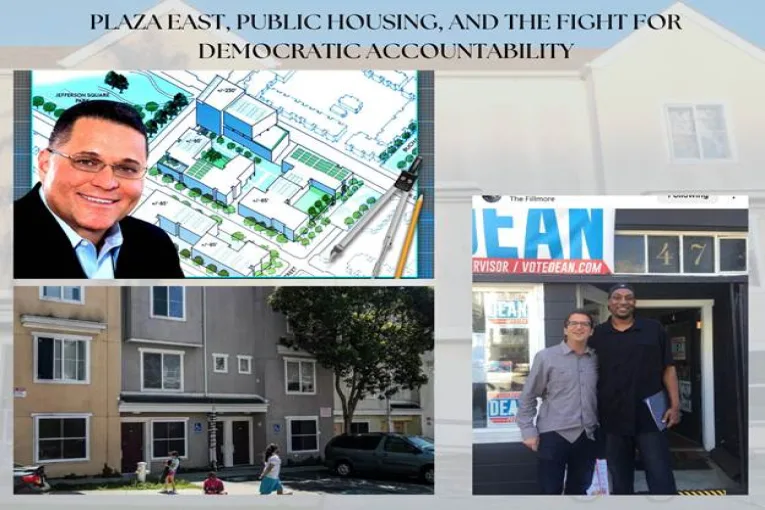
By Malik Washington, Investigative Journalist, Destination Freedom Media Group | The Davis Vanguard
“A community can survive broken plumbing longer than it can survive broken democracy.”
For years, residents of Plaza East Apartments have documented mold creeping across bedroom walls, rats moving through hallways, sewage backing into living spaces, broken appliances left unrepaired, and buildings slowly falling apart in the heart of San Francisco’s historic Fillmore District.
Those conditions are no longer seriously disputed.
City records, HUD inspections, investigative reporting, and emergency repair documents have all confirmed what residents have been saying for years: Plaza East has suffered from extensive deferred maintenance, life-safety deficiencies, chronic code violations, and deteriorating living conditions.
sanfrancisco_accracity: https://www.instagram.com/reels/DZbW4LLsYHv/
But residents are now raising a different question—one that reaches far beyond leaking ceilings and broken infrastructure.
Who was actually speaking for them while decisions about the future of their community were being made?
That question lies at the center of a detailed written complaint submitted by longtime resident leader Dennis Williams Jr., who alleges that Plaza East has gone approximately 14 to 15 years without a legitimate, comprehensive Resident Council election while redevelopment discussions continued and major decisions affecting residents moved forward.
If those allegations are ultimately substantiated, the implications extend well beyond one public housing development. They strike at the legitimacy of resident representation itself.
A RECORD OF NEGLECT
The deterioration of Plaza East did not happen quietly. San Francisco Public Press documented years of complaints involving mold, plumbing failures, sewage leaks, vermin infestations, fire-safety deficiencies, broken windows, dry rot, sanitation failures, and dozens of unresolved building violations.
The investigation found a property burdened by repeated complaints and enforcement actions stretching back years. Then city government confirmed much of what residents had already been documenting.
A 2021 evaluation by the San Francisco Mayor’s Office of Housing and Community Development approved nearly $2.7 million in emergency repairs after describing Plaza East as suffering from extensive deferred maintenance and multiple life-safety concerns.
The City’s own assessment concluded that maintenance had become reactive rather than preventative, operating reserves had been depleted, and critical systems—including sewer laterals, electrical infrastructure, fire alarms, lighting, heating systems, flooring, railings, and windows—required substantial repair.
Two years later, conditions had deteriorated even further.
HUD assigned Plaza East a failing physical inspection score of just 40 out of 100—a dramatic decline from its previous passing score of 82. Investigative reporting also documented unresolved complaints, dozens of outstanding code violations, and a growing frustration among residents who believed years of promises had produced little meaningful change.
A DIFFERENT KIND OF FAILURE
Physical neglect is visible. Democratic neglect is often harder to detect.
Williams’ complaint alleges that residents recently received notice of elections for subordinate Resident Council offices—including vice president, secretary, and treasurer—while the presidency itself was excluded from the ballot. He further alleges that repeated resident requests for a complete Resident Council election have gone unanswered.
Those allegations remain allegations. But they raise an important question because HUD’s guidance governing Resident Councils is remarkably clear.
Federal guidance requires Resident Councils to adopt governing bylaws, conduct democratic elections at least every three years, provide proper notice to eligible residents, and utilize an independent third party to oversee elections.
HUD also emphasizes that Resident Councils exist to represent all eligible residents—not simply those already occupying leadership positions. These federal standards do not establish that violations occurred at Plaza East. They do, however, provide the benchmark against which residents’ concerns must ultimately be evaluated.
THE PUBLIC RECORD SHOWS THESE CONCERNS ARE NOT NEW
The allegations contained in Williams’ complaint did not emerge overnight. Public meeting minutes from the San Francisco Housing Authority show residents—including Williams himself—raising concerns about transparency, redevelopment planning, communication failures, and the ability of tenants to meaningfully participate in decisions affecting Plaza East.
Additional Housing Authority records document discussions involving Section 3 hiring requirements, tenant participation funding, procurement practices, and resident involvement in redevelopment planning. The concerns now being raised privately have, in many respects, already been voiced publicly.
WHAT’S REALLY AT STAKE
Redevelopment is never simply about replacing buildings.
It determines who gets to return. Who receives contracts. Who benefits economically. Who shapes the future of the neighborhood. And who has a voice while those decisions are made.
Earlier reporting documented resident opposition to demolition proposals, concerns over displacement, and calls for greater transparency as redevelopment discussions evolved.
Residents feared that redevelopment decisions affecting a historically Black community were moving faster than meaningful public participation. Williams’ complaint expands that concern by questioning whether the very body presumed to represent residents maintained democratic legitimacy throughout that process.
RESIDENTS TOOK THEIR CASE BEYOND CITY HALL
Unable to secure satisfactory responses locally, Plaza East residents continued organizing. They testified before public bodies. They filed complaints. They pursued litigation. They invited federal officials to witness conditions firsthand.
In 2024, residents escorted a senior HUD official through Plaza East, showing mold, rodent infestations, plumbing failures, clogged drainage systems, accumulated trash, and other longstanding habitability problems that residents say had persisted despite repeated complaints. The visit reinforced what investigative reporting had already established:
Residents were not exaggerating.
They were documenting.
BEYOND HOUSING CONDITIONS
Williams’ complaint also raises broader concerns regarding economic participation under Section 3 of the Housing and Urban Development Act. He alleges that redevelopment failed to create meaningful opportunities for resident ownership, co-development, local micro-developers, and Section 3 businesses despite years of discussion surrounding redevelopment planning.
Public Housing Authority records confirm that Section 3 compliance, tenant participation funding, procurement, and resident involvement were recurring topics of official discussion. Whether those efforts satisfied federal requirements remains an important question deserving independent review.
THE LARGER QUESTION
If a Resident Council has not undergone regular democratic elections consistent with HUD guidance, difficult legal and policy questions inevitably follow.
How much weight should decisions made through that structure carry? Were residents adequately represented during redevelopment planning? Were consultation processes sufficiently legitimate? Can confidence in redevelopment be restored without first restoring confidence in resident representation?
These questions deserve answers grounded in evidence—not speculation.
ACCOUNTABILITY REQUIRES TRANSPARENCY
Residents are not asking simply for another election. They are asking for confidence that the process itself reflects federal standards and democratic principles. That confidence can only come through transparency: disclosure of bylaws, election history, redevelopment records, independent review of Resident Council governance, and, if necessary, a comprehensive election supervised by an independent third party consistent with HUD guidance.
Equally important are protections against retaliation for residents who have spoken publicly about habitability, governance, or redevelopment. Democracy cannot function where participation carries fear.
THE BOTTOM LINE
The story of Plaza East is no longer solely about deteriorating buildings. It is about whether residents of one of San Francisco’s most historically significant Black communities were afforded the democratic representation federal policy envisions while consequential decisions about redevelopment were unfolding.
The mold can be remediated.
The plumbing can be repaired.
Buildings can be rebuilt.
Trust is far more difficult to restore.
Before another redevelopment decision is made, Plaza East residents—and the public—deserve a clear answer to a simple question:
Was resident representation authentic, transparent, and democratically maintained—or did the appearance of participation replace the real thing?
A COMMUNITY’S VISION BEYOND SURVIVAL
For Dennis Williams Jr., one of the resident leaders who has spent years organizing around conditions at Plaza East, the fight has always extended beyond repairing deteriorating buildings. It has always been about restoring the power of residents to shape the future of the community they call home.
“This movement was never just about fixing broken apartments,” Williams said during an interview with The Davis Vanguard and Destination Freedom Media Group. “It was about restoring dignity, democracy, and opportunity.”
Williams said residents organized because they believed their voices mattered and ultimately demonstrated that collective action could force long-overdue public attention to unsafe living conditions.
“For years, Plaza East residents documented unsafe living conditions, organized our neighbors, challenged powerful institutions, and demanded accountability,” Williams said. “We proved that when residents stand together, they can change the course of billion-dollar redevelopment.”
As Plaza East enters a new phase of redevelopment, Williams believes the focus must shift from simply repairing buildings to ensuring residents have a meaningful role in determining the community’s future.
“Now we’re demanding the next step: democratic representation, transparency, and a real pathway for residents to help rebuild the historic community they fought to protect,” he said. “Residents deserve more than consultation—they deserve representation, transparency, and a genuine opportunity to help rebuild the community they’ve spent years fighting to protect. Public housing shouldn’t simply create new buildings; it should create pathways for the very people who call these communities home.”
Williams’ remarks capture the central question raised throughout this investigation. The debate surrounding Plaza East is no longer confined to habitability alone. It is about whether the people who endured years of neglect will have a genuine voice in shaping what comes next, or whether redevelopment will move forward without fully restoring the democratic participation residents have long sought.
FROM THE REPORTER
As a Black journalist in San Francisco, I have made it my mission to investigate and report the stories that too often go uncovered or underreported. My work is rooted in a simple belief: every community deserves to be seen, heard, and taken seriously—especially when those in power are not listening.
Long before the mainstream press turned its attention to the King-Garvey Cooperative evictions, I was documenting the voices of residents, attending meetings, reviewing records, and bringing their experiences to light. What many people do not know is that I also worked behind the scenes with members of the mainstream media to help elevate that story so it could reach a broader audience.
The goal was never personal recognition. The goal was justice.
As I continue reporting across San Francisco, I have observed that stories reflecting negatively on the administration of Mayor Daniel Lurie often receive limited or delayed media attention. That observation raises difficult but necessary questions about how news judgment is exercised, whose stories are prioritized, and whose communities remain overlooked. Those are questions every journalist—and every reader—should be willing to examine.
When I say that I cover Black San Francisco, I mean the entire city. Wherever Black residents, working-class families, low-income communities, or people who have been marginalized are struggling to be heard, that is where I intend to be. Whether the story unfolds in the Fillmore, Bayview-Hunters Point, the Tenderloin, Visitacion Valley, the Western Addition, or any other neighborhood, my commitment remains the same:
to document the truth with accuracy, fairness, and accountability.
If this investigation has informed you, challenged you, or prompted new questions, I ask one thing of you: please share it. Independent journalism survives because communities choose to amplify it. Every share expands the reach of voices that have too often been ignored and brings us one step closer to the transparency, accountability, and justice that every San Franciscan deserves.
As part of our commitment to fair and accurate reporting, we’ve reached out to the following agencies for their response regarding matters addressed in the above article; specifically, any comment the agency desires with regard to the following:
- The current condition of Plaza East Apartments and efforts undertaken to address documented maintenance and habitability concerns.
- The status of Resident Council governance and any policies or procedures governing Resident Council elections.
- Whether your agency believes Resident Council elections have been conducted in accordance with applicable HUD guidance and regulations.
- Your agency’s role in redevelopment planning and resident engagement at Plaza East.
- Section 3 compliance, resident participation, and economic inclusion opportunities associated with redevelopment activities.
- Any additional information your agency believes would assist the public in understanding these matters.
Public Records, San Francisco Housing Authority; HUD Public Affairs; Mayor’s Office of Housing and Community Development; Plaza East/John Stewart Company; McCormack, Baron, Salazar; Bilal Mahmood, San Francisco Board of Supervisors, District 5; and Mayor Daniel Lurie. We will publish updates to this article upon receipt of any information received from these agencies.

ABOUT THE AUTHOR
Malik Washington is a San Francisco-based journalist and co-founder of Destination Freedom Media Group, an independent nonprofit newsroom dedicated to accountability reporting at the intersection of civil rights, public integrity, disability justice, structural accountability within American institutions, and community survival. He has been a published journalist for over 14 years.
His work—published in partnership with the Davis Vanguard—focuses on government power, criminal justice, environmental justice, and the human consequences of policy decisions too often insulated from public scrutiny. Washington’s reporting amplifies the voices of impacted communities while insisting on documentary evidence, transparency, and the unvarnished truth—especially when institutions demand silence.
His work appears on platforms such as Muck Rack and Black Voice News, examining the intersection of justice, governance, and community.
You can reach him via email: mwashington2059@gmail.com or call him at (719) 715-9592.
Facebook: facebook.com/destfreedom13
Instagram: @destinationfreedom13
X: @dest_freedom
Follow the Vanguard on Social Media – X, Instagram and Facebook. Subscribe the Vanguard News letters. To make a tax-deductible donation, please visit davisvanguard.org/donate or give directly through ActBlue. Your support will ensure that the vital work of the Vanguard continues.
