

By Susan Bassi, Fred Johnson and Faith Strader
A COURTROOM TOO SMALL
The courtroom couldn’t hold everyone who came. A fourteen-year-old boy watched from his phone in the hallway. Adults sobbing. A man’s voice breaking apart mid-sentence. It landed hard, even through a screen.
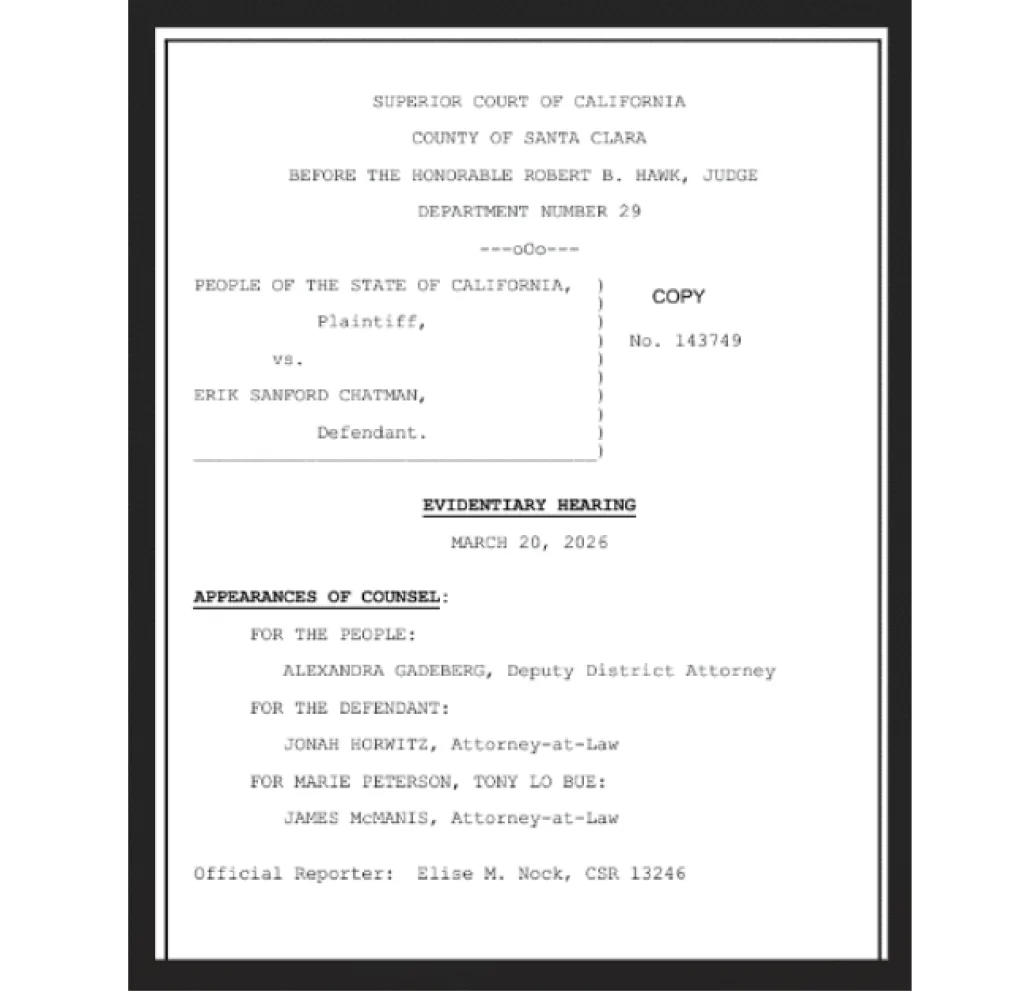
Inside, a prosecutor was asking a judge, for the second time in two years, to shrink the sentence of the man who murdered a young woman nearly four decades earlier.
What the teen watched that day is what crime victims across California keep watching happen to their own cases: a jury’s decision, once treated as final, reopened again, and the people it was decided for forced to relive it.
BEFORE NUMBER 51
Before a legal fight over statutes and standing, Rosellina LoBue, 18, was working at a small photo shop in San Jose. The kind of job teenagers have always taken.
Erik Chatman wasn’t a stranger. His wife worked at the same shop. Court testimony describes him showing up that evening with his young son to pick up a photograph order. He wasn’t happy with how the photos turned out. That was, as far as anyone has determined, the entire reason. He stabbed Rosellina fifty-one times, took cash from the register, and used it to buy drugs that same night. His son, not yet three, was the only other person in the store.
This was 1987: no phone to reshoot a bad picture in a second, no delete button, just a roll of film and whatever came back.
She was stabbed 51 times because her killer wasn’t happy with the way his photographs had turned out.
The teenager in the court hallway nearly four decades later wasn’t born when she died. To him, a bad photo is something you delete and try again before anyone sees it. That gap doesn’t make the crime feel distant. It makes it feel absurd, a life ended over something today’s teenagers wouldn’t think twice about, let alone die for.
A BELIEF THAT DOESN’T HOLD UP ANYMORE
Most people grow up assuming once a jury decides something, and the state’s highest court agrees, the decision is permanent. That assumption is what made the hallway feel like a betrayal. It’s increasingly out of date. Resentencing laws now let prosecutors and defense attorneys unwind decades-old, appellate-affirmed verdicts by agreement, without a new jury or trial, and without the family impacted by the crime getting a vote.

Hall of Justice in San Jose on March 20, 2026. Photo by Susan Bassi
A VERDICT THAT WAS SUPPOSED TO BE FINAL
In 1992, a jury heard how the defendant killed an 18-year-old shop clerk over a complaint about how photographs were developed from his film roll, then used her stolen cash to buy drugs. They decided, unanimously, that the crime deserved death. California’s Supreme Court upheld it. For thirty years, that was the end of the story. That’s what finality is supposed to mean.
Then it stopped meaning that. In 2024, prosecutors asked a judge to undo the death sentence and replace it with life without parole, one of more than a dozen death-row cases the office moved to resentence at once. No new jury heard anything. A judge agreed.
Less than a year later, the district attorney’s office asked a different judge to cut the sentence again, to twenty-five years to life, opening the door to parole. That judge said no. So prosecutors tried again, before a third judge. This time, on March 20, it worked.
For a family that believed a jury’s decision was permanent, this looked less like justice than a door that never locks. Somewhere in California are twelve people who voted unanimously for death in 1992. No one is required to tell them their verdict has since been renegotiated twice by lawyers who no longer disagree.
Jury duty asks ordinary people to trust the hardest decision they’ll make will hold. When it doesn’t, nobody comes back to explain why.
THE PROSECUTION AND THE DEFENSE, ON THE SAME SIDE
For the teenager watching from the hallway, the hardest part to understand wasn’t the law. It was the alliance. The prosecutor and the defense attorney are supposed to be opponents. Here, they wanted the same outcome.
Santa Clara County District Attorney Jeff Rosen has said his office’s goal was policy, not this case alone: shrinking death row countywide after the governor’s 2019 execution moratorium.
Rosellina’s case was one of fifteen the office moved to resentence the same way. The defense wanted the best outcome for its client, period. With both sides wanting the same result, no one was left to argue the other way, until the family’s own attorney stepped in.
WHAT “COLORABLE” COSTS CRIME VICTIMS
Part of what pushed prosecutors toward this deal is California’s Racial Justice Act. Passed in 2020, it lets a defendant argue racial bias touched their case, in the investigation, the charges, a witness’s words at trial, even the sentence. If a court finds the claim “colorable,” serious enough to deserve a real look, the defendant can get a new trial or sentence.
The defense argued Chatman had colorable claims tied to statements from his 1992 trial, decades before the law existed. Prosecutors never denied them and never proved them. Instead, they used the possibility of those claims, paired with the resentencing law, as a reason to strike a deal rather than fight it out in front of a judge.
“I’m not even sure what that means,” Rosellina’s brother said in court, describing the district attorney’s reasoning. “It’s certainly not a proper consideration in terms of the interest of justice.”
The Racial Justice Act exists for a real reason. Decades of California trials, this one included, took place in a system where racial bias sometimes shaped who got charged, what a jury heard, how a case was argued. Some people affected by that bias were genuinely wronged and deserve a real path to correct it. That is not in dispute.
Less examined is who bears the cost of correcting it. When a claim surfaces decades later, the process runs through the same family that has already endured the crime. They do not get a hearing that resolves the question. They get a phone call saying the case is being reopened, sometimes more than once. The law is not the problem. The problem is that correcting one injustice can quietly create another for people who played no part in the first.
“Colorable” doesn’t mean proven. It means a claim is serious enough that a court can’t wave it off. For a family told for decades that a jury’s word was final, learning that a new legal standard can reopen everything is its own injury.
A full hearing might have proven those claims serious, or shown they weren’t strong enough to matter. Either way, the family would have gotten a tested answer. Instead, the case settled through negotiation. The family’s attorney, James McManis, founding partner of McManis Faulkner in San Jose, asked the court to wait three months for the state Supreme Court to clarify how much such claims should weigh. The judge declined.
“We’ll take another trial. No one is going to let this man out after he stabbed a woman, an innocent woman 51 times.” — Rosellina’s sister
That is the message this case sends crime victims statewide: a jury’s decision can be unsettled decades later by a standard as soft as “colorable,” through a deal between two sides who no longer disagree.
Getting justice doesn’t mean what it used to mean, for families reliving old crimes or for the wrongly convicted still waiting their turn. Dozens of similar resentencings are already moving through California courts. There’s no count yet of how many more people this process will reach.
A SISTER WHO REFUSED TO SIT DOWN
When Judge Hawk began reading his tentative decision on March 20, Rosellina’s sister didn’t wait to be called on.
“I don’t care. I am going to say something,” she screamed from the back of the small courtroom. “My sister was murdered, stabbed 51 times. Give me another trial. No one is going to let this guy out. Get that through your head.”
What came next wasn’t the language of a legal filing. It was one woman explaining what thirty-seven years of grief costs a family.
“My mom died of cancer from it. She abandoned us as soon as this happened. I had to step in. I had to be the mother to my brother. I had to be the wife to my dad. I was 16 years old.” — Rosellina’s sister
She talked about cooking for her father every night, driving her little brother to school because their mother couldn’t get out of bed, becoming, at sixteen, the adult in a house that had stopped functioning.
None of it appears in Section 1172.1 of the Penal Code, the law the hearing was about. All of it happened because of the fifty-one stab wounds a jury had already ruled on.
“Look at what’s out there,” she said, describing her fear of him walking free. “He’s gonna do it again. It’s an uncontrolled environment.”
Her attorney, James McManis said, gently, “Sweetheart, you had your say.” She wasn’t finished. “It’s not enough for you people.”
Through shouting sobs she warned the room that years of this fight had taken a toll on her brother’s health that stood to take his life as well.
“One of those stab wounds was in her eye, in her eye. In her eye, Your Honor.” — Rosellina’s brother
Now it was his turn, and the room could see exactly what she meant. Sweat beaded across his forehead. His breathing turned shallow, like a man carrying something too heavy to put down.
“In the interest of justice, for who?” he asked. “Not us.”
He laid out details few in that room could have known without living them, how Chatman’s prison security classification dropped from the highest level to the lowest in a single year, after thirty-four years at the top.
He told the judge he’d slept two hours the night before. When Judge Hawk said he intended to move forward, something in him broke.
“You don’t acknowledge nothing. This is bullshit. This is wrong,” he said. “Don’t release him from prison. You know he’s going to be out in two years, six months. What’s wrong with you?”
Then his body stopped keeping up. He appeared to be having a medical emergency, right there in open court. The judge called an immediate recess. That was the moment that reached the hallway as a dead screen and a boy’s quiet words to a reporter.

Emergency Responders at Hall of Justice on March 20,2026. Photo by Susan Bassi
When the hearing resumed, Judge Hawk warned that further outbursts would mean deputies removing people from the courtroom. Then he signed the order.
A man once sentenced to death by a jury of his peers could now, someday soon, be a free man.
THE LAWYER WHO WOULDN’T LET IT GO QUIET
The family’s attorney has a name: James McManis. Set beside the sister’s shout and the brother’s collapse, the legal work he did that day reads like a different language, and that contrast is the point. He introduced a binder of evidence, read from the California Supreme Court’s 2006 decision upholding the conviction, and challenged the district attorney’s account of an earlier hearing, arguing prosecutors had once promised the family that life without parole meant Chatman would never walk free, only to return a year later seeking a sentence that opened the door to parole.
“Why are you so concerned? Life without parole. He is never going to be on the street again. And a year later they’re back to court.” — James McManis, describing District Attorney Jeff Rosen’s earlier assurance to the family
He asked the judge to weigh a new trial on a forty-year-old case against three months’ patience for the state Supreme Court to rule on questions the prosecution itself called serious. He didn’t get the answer he wanted. But every objection now lives in a transcript a higher court can read.
WHAT THE CALIFORNIA SUPREME COURT IS BEING ASKED
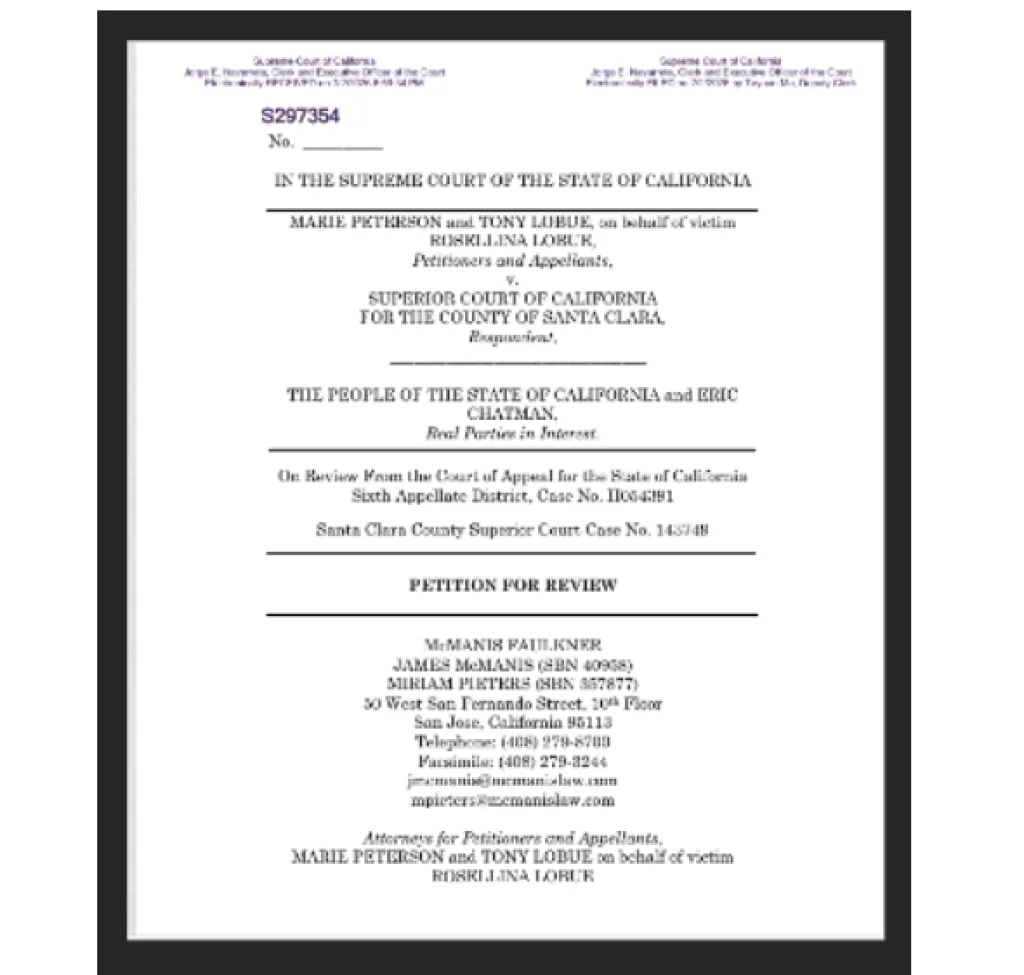
On July 2, McManis and his colleague Miriam Pieters filed a petition asking the state’s highest court to step in, after a lower appeals court turned the family away without explanation. The petition makes two arguments.
First, Section 1172.1 lets a judge reduce a defendant’s “term of imprisonment,” and a death sentence isn’t classified as imprisonment. If that’s right, the law never applied to this case at all.
Second, who gets to fight a decision like this?
In 1991, the California Supreme Court ruled that crime victims generally lack standing to challenge decisions in someone else’s criminal case, on the theory that the adversarial system would protect them.
“There is no canon of statutory construction capable of such heavy lifting.” — Petition for Review, McManis Faulkner
That theory, the petition argues, collapses the moment prosecution and defense stop being adversaries. The ruling predates Marsy’s Law, the 2008 amendment expanding victims’ right to be heard. The petition points to more than forty-five similar resentencings statewide since 2019.
WHAT THE HALLWAY TEACHES
There’s a version of this story that ends with anger, at the judge, at the district attorney’s office, at a law Rosellina’s sister and brother believe was never meant to apply to their sister’s killer. That version isn’t wrong. It’s incomplete.
James McManis and Miriam Pieters gave Rosellina’s sister and brother something the system rarely guarantees victims on its own: a real advocate, a preserved record, a shot at review by California’s highest court. In a system where victims can be silenced the moment prosecutors and defense agree, a lawyer who refuses to let that happen is close to everything.
And still, a family that did everything right ended up watching part of their own case from a hallway, because the room was too small and nobody thought of making it bigger.
That is the gap this story is really about: not what the law technically allows, but what it costs the people it’s supposed to serve. A jury’s decision, even one upheld by the state’s highest court, doesn’t mean what it used to. The fourteen-year-old who watched part of it through a buffered feed outside the door didn’t need a law degree to understand that. He only needed to watch what “final” looks like when it isn’t.
To comment please go to one of these social media platforms:
Facebook: https://www.facebook.com/DavisVanguard
LinkedIn: https://www.linkedin.com/company/peoples-vanguard-of-davis-inc/
Instagram: https://www.instagram.com/davisvanguard/
X: https://x.com/davisvanguard
Bluesky: https://bsky.app/profile/vanguardnewsgroup.bsky.social
Subscribe to the Vanguard News letters. To make a tax-deductible donation, please visit davisvanguard.org/donate or give directly through ActBlue. Your support will ensure that the vital work of the Vanguard continues.
