
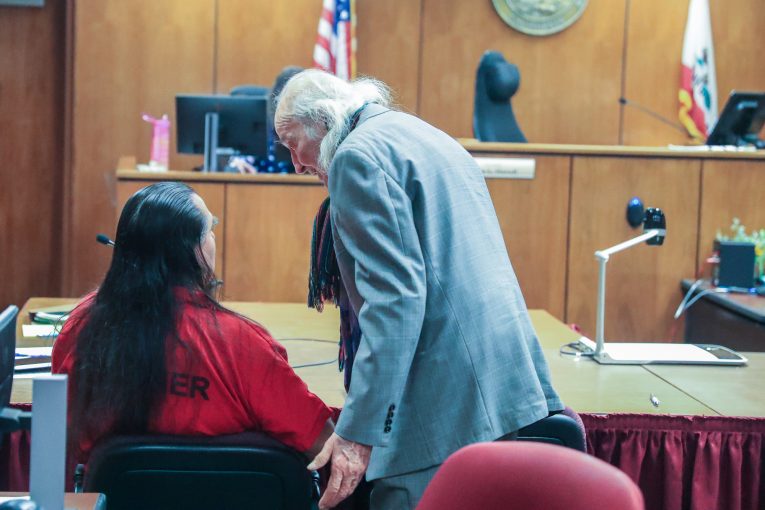
FRESNO, Calif. — A Fresno County Superior Court judge on Friday largely rejected prosecutors’ effort to scale back a discovery order requiring them to turn over records that could reveal racial bias in the decades-old case of Douglas “Chief” Stankewitz, formerly the longest-serving person on California’s death row.
The Aug. 14 discovery hearing centered on prosecutors’ request to modify an order requiring them to produce records that could reveal racial bias, but the judge held them to nearly every part of the order they had sought to modify.
Stankewitz, a Monache man from Big Sandy Rancheria, was convicted of first-degree murder with a special circumstance in the 1978 killing of Theresa Greybeal. He was sentenced to death and became the longest-serving person on California’s death row.
The Fresno County District Attorney’s Office dropped the death penalty in 2019. He was resentenced to life without the possibility of parole.
Stankewitz and his team are seeking relief under the California Racial Justice Act, which prohibits the state from seeking or obtaining a criminal conviction or imposing a sentence on the basis of race, ethnicity or national origin. He argues racial bias affected his arrest, prosecution, conviction and sentence, including jury selection during his retrial.
The hearing in Dept. 74 followed up on a June 2 discovery order that Judge Alvin Harrell III issued under the Racial Justice Act. The order directed the prosecution to produce a spreadsheet of every defendant who had been charged with murder in Fresno County from 1975 to 1985.
The order also called for data linking co-participants charged in the same homicide, a list of death sentences and any other evidence that someone involved in the case acted with any racial bias.
Senior Deputy District Attorney Jamie Kalebjian filed a response asking the court to modify several parts of that order.
Defense attorney Curtis Briggs told the court the defense hadn’t filed a written reply because it considered the order to be thorough. Briggs argued the prosecution was largely trying to relitigate some factors the court had already balanced when the order was made.
The prosecution first asked to swap defendant names for anonymized identifiers. This raised privacy concerns about the third-party defendants. Harrell rejected this request.
He found that the case Kalebjian cited involved third-party witnesses rather than defendants. He also noted that the case numbers would lead back to the names anyway.
Kalebjian said that if names were ordered, the office would likely seek a protective order. The parties agreed to one over the material.
On the co-participant data, Kalebjian told the court that the DA’s office could not substantially comply. The case management system has only been in use since 2019 and cannot reliably link defendants charged separately in the same incident.
Kalebjian said she flagged the limitation so that no one would later question why the data was incomplete. Harrell said he could not order the office to do the “impossible” and directed it to comply to the best of its ability.
For a list of death sentences reaching back to 1975, Kalebjian urged the defense to use the Death Penalty Information Center’s public website. She warned that the office’s own query would likely be inaccurate and missing large portions of data.
Briggs responded that the website does not give the full picture. He noted, for example, that it would not show whether a charge had later been struck.
Harrell left the order in place. He again told the prosecution to comply as best it could.
Turning to jury notes from the trial, Kalebjian said the office was not claiming a work-product privilege. Senior Deputy District Attorney Elana Smith told the court that during earlier habeas proceedings, she and defense counsel had gone through every box of the physical file.
Smith said she recalled no notes specific to jury selection. The defense contends that the only prospective Native American juror was improperly dismissed at trial.
The prosecution also objected that producing evidence of bias by a judge, attorney, officer or juror asked it to reach a legal conclusion. Harrell clarified that he wasn’t asking the DA’s office to decide whether the Racial Justice Act had been violated.
He asked only for information that might support such a finding. Kalebjian agreed to search the file.
Stankewitz appeared by video from custody. He remains held on a sentence of life without parole while his attorneys seek the records they say could support their claim that Fresno County charged and sentenced Indigenous, Black and Hispanic defendants more harshly.
Harrell held the prosecution to nearly all of the June order. He set the next hearing for Friday, Nov. 6, at 9:15 a.m., when the office is expected to report on its progress.
To comment please go to one of these social media platforms:
Facebook: https://www.facebook.com/DavisVanguard
LinkedIn: https://www.linkedin.com/company/peoples-vanguard-of-davis-inc/
Instagram: https://www.instagram.com/davisvanguard/
X: https://x.com/davisvanguard
Bluesky: https://bsky.app/profile/vanguardnewsgroup.bsky.social
Subscribe to the Vanguard News letters. To make a tax-deductible donation, please visit davisvanguard.org/donate or give directly through ActBlue. Your support will ensure that the vital work of the Vanguard continues.
