
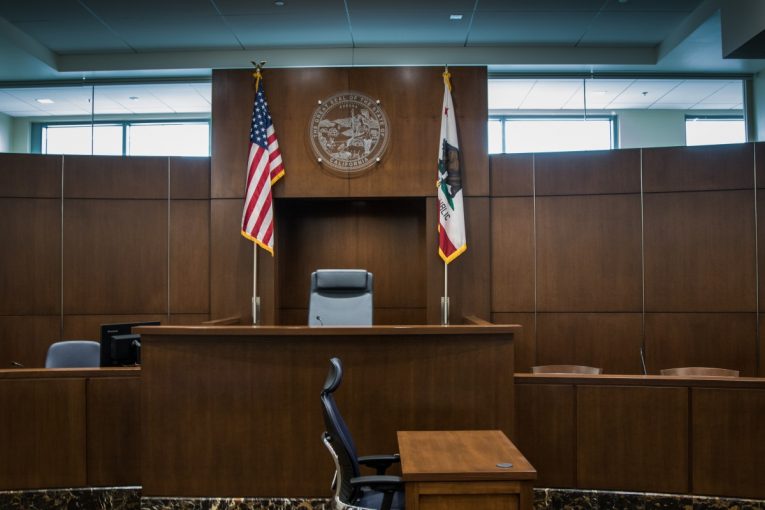
WOODLAND, Calif. — A Yolo County Superior Court judge revoked supervised release and set bail at $10,000 Monday for a low-income accused individual who missed a court appearance, raising questions about the consequences of unaffordable bail for people already facing financial instability.
Judge Paul Richardson revoked the accused’s supervised own recognizance, or SOR, release with GPS monitoring during a pretrial conference after the accused failed to appear in court.
The accused faces a misdemeanor petty theft charge and a felony charge of obstructing or resisting an officer, along with an aggravating enhancement.
On July 27, the court reduced bail to $1,000 so the accused could be placed on SOR with GPS monitoring. After the accused missed the subsequent court date, Richardson increased bail to $10,000.
The accused is low-income and is not expected to be able to afford the new bail amount.
Deputy District Attorney Aloysius Patchen advocated for revoking the accused’s supervised release despite the reason for the missed appearance being unknown.
The decision means that if the accused is arrested on the outstanding warrant and cannot afford the $10,000 bail, they could remain incarcerated while the case proceeds.
The circumstances highlight broader concerns about the intersection of poverty, housing instability and the pretrial justice system, particularly when people with limited financial resources face requirements involving transportation, communication and regular court appearances.
For people experiencing homelessness or housing instability, maintaining reliable transportation and consistent access to a phone or other device can present additional obstacles to appearing in court.
Research from the Prison Policy Initiative has documented a particularly strong relationship between incarceration and homelessness. The organization has reported that formerly incarcerated people are nearly 10 times more likely to experience homelessness than the general public.
Prison Policy Initiative policy analyst Lucius Couloute has also examined how homelessness, food insecurity and financial hardship can contribute to circumstances in which people commit low-level offenses, including petty theft, as a means of survival.
Couloute has described the relationship between homelessness and the criminal legal system as a revolving door, with incarceration contributing to instability while a lack of housing and other resources can increase the likelihood that people return to the system.
California courts are required to consider whether a person can afford bail before imposing conditions that result in pretrial detention solely because of an inability to pay.
In its 2021 In re Humphrey decision, the California Supreme Court held that courts must consider a person’s ability to pay as well as nonfinancial alternatives before imposing bail that effectively results in detention.
The ruling established that pretrial detention cannot be based simply on an accused person’s inability to afford the amount of bail imposed.
Despite those protections, the use of monetary bail can leave low-income defendants facing substantially different consequences than people with greater financial resources when courts determine that additional restrictions are warranted.
The United States Interagency Council on Homomelessness, or USICH, has similarly identified the relationship between homelessness and incarceration as an issue requiring intervention and has supported federal and local initiatives aimed at reducing the cycle between homelessness and the criminal legal system.
USICH programs around the country have focused on connecting people leaving incarceration or otherwise involved with the criminal legal system to housing and financial assistance. Efforts in California, including in the Bay Area and Los Angeles, have emphasized housing stability as a means of reducing future incarceration.
According to USICH, programs that provide stable housing can decrease incarceration while improving the overall well-being of people involved with the criminal legal system.
At the federal level, USICH has also supported efforts intended to ensure that people with prior convictions remain eligible for housing assistance through the U.S. Department of Housing and Urban Development.
Those policies reflect a broader effort to address conditions that can contribute to repeated involvement with the criminal legal system rather than relying exclusively on incarceration.
In the Yolo County case, the precise reason the accused missed court remains unknown.
That distinction is significant because people facing poverty or housing instability can encounter barriers to attending court that extend beyond an intentional decision not to appear, including unreliable transportation and difficulty maintaining access to phones or other devices needed to track court dates.
With bail now set at $10,000, the accused faces the possibility of remaining incarcerated if arrested and unable to pay the required amount.
A warrant has been issued for the accused’s arrest, and a time waiver for the 10th day was applied because of the accused’s absence.
To comment please go to one of these social media platforms:
Facebook: https://www.facebook.com/DavisVanguard
LinkedIn: https://www.linkedin.com/company/peoples-vanguard-of-davis-inc/
Instagram: https://www.instagram.com/davisvanguard/
X: https://x.com/davisvanguard
Bluesky: https://bsky.app/profile/vanguardnewsgroup.bsky.social
Subscribe to the Vanguard News letters. To make a tax-deductible donation, please visit davisvanguard.org/donate or give directly through ActBlue. Your support will ensure that the vital work of the Vanguard continues.
