
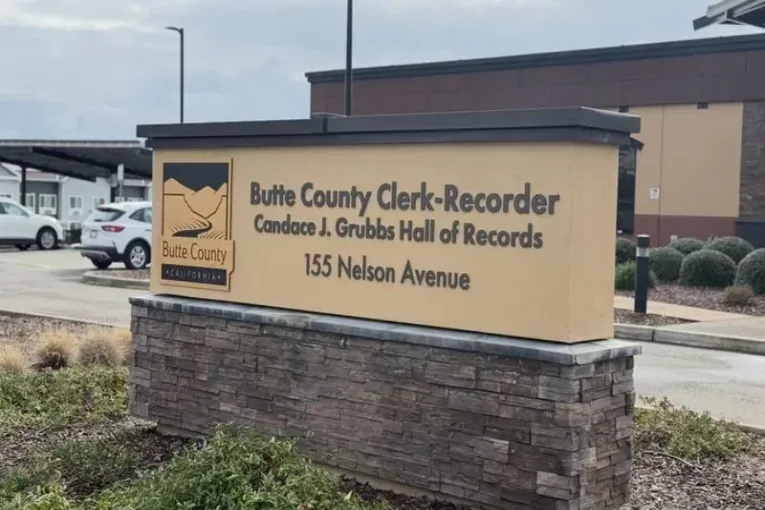
BUTTE COUNTY, Calif. — Butte County’s top election official rejected a federal request to set aside ballots belonging to suspected noncitizens after reviewing a Justice Department list and finding that most of the names could not be matched to active voter registrations.
Butte County Clerk-Recorder and Registrar of Voters Keaton Denlay said the list contained duplicate entries, incomplete identifying information and names that did not correspond to active voters, raising questions about the reliability of the federal government’s allegations just days before California’s Nov. 3 election.
According to The Guardian, a federal agent delivered a letter and a two-page list to Denlay’s office requesting that the county identify and segregate ballots associated with individuals the Justice Department suspected were not U.S. citizens.
The letter gave the county 48 hours to respond and sought additional identifying information about the individuals, including Social Security numbers.
It also warned that election officials who knowingly counted ballots cast by noncitizens could face criminal prosecution.
Denlay said the federal government initially identified 47 suspected noncitizens who allegedly had registered to vote unlawfully in Butte County.
However, his review found that the document contained 46 entries, including one duplicate, leaving only 45 distinct names.
Of those 45 individuals, 32 were not on the county’s active voter rolls and had not been issued ballots.
Another seven entries lacked sufficient identifying information to determine whether they corresponded to registered voters.
Some records contained incomplete names or addresses, while others lacked identifying information such as dates of birth, driver’s license numbers or Social Security numbers.
That left six individuals whose names could potentially be matched to voter registrations, but Denlay said the federal government had not provided sufficient evidence to establish that those voters were ineligible.
California law establishes procedures for challenging voter eligibility and requires evidence supporting a challenge before election officials can restrict a registered voter’s ballot.
In his official statement, Denlay cited the state’s requirement that a challenger provide extraordinary proof of the validity of a voter eligibility challenge when it is made.
“Given the overall inaccuracy of the list provided and its lack of specificity, I believe the Department of Justice has not met that burden,” Denlay stated.
Denlay also described problems with the document itself, which appeared to be a poorly formatted spreadsheet with information missing or cut off.
The incomplete records made it difficult to compare the names against the county’s voter registration database.
The federal agent who delivered the documents identified himself as an official with the Department of Homeland Security.
The accompanying Justice Department letter was signed by Eric Grant, U.S. attorney for the Eastern District of California, and incorrectly spelled Denlay’s name.
Denlay said he personally reviewed the federal list rather than assigning the task to election staff, allowing employees to remain focused on preparations for the upcoming election.
He also said his office had not received a digital copy of the spreadsheet or additional communication from the Justice Department following the initial delivery.
The Butte County dispute is part of a broader effort by the Trump administration to identify suspected noncitizens on California voter rolls and require election officials to set aside ballots associated with those individuals.
Federal authorities have relied on Department of Homeland Security data to question the eligibility of thousands of registered voters.
California election officials have challenged the accuracy of that information and questioned whether federal authorities can require counties to alter established election procedures based on unverified citizenship claims.
On Oct. 28, U.S. District Judge David O. Carter denied the Justice Department’s request for an emergency order requiring California officials to segregate approximately 20,000 ballots associated with suspected noncitizens.
In his ruling, Carter questioned the federal government’s evidence and warned that the requested intervention could prevent eligible voters from having their ballots counted.
The judge also raised concerns about federal efforts to compel state and local officials to change election procedures shortly before Election Day.
The ruling did not determine the citizenship status of every individual identified by federal authorities, but it rejected the government’s request for immediate intervention in California’s election administration.
A federal appeals court subsequently rejected another Justice Department request to require California to set aside the disputed ballots, citing the potential disruption to election administration and the risk of disenfranchising eligible voters. <Cite ref=”turn323735news15″/>
Similar concerns have emerged in other counties that received federal lists of suspected noncitizens.
According to The Guardian, San Benito County Registrar of Voters Francisco Diaz reviewed a separate list containing 33 names and identified discrepancies, including individuals who were not currently registered to vote in the county.
In San Luis Obispo County, Clerk-Recorder Elaina Cano also questioned the accuracy of a federal list identifying 63 suspected noncitizens, reporting that some individuals with active registrations had been confirmed as U.S. citizens.
The disputes highlight the difficulty of determining voter eligibility from incomplete federal records and the potential consequences of restricting ballots before allegations can be independently verified.
Denlay emphasized that election officials are responsible for following California law when reviewing challenges to voter eligibility, regardless of whether those challenges originate with federal authorities.
His decision leaves Butte County’s existing ballot-processing procedures in place while rejecting the Justice Department’s request to segregate ballots based on the information provided.
To comment please go to one of these social media platforms:
Facebook: https://www.facebook.com/DavisVanguard
LinkedIn: https://www.linkedin.com/company/peoples-vanguard-of-davis-inc/
Instagram: https://www.instagram.com/davisvanguard/
X: https://x.com/davisvanguard
Bluesky: https://bsky.app/profile/vanguardnewsgroup.bsky.social
Subscribe to the Vanguard News letters. To make a tax-deductible donation, please visit davisvanguard.org/donate or give directly through ActBlue. Your support will ensure that the vital work of the Vanguard continues.
