
This story was originally published by EdSource. Sign up for their daily newsletter.
Top Takeaways
- Nearly 500 Californians are pursuing bachelor’s degrees while incarcerated, more than twice the number of students enrolled three years ago.
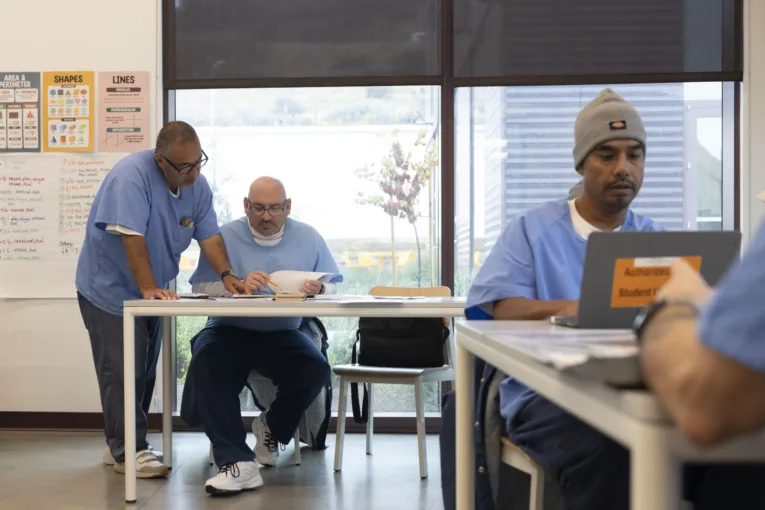
- California State University, Los Angeles has launched the state’s newest bachelor’s degree program at San Quentin Rehabilitation Center, where 34 incarcerated men are pursuing majors in liberal studies.
- Inmate demand for higher education in prisons often exceeds availability, say program leaders, who hope to continue growing prison bachelor’s programs.
Jason Jenkins had spent 14 years in prison before he used a computer for the first time in 2021.
Now, the 42-year-old regularly logs onto his state-issued laptop to write discussion posts in pursuit of his bachelor’s degree in liberal studies. Juggling a job and full-time course schedule while incarcerated at San Quentin Rehabilitation Center is exhausting, Jenkins said, but it’s helped him learn to multitask and hold himself to high expectations.
“I feel like that’s what we have to be in order to be successful in society,” said Jenkins, one of 34 men enrolled in California’s newest bachelor’s degree program inside the state’s oldest prison. “Everything we do is going to pay off in the long run.”
In 2014, then-Gov. Jerry Brown signed legislation to fund community college courses inside jails and prisons, part of a slate of criminal justice and prison reforms to reduce the rate of people returning to prison after serving their sentences. More than a decade later, California’s higher education offerings in prisons now include 13 bachelor’s degree programs with nearly 500 graduates to date, with plans for further expansion.
UC Santa Barbara, for instance, will enroll students for a 2027 program at a state prison in Corcoran. UC Riverside, which already operates one program in Riverside County, will expand to a second prison in the Inland Empire in the coming years. California State University, Los Angeles, which runs the San Quentin program, plans to launch a bachelor’s of science degree program in rehabilitation services — the first in the state’s prison system — by 2028 at the correctional facility in Lancaster.
The number of incarcerated students enrolled in a bachelor’s degree program, which currently stands at 495 according to the California Department of Corrections and Rehabilitation, has more than doubled in the last three years. Since these programs were first offered a decade ago, CSUs and UCs have reported granting at least 390 bachelor’s degrees to incarcerated students. The department reported ahigher number of bachelor’s degrees, 484, which CDCR attributed to the fact that some inmates have received bachelor’s degrees through correspondence programs.
University officials who run the bachelor’s programs embrace the growth of higher education in prisons. But to ensure the continued success of these programs, particularly those that don’t receive funding from the department, they call on the state to allocate ongoing funding.
“Our students feel seen and heard, and they feel like they are part of a community,” said Farah Godrej, a UC Riverside professor and co-founder of the program inside the Ironwood State Prison in Blythe. “I think you can’t underestimate what that does for a person’s self-understanding and their self-image.”
Directors of prison bachelor’s degree programs noted that not every student who enrolls ends up graduating while incarcerated. Several have gone on to finish their degrees on campus after being released from prison.
Most of the California Department of Corrections and Rehabilitation’s higher education offerings are for associate degrees. Nearly 10,000 incarcerated students are enrolled in community college programs that operate in all 30 state prisons, according to the department. The cost to the state is $17 million annually, according to the California Community Colleges Chancellor’s Office.
In contrast, California included $5.5 million in the department’s current budget to fund the bachelor’s degree programs, which also receive federal dollars. That represents a fraction of its total budget of $14 billion.
A new bachelor’s degree and a new facility
The Newsom administration’s most visible spending on prisons can be seen in the Bay Area facility where Jenkins lives.
San Quentin’s new state-funded $239 million education facility features outdoor classrooms, music and podcast recording studios and a library with open stacks, where incarcerated students can freely browse instead of relying on clerks to check out books. The sleek buildings and artful landscaping stand in stark contrast to the imposing 174-year-old prison buildings where men live and sleep just across the concrete yard.
The prison has changed significantly since it was the home of men on death row, Warden Chance Andes said earlier this month.
The state-funded $239 million education facility at San Quentin Rehabilitation Center opened in spring 2026. Photo credit: J. Emilio Flores / Cal State LAJ. Emilio Flores/Cal State LA
At a celebration announcing the launch of the Cal State LA program, Andes addressed the question of why the state was spending money educating people in prison.
It’s the right thing to do, he said, considering that people who pursue higher education while incarcerated are less likely to return to prison.
“There is no price on revictimizing people, right? We don’t want more victims; that’s the bottom line,” he added.
Jenkins, who has served nearly two decades of his 43-year sentence for aggravated mayhem and carjacking convictions, said the new learning facility, which enables the incarcerated men to see the San Francisco Bay from the second- and third-story balconies, gives him hope.
After a near-death experience of overdosing on drugs while incarcerated in 2013, Jenkins told EdSource he had a religious awakening and created two goals for himself: Read the Bible and get an education. After completing several associate degrees while incarcerated, Jenkins is now taking courses in social Darwinism and art history as part of the Cal State LA program.
The CDCR tries to accommodate inmates’ requests to move to facilities where their desired bachelor’s degree programs are offered. In the 2025-26 admissions cycle, the department moved 83 students for bachelor’s degree programs.
Bidhan Roy, Cal State LA’s Prison Graduation Initiative program director, said one of his goals is for some formerly incarcerated participants in the program to return to prison to teach as faculty.
“One of the things we try to do is model life on the outside,” Roy said. “When you can have a space that you can be freer in, not be hypervigilant in, think and be treated as a human being, you’re really kind of given the experience of rehabilitation.”
How are prison bachelor’s degree programs funded?
In the early 1990s, there were nearly 800 postsecondary degree programs operating in prisons across the country. That changed abruptly after President Bill Clinton signed the 1994 Crime Bill, revoking incarcerated students’ eligibility for Pell Grants.
It took three decades for the federal government to fully reinstate federal financial aid opportunities for students in prison after the Obama administration pushed to restore Pell Grants to the population. Postsecondary institutions can apply for eligibility for financial aid through the federal Prison Education Program.
Some, but not all, California universities offering bachelor’s degrees in prison have access to those federal dollars, which are approved by the U.S. Department of Education.
The UC Riverside program at Ironwood State Prison has not yet been approved to receive this funding, said Godrej, the program’s co-founder. In the absence of federal assistance, the UC Riverside program is operating with a shoestring budget of less than $500,000, she said. Unlike the CSU programs, the UC degree options don’t receive funding from the CDCR.
The “human interactions” with professors and volunteers are one of the most valuable parts of his college classes, said Jenkins, the San Quentin student. Those connections have helped him stay focused on his degree in preparation for his parole hearing in 2030.
Jenkins said that many of the other men incarcerated at San Quentin are curious about the bachelor’s program, but are waiting to sign up until they know how difficult it is to complete the degree.
“Hopefully they will join when they see the benefits,” he said.

To comment please go to one of these social media platforms:
Facebook: https://www.facebook.com/DavisVanguard
LinkedIn: https://www.linkedin.com/company/peoples-vanguard-of-davis-inc/
Instagram: https://www.instagram.com/davisvanguard/
X: https://x.com/davisvanguard
Bluesky: https://bsky.app/profile/vanguardnewsgroup.bsky.social
Subscribe to the Vanguard News letters. To make a tax-deductible donation, please visit davisvanguard.org/donate or give directly through ActBlue. Your support will ensure that the vital work of the Vanguard continues.
