
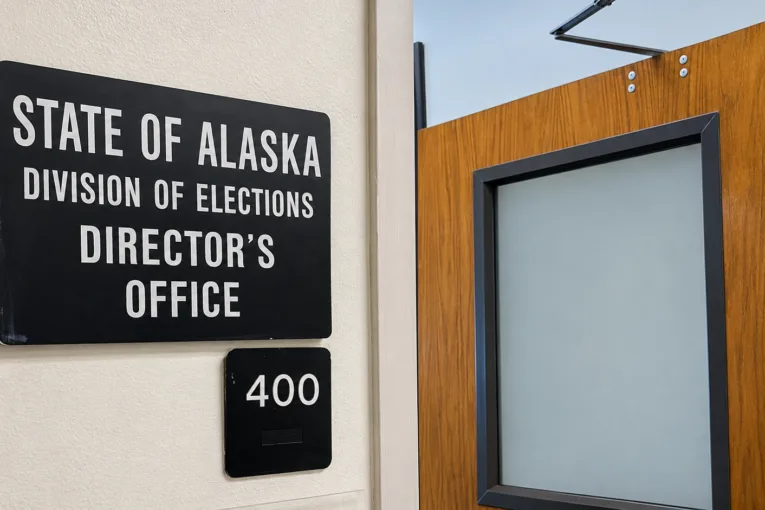
ANCHORAGE, Alaska — A federal lawsuit seeking to prevent Alaska from certifying its U.S. Senate election results under certain circumstances is facing additional legal opposition, with the NAACP arguing that the Justice Department is improperly using federal voter registration law to challenge the state’s election procedures.
The dispute centers on the appearance of two candidates with similar names on Alaska’s November ballot: incumbent Republican Sen. Dan S. Sullivan and Daniel J. Sullivan, Jr.
The Justice Department alleges that voters could confuse the two candidates, potentially affecting the election’s outcome. Federal prosecutors have sought an order preventing certification of results they contend may be affected by that confusion.
According to the NAACP Legal Defense Fund, the NAACP filed an amicus curiae, or friend-of-the-court, brief in the U.S. District Court for the District of Alaska on Oct. 30, arguing that the National Voter Registration Act of 1993 does not authorize federal intervention in candidate eligibility, ballot design or election certification.
The brief was submitted on behalf of the NAACP and the NAACP Alaska Oregon Washington State Area Conference, which includes the NAACP Anchorage Branch.
The Justice Department filed its original lawsuit Oct. 22 and amended its complaint Oct. 29, adding a claim under the Constitution’s Supremacy Clause.
According to Democracy Docket’s case records, federal prosecutors subsequently requested expedited discovery and a preliminary injunction, while Alaska election officials and several intervening parties sought dismissal.
The Justice Department contends that Daniel J. Sullivan, Jr.’s presence on the ballot could mislead voters intending to support the incumbent senator.
The dispute began in June when the Alaska Republican Party challenged Daniel J. Sullivan, Jr.’s candidacy, alleging that his participation was intended to confuse voters.
Alaska Division of Elections Director Carol Beecher initially removed the candidate from the ballot.
However, the Alaska Supreme Court subsequently ruled that state law required Daniel J. Sullivan, Jr. to appear on the ballot.
According to the ACLU of Alaska, the general election ballot identifies Dan S. Sullivan as the incumbent and includes his political affiliation, distinguishing him from Daniel J. Sullivan, Jr.
Despite the state court ruling, the Justice Department brought a federal lawsuit alleging that the possibility of voter confusion could undermine the integrity of the election.
The government’s requested relief would prevent certification of results potentially affected by the alleged confusion while officials investigate whether voters intended to support the incumbent.
The NAACP disputes the legal basis for that request.
Its brief argues that the Justice Department relies on a reference to election integrity in the introductory language of the National Voter Registration Act while disregarding the statute’s substantive provisions.
The organization maintains that Congress enacted the law to expand voter registration, encourage participation and establish requirements for maintaining accurate voter rolls.
The NAACP argues that none of those provisions authorizes the federal government to challenge candidate qualifications or prevent certification based on which candidate wins.
“Alaskans deserve to have their votes counted,” said Kristen Clarke, general counsel of the NAACP, in a statement released by the Legal Defense Fund.
“The Department of Justice’s case is based on two words from the National Voter Registration Act, taken grossly out of context,” Clarke said. “Federal law does not support this attempt to interfere with the election.”
The brief also argues that candidate qualifications and ballot design are generally matters governed by state election law, subject to applicable constitutional and federal statutory requirements.
The NAACP contends that allowing the Justice Department to use the National Voter Registration Act to intervene in election certification would expand federal authority beyond the powers Congress established in the statute.
Kathryn Sadasivan, senior counsel at the Legal Defense Fund, said the law addresses voter registration rather than disputes over which candidates may appear on ballots.
“The NVRA simply has nothing to say about challenges to ballot ordering, candidate qualification, or election certification,” Sadasivan said.
The organization argues that the Justice Department’s interpretation would permit federal intervention in election disputes unrelated to voter registration and could interfere with voters’ ability to have their ballots counted.
The lawsuit has drawn additional opposition from Alaska election officials and voting rights organizations.
According to the ACLU of Alaska, two Alaska voters, the League of Women Voters of Alaska and Common Cause sought to intervene in the case and requested dismissal of the federal government’s claims.
The court granted their motion to intervene, allowing them to participate directly in the litigation.
Alaskans for Mary, a political organization supporting Democratic Senate candidate Mary Peltola, and the Democratic Senatorial Campaign Committee were also permitted to intervene.
Those parties have challenged the Justice Department’s interpretation of federal law and argued that the requested injunction would interfere with the state’s election administration.
Alaska election officials have similarly argued that the National Voter Registration Act does not govern candidate placement or certification of election results.
The Justice Department, meanwhile, has maintained that the alleged possibility of voter confusion warrants federal intervention and has sought expedited consideration of its request for preliminary relief.
The case is pending before U.S. District Judge Sharon Gleason, who granted expedited consideration of the dismissal motions as the Nov. 3 election approaches.
The court has not resolved the underlying dispute or determined whether the Justice Department is entitled to the requested injunction.
The litigation raises questions about the scope of federal authority under the National Voter Registration Act and whether its provisions can be used to challenge state election procedures involving candidate identification and certification.
For the NAACP and other organizations opposing the lawsuit, the central argument is that a statute governing voter registration cannot be used to prevent a state from certifying an election based on the outcome of a contested Senate race.
To comment please go to one of these social media platforms:
Facebook: https://www.facebook.com/DavisVanguard
LinkedIn: https://www.linkedin.com/company/peoples-vanguard-of-davis-inc/
Instagram: https://www.instagram.com/davisvanguard/
X: https://x.com/davisvanguard
Bluesky: https://bsky.app/profile/vanguardnewsgroup.bsky.social
Subscribe to the Vanguard News letters. To make a tax-deductible donation, please visit davisvanguard.org/donate or give directly through ActBlue. Your support will ensure that the vital work of the Vanguard continues.
