
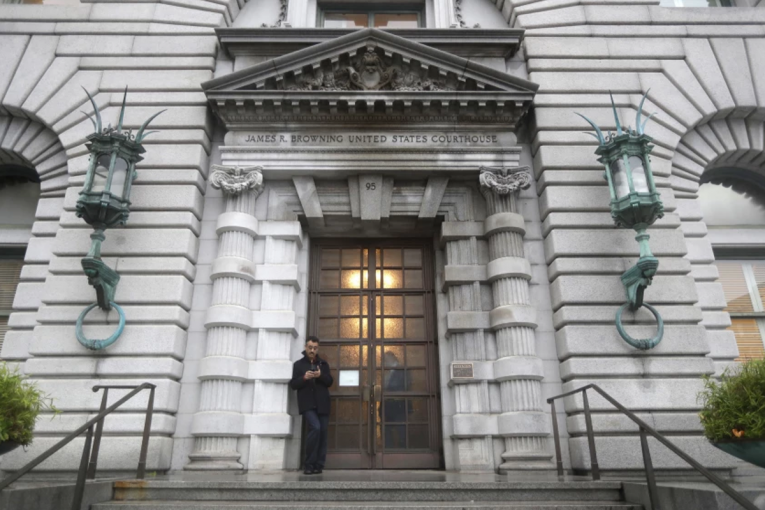
SAN FRANCISCO — The Ninth Circuit Court of Appeals rejected the Trump administration’s emergency request Friday to require California to segregate ballots associated with approximately 20,000 voters whose citizenship the federal government questioned, as 60 former Department of Justice attorneys filed a brief arguing that the administration’s actions violated longstanding department policies intended to prevent election interference.
The three-judge panel denied the Justice Department’s request for an injunction pending appeal in a 2-1 decision, leaving California’s existing election procedures in place ahead of the Nov. 3 general election.
Judges Mark Bennett and Gabriel Sanchez formed the majority, while Judge Patrick Bumatay dissented.
The ruling followed an Oct. 28 decision by U.S. District Judge David O. Carter denying the federal government’s request for a temporary restraining order requiring California and Los Angeles County election officials to identify and segregate ballots belonging to voters flagged by federal databases.
In an amicus brief filed Oct. 30, the Brennan Center for Justice at New York University School of Law and Complex Appellate Litigation Group LLP represented 60 former Justice Department attorneys who served in Republican and Democratic administrations.
The signatories include former Deputy Attorney General Donald Ayer, former U.S. attorneys Joyce Vance and Barbara McQuade, and attorneys who served in the department’s Public Integrity Section and Civil Rights Division’s Voting Section.
Their government service spans six decades, including every presidential administration since Lyndon B. Johnson.
The former attorneys argued that the Justice Department’s lawsuit departed from policies developed to prevent federal law enforcement activity from influencing elections or disrupting state election administration.
They cited the Justice Manual, which warns that federal investigations can risk “chilling legitimate voting and campaign activities” and injecting investigations into ongoing election contests.
The brief also cited department guidance stating that overt investigative measures involving alleged ballot fraud generally should be deferred until an election has concluded, its results have been certified and related recounts and election contests have ended.
The former attorneys argued that these restrictions are intended to prevent both actual election interference and the appearance of interference by federal law enforcement.
They pointed to directives issued under former Attorneys General William Barr and Merrick Garland emphasizing the importance of maintaining the department’s reputation for fairness, neutrality and nonpartisanship.
The Justice Department filed its lawsuit against California on Oct. 15, less than three weeks before Election Day.
The federal government alleged that California was failing to prevent potentially ineligible noncitizens from participating in federal elections.
The administration relied in part on 18 U.S.C. Section 611, which prohibits certain noncitizens from voting in federal elections.
The Justice Department sought an order requiring state and county election officials to identify and segregate ballots associated with voters flagged by federal citizenship databases while their eligibility was reviewed.
The former department attorneys disputed the legal basis for that request, arguing that Section 611 authorizes criminal prosecution of individuals who vote unlawfully but does not grant the Justice Department authority to direct state election procedures.
“DOJ does not point to any clear congressional authorization for this lawsuit as none exists,” the brief states.
The attorneys argued that the federal government’s legal theory would permit the Justice Department to use criminal statutes directed at individuals to compel states to change election procedures.
They also cited constitutional provisions assigning states responsibility for administering elections, subject to federal laws enacted by Congress.
According to the brief, the Justice Department’s established role is to investigate and prosecute violations of federal election law rather than direct how states determine voter eligibility and process ballots.
The former officials described the government’s approach as “investigation-by-algorithm,” arguing that the Justice Department relied on database matching without adequately establishing the reliability of the underlying information.
The filing noted that federal officials previously alleged that California had as many as 190,832 noncitizens registered to vote before presenting a substantially smaller list of approximately 20,000 individuals.
The attorneys said the government had not adequately explained the discrepancy or demonstrated why the smaller list was more reliable.
They also cited evidence from Nevada, where federal officials initially identified 15,903 potential noncitizen registrants before providing state officials with 185 names for review.
According to the brief, Nevada officials determined that all 185 individuals were U.S. citizens.
The filing cited a sample analysis by Los Angeles County finding that 42.9% of voters on the federal list had canceled registrations and another 4.6% were inactive.
Among individuals for whom birthplace information was available, 38.9% were recorded as having been born in the United States.
The former attorneys argued that the data raised questions about whether the government’s list could reliably identify ineligible voters.
They also noted that the Justice Department acknowledged it could not complete its own citizenship verification process before Election Day while demanding that state and local officials conduct extensive verification within a limited period.
In his Oct. 28 ruling, Carter found that the federal government had not demonstrated a sufficient basis for the requested temporary restraining order.
The district court also raised concerns about the accuracy of the federal government’s voter list and the administrative burdens associated with requiring election officials to establish new ballot segregation procedures during an ongoing election.
The former Justice Department attorneys cited Carter’s finding that a “ballot segregated, in effect, would be a ballot removed.”
The filing argued that withholding ballots pending additional citizenship verification could prevent eligible voters from having their ballots counted if election officials could not complete the review.
The attorneys also addressed the Justice Department’s reported requests to election officials in 57 of California’s 58 counties.
According to the brief, federal officials warned county election administrators of potential legal consequences if they failed to comply with demands to identify voters suspected of being noncitizens.
The former attorneys argued that the requests could divert election officials from their immediate responsibilities and create uncertainty about ballot processing.
The brief also cited the Justice Manual’s instruction that states, rather than the federal government, are responsible for administering elections, determining the validity of votes and tabulating results.
The attorneys argued that the department should investigate suspected violations of federal election law through established criminal investigative procedures rather than seek emergency changes to statewide election administration.
They maintained that the government’s request was unsupported by sufficiently reliable evidence and exceeded the authority Congress granted to the Justice Department.
The brief urged the Ninth Circuit to deny the emergency injunction pending appeal.
The appellate court denied that request Friday, although the underlying lawsuit remains pending.
To comment please go to one of these social media platforms:
Facebook: https://www.facebook.com/DavisVanguard
LinkedIn: https://www.linkedin.com/company/peoples-vanguard-of-davis-inc/
Instagram: https://www.instagram.com/davisvanguard/
X: https://x.com/davisvanguard
Bluesky: https://bsky.app/profile/vanguardnewsgroup.bsky.social
Subscribe to the Vanguard News letters. To make a tax-deductible donation, please visit davisvanguard.org/donate or give directly through ActBlue. Your support will ensure that the vital work of the Vanguard continues.
