
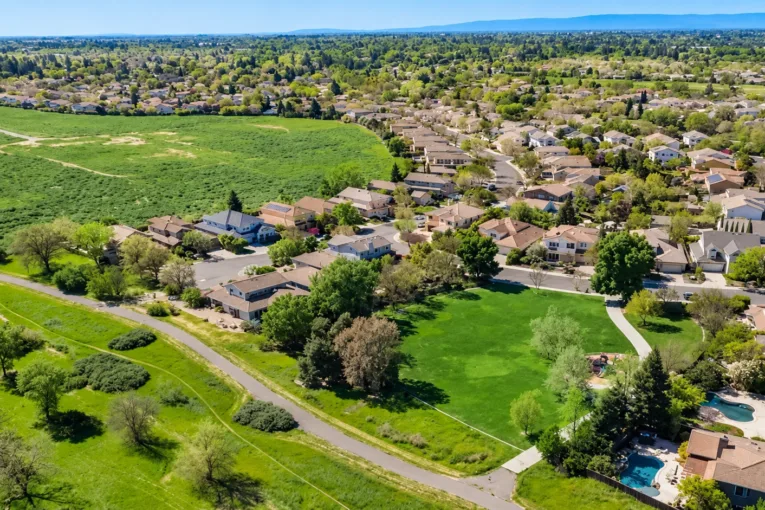
DAVIS, Calif. — As Davis voters prepare to decide the fate of the proposed Willowgrove development through Measure W, the debate raises a critical question: Can Davis continue rejecting peripheral growth without identifying a realistic alternative for accommodating future housing needs?
Davis has sought to preserve agricultural land and limit outward expansion, requiring voter approval for certain changes involving agricultural and open-space properties. THe policy has given residents considerable control over the city’s physical growth, but it has also created a recurring conflict over where additional housing should be built.
The proposed Willowgrove development would add 1,250 homes, including at least 250 deed-restricted affordable units, on approximately 232 acres north of Covell Boulevard adjacent to Wildhorse. The project also includes a $6.8 million affordable housing contribution, parks, bicycle infrastructure and traffic improvements.
Supporters point to the project’s housing production and affordability commitments, while critics raise concerns about farmland conversion, traffic and the cumulative effects of continued expansion.
But the larger question is what happens if projects such as Willowgrove are rejected without an alternative strategy capable of accommodating the city’s housing needs.
According to estimates presented during the city’s Oct. 14 General Plan workshop, Davis needs to plan for at least 7,300 additional housing units through 2050. That figure includes the city’s current Regional Housing Needs Allocation of 2,075 units for the 2021-2029 housing cycle and projected needs during subsequent cycles.
The current allocation is a state-mandated housing planning requirement, while the longer-term figure represents an estimate of future housing needs that will be refined as subsequent allocations are established.
The city’s General Plan update also identifies potential capacity for approximately 21,000 additional housing units across its planning area, including about 3,000 within existing city limits and 18,000 in surrounding areas.
Identifying potential housing sites does not guarantee construction, as financial, infrastructure and political obstacles can delay or prevent projects, as the Willowgrove debate illustrates.
While there have been few public opponents of the project, one of the arguments put forward is that the reasons to reject the project outweighed the reasons to approve it.
That leaves the question — if not this project, where does Davis grow to satisfy growing state insistence on the development of housing?
The responses so far fail to identify an alternative housing strategy.
Some critics dispute the state’s housing requirements and question whether Davis needs additional housing at all, while others oppose peripheral expansion without identifying where future development should occur.
These positions reflect different approaches to the city’s growth debate: one rejects the premise that more housing is necessary, while the other leaves unresolved how Davis would accommodate additional housing without expanding outward.
The divide is also evident in a letter to the editor of The Davis Enterprise by Blake McDonald, who questioned the need for additional peripheral development and criticized the cumulative impact of previous housing projects.
“Would you rather see a beautiful green field, full of birds and animals, or a bunch of ugly houses and noisy polluting cars?” McDonald wrote.
He also questioned whether residents wanted 3,000 additional cars on Covell Boulevard and 5,000 more people shopping at Nugget, although the letter did not establish those figures as findings from a traffic or population study.
McDonald argued that the number of homes currently offered for sale demonstrated that Davis did not need a development of Willowgrove’s size.
“Right now. there are 60 houses for sale in Davis, there are always 60 houses for sale in Davis,” he wrote.
But 60 homes on the market in a city the size of Davis represents a relatively limited inventory, not evidence of a housing surplus. Moreover, California’s housing requirements are based on projected regional housing needs, including population and household growth, rather than the number of homes listed for sale at any given moment. The availability of 60 homes does not negate the city’s obligation to plan for thousands of additional units over the coming decades.
McDonald also cited earlier developments as evidence that continued expansion has failed to settle the debate over growth.
“Do you remember Mace Ranch, Wildhorse, Lake Alhambra, the Cannery?” he asked. “Each, in its time, was ‘the answer’ to all of Davis’ problems and ‘the last one.’ When will this sprawl stop?”
His argument raises a question about the long-term direction of the city. Even if Davis rejects Willowgrove, future housing proposals will confront many of the same concerns involving farmland, traffic, infrastructure and neighborhood impacts.
Those concerns are not unique to Willowgrove, and rejecting one development does not necessarily mean opposing all housing growth.
Infill development has long been presented as an alternative to peripheral expansion, allowing Davis to accommodate additional housing without converting surrounding agricultural land.
But the city has already warned that infill alone will not provide sufficient capacity to meet its projected housing needs. As part of the General Plan update, planners identified potential capacity for approximately 3,000 additional homes within existing city limits, compared with a projected need for at least 7,300 homes through 2050.
Even that infill capacity does not guarantee construction, as redevelopment costs, infrastructure requirements and market conditions can prevent designated sites from being developed.
The question facing Davis is therefore not simply whether infill should be prioritized, but how the city intends to accommodate the housing needs that cannot realistically be met within its existing boundaries.
The city’s draft General Plan identifies potential capacity for approximately 3,000 homes within existing city limits, compared with the estimated need for at least 7,300 additional homes through 2050.
Infill development also faces infrastructure, financing and redevelopment challenges that can limit construction, even where higher densities are permitted. These constraints further limit how much of Davis’ projected housing need can realistically be accommodated within existing city boundaries.
The city’s ongoing General Plan update provides an opportunity to examine those questions more comprehensively.
Rather than evaluating peripheral development proposals individually, the planning process can consider the relationship between future population growth, housing demand, transportation, infrastructure, agricultural preservation and the availability of developable land.
It can also evaluate the consequences of different growth scenarios, including a strategy relying primarily on infill and one allowing limited peripheral expansion.
Willowgrove has become the immediate focus of that debate, but the same questions apply to other potential development sites, including Village Farms and properties that may be considered as part of the General Plan update.
Opponents of any particular project can argue that its environmental, fiscal or transportation impacts outweigh its benefits.
A broader policy of rejecting peripheral development, however, raises a different issue: whether the city has identified enough feasible alternatives to accommodate housing demand without continued outward expansion.
If Davis voters reject Willowgrove, the city’s existing housing needs and planning obligations will remain. If they approve it, questions about future development, agricultural preservation and the appropriate limits of growth will also remain.
The decision therefore represents one part of a larger debate about how Davis intends to reconcile its growth restrictions with housing affordability, state requirements and the community’s future.
To comment please go to one of these social media platforms:
Facebook: https://www.facebook.com/DavisVanguard
LinkedIn: https://www.linkedin.com/company/peoples-vanguard-of-davis-inc/
Instagram: https://www.instagram.com/davisvanguard/
X: https://x.com/davisvanguard
Bluesky: https://bsky.app/profile/vanguardnewsgroup.bsky.social
Subscribe to the Vanguard News letters. To make a tax-deductible donation, please visit davisvanguard.org/donate or give directly through ActBlue. Your support will ensure that the vital work of the Vanguard continues.
