
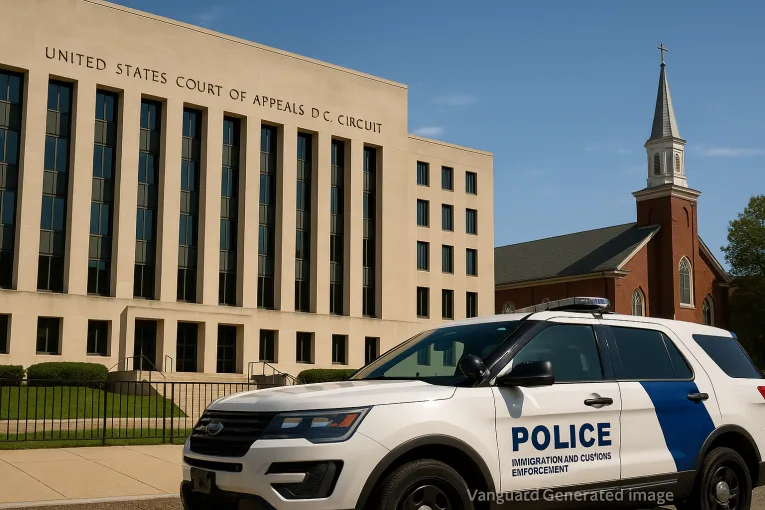
WASHINGTON, D.C. — Three organizations representing prosecutors, law enforcement professionals and policy researchers are urging a federal appeals court to uphold restrictions on warrantless immigration arrests in Washington, D.C., arguing that federal enforcement practices violate constitutional protections, encourage racial profiling and divert resources from investigations of serious crimes.
In an amicus brief filed Oct. 16, Fair and Just Prosecution (FJP), the Cato Institute and the Law Enforcement Action Partnership (LEAP) asked the U.S. Court of Appeals for the D.C. Circuit to affirm a preliminary injunction in Escobar Molina v. U.S. Department of Homeland Security.
The organizations argue that federal immigration agents have conducted arrests without establishing the individualized probable cause required under federal law and have relied on race, ethnicity and physical appearance in determining whom to stop.
The brief maintains that the challenged practices violate both the Fourth Amendment’s protections against unreasonable searches and seizures and the Fifth Amendment’s guarantee of due process and equal protection under federal law.
Under federal immigration law, officers may conduct certain warrantless arrests when they have reason to believe a person is unlawfully present and likely to escape before an administrative warrant can be obtained.
The organizations argue that immigration authorities have failed to make those required individualized determinations.
The brief specifically challenges a January 2026 memorandum issued by then-acting ICE Director Todd Lyons concerning warrantless civil immigration arrests.
According to the filing, the district court determined that the memorandum failed to comply fully with the preliminary injunction because it did not adequately require officers to consider whether individuals could be located later or whether their community ties reduced the likelihood of escape.
The organizations contend that this approach permits immigration agents to make arrests without adequately establishing either unlawful immigration status or the likelihood that a person will evade authorities.
The brief describes the circumstances surrounding plaintiff José Escobar Molina’s arrest, alleging that federal agents did not know his name, request identification or examine his documents before determining that he was unlawfully present.
It also describes another plaintiff who was allegedly arrested without an individualized assessment of immigration status or flight risk.
The organizations argue that these incidents demonstrate why judicial restrictions on warrantless arrests remain necessary.
Beyond the Fourth Amendment, the brief raises concerns that immigration agents have relied on race and ethnicity when conducting enforcement operations.
The organizations contend that using perceived ethnicity as a substitute for individualized evidence violates the Fifth Amendment’s equal protection principles.
The filing cites federal court decisions establishing that constitutional protections extend to noncitizens and that immigration enforcement cannot disregard restrictions on discriminatory government conduct.
The brief also points to reporting by ProPublica, which documented more than 500 cases involving U.S. citizens detained by federal immigration agents during the current administration.
The organizations cite those findings as evidence of the risks associated with immigration stops and arrests conducted without adequate verification of a person’s legal status.
The filing further argues that immigration enforcement priorities have diverted substantial personnel and resources away from traditional criminal investigations.
According to a September 2025 analysis by Cato Institute researcher David J. Bier, 42,153 federal, state and local personnel assisted immigration enforcement operations during a period in August 2025, including 28,390 personnel from federal law enforcement agencies.
The analysis identified personnel drawn from agencies including the FBI, Drug Enforcement Administration, Bureau of Alcohol, Tobacco, Firearms and Explosives, U.S. Marshals Service and Homeland Security Investigations.
Cato reported that the reassignment of personnel had reduced the resources available for investigations involving human trafficking, child exploitation, cybercrime, terrorism and other serious offenses.
The amicus brief incorporates those findings in arguing that prioritizing civil immigration arrests over criminal investigations can undermine public safety.
The organizations also contend that aggressive immigration enforcement damages relationships between law enforcement agencies and the communities they serve.
They argue that residents who fear immigration enforcement may become less willing to report crimes, cooperate with investigators or seek assistance from authorities.
The brief maintains that this erosion of public confidence can interfere with criminal investigations and make communities less safe.
The organizations further argue that the preliminary injunction reinforces existing constitutional and statutory requirements rather than preventing immigration authorities from carrying out lawful enforcement activities.
The Immigrant Legal Resource Center similarly explains that administrative immigration warrants differ from judicial warrants and generally do not authorize immigration agents to enter private homes without consent or another recognized legal exception.
Although the lawsuit concerns warrantless arrests rather than solely residential searches, both issues involve constitutional restrictions on immigration enforcement authority.
The organizations are asking the D.C. Circuit to affirm the district court’s preliminary injunction, maintaining that federal immigration authorities must comply with individualized arrest requirements and constitutional protections against discriminatory enforcement.
They argue that preserving those safeguards is necessary to protect individual rights, maintain public confidence in law enforcement and prevent immigration enforcement priorities from undermining investigations of serious crimes.
To comment please go to one of these social media platforms:
Facebook: https://www.facebook.com/DavisVanguard
LinkedIn: https://www.linkedin.com/company/peoples-vanguard-of-davis-inc/
Instagram: https://www.instagram.com/davisvanguard/
X: https://x.com/davisvanguard
Bluesky: https://bsky.app/profile/vanguardnewsgroup.bsky.social
Subscribe to the Vanguard News letters. To make a tax-deductible donation, please visit davisvanguard.org/donate or give directly through ActBlue. Your support will ensure that the vital work of the Vanguard continues.
