

SAN QUENTIN, Calif. — For San Quentin Rehabilitation Center Warden Chance Andes, filmmaking is more than an opportunity for incarcerated people to express themselves. It is part of a fundamental rethinking of what prisons can accomplish, how rehabilitation contributes to public safety and why the ability to tell one’s own story matters for people whose lives have often been defined by their convictions.
Speaking Thursday at the third annual San Quentin Film Festival, Andes reflected on his more than two decades in corrections and the changes he has witnessed since becoming warden in January 2024.
He acknowledged that when he began his career as a correctional officer in March 2003, he could hardly have imagined presiding over a prison that hosts an annual film festival featuring work by incarcerated and formerly incarcerated filmmakers.
“I definitely didn’t think we’d be at a film festival down the road,” Andes said.
The transformation, he explained, represents a change in how correctional institutions approach rehabilitation, opportunity and public safety.
“I am still a peace officer,” Andes told the audience. “People forget, people think I’ve totally sold out and that’s not it at all. This is public safety. This is what we do. Giving hope is safety and filmmaking is such a big part of that.”
His remarks established a central theme of the festival, which brought together incarcerated filmmakers, correctional officials, film industry professionals and community members to screen six short-film finalists addressing incarceration, family separation, suicide, immigration, rehabilitation and the challenges of returning to society.
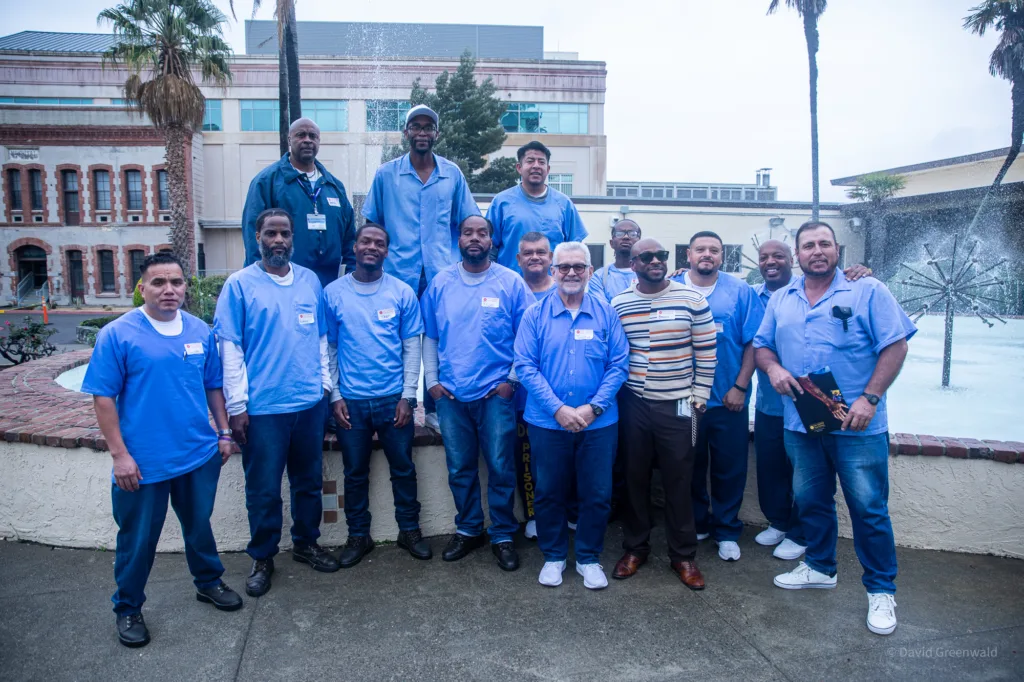
For Andes, the films demonstrate both the creativity of incarcerated people and the possibilities that emerge when prisons provide opportunities beyond traditional institutional jobs.
“What’s truly impressed me with the storytelling is the resources that you do it with,” he said, describing filmmakers who work without elaborate sets, large budgets or professional casts.
“You guys do it in our small community and you guys make such inspiring films and you’re able to tell these great stories,” he added.
Andes also challenged the assumption that filmmaking inside prison is merely a recreational activity rather than a pathway toward professional development.
“This is also a transferable skill set to the community,” he said. “I don’t think people really believe that and we’ve seen it firsthand.”
The festival, held Oct. 22 at San Quentin, featured three documentary shorts and three narrative shorts selected by an industry jury from submissions open exclusively to currently and formerly incarcerated filmmakers.
The event also provided an opportunity for correctional officials to describe the broader transformation underway at San Quentin, where education, creative expression and vocational training have become increasingly prominent components of the institution’s mission.
Sircoya Williams, acting associate director for Region 2 of the California Department of Corrections and Rehabilitation, described returning to a facility where she previously worked during a period when its operations were considerably different.
Williams recalled a San Quentin dominated by controlled movement, frequent alarms and persistent concerns about violence.
“Most of the movement was controlled. The alarms were constant. Violence was a real concern. Safety was a constant priority,” Williams said.
She said those experiences made the changes at San Quentin particularly meaningful.
“The transformation of San Quentin reminds us that an institution’s history does not have to dictate its future,” Williams said.
She argued that institutional security and rehabilitation should not be viewed as competing objectives.
“Progress requires vision. It requires leadership. It requires people who are willing to challenge traditional ways of thinking and recognize that we can maintain safety and security while also creating opportunities for people to learn, take accountability, grow and prepare for a different future.”
Williams identified filmmaking as particularly valuable because it allows people to communicate experiences that audiences might otherwise never encounter.
“Film has a unique ability to bring people together,” she said. “It allows us to tell stories, share experiences, challenge assumptions, and see the world from perspectives that may be different from our own.”
She added that the festival creates opportunities for audiences to look beyond the labels frequently attached to incarcerated people.
“Your voices and your creativity matter,” Williams told the filmmakers.
The festival’s growth reflects an expanding effort to connect filmmakers working inside correctional institutions with the broader film industry.
Festival co-founder and artistic director Cori Thomas described the challenges of organizing a major cultural event inside a prison, where security requirements and institutional operations complicate nearly every aspect of production.
Thomas, who previously worked at the Tribeca Film Festival for 17 years, said organizing a film festival is difficult under ordinary circumstances and considerably more complicated inside a correctional facility.
Rain forced organizers to relocate Thursday’s activities to the prison chapel, requiring incarcerated volunteers and staff to make last-minute adjustments.
Thomas credited incarcerated organizers, including Harold Meeks and Kevin Sawyer, with coordinating logistics, organizing volunteers and managing festival responsibilities.
The work involved food preparation, cleanup, guest registration and numerous other tasks necessary to operate the event.
Thomas also recalled that when she first proposed the festival, she described it as an annual event but was asked to remove that designation.
The possibility of continuing the festival became clearer during its inaugural year when then-CDCR Secretary Ralph Diaz’s successor, Jeff Macomber’s predecessor Ron Broomfield, expressed support for returning the following year.
Now in its third year, the festival has expanded beyond San Quentin.
Thomas said submissions have arrived from approximately 22 prisons, including an international entry from Panama.
The festival has also developed an additional jury at the Central California Women’s Facility in Chowchilla.
Thomas announced plans to establish another jury at Mule Creek State Prison next year, bringing incarcerated residents and custody staff together to watch films, deliberate and select winners.
The proposal reflects her belief that shared creative experiences can change relationships within correctional institutions.
“The whole idea was bring the outside in, bring the industry in to meet the filmmakers inside because that was the only way to do it,” Thomas said.
She envisioned correctional employees and incarcerated people working together, watching the same films and participating in the same decision-making process.
For Andes, San Quentin’s growing filmmaking program is part of a broader institutional transformation that includes expanded higher education opportunities and new facilities.
He pointed to the development of a new building, the establishment of additional educational programs and the presence of two four-year colleges as evidence of the institution’s changing direction.
“We have a long way to go,” Andes acknowledged.
He also described receiving a letter from an incarcerated person who had recently appeared before the parole board and reflected on the changes he had witnessed during the previous three years.
The letter, Andes said, reinforced his belief that institutional promises must be matched by tangible opportunities.
While acknowledging opposition to San Quentin’s transformation, Andes encouraged formerly incarcerated filmmakers to demonstrate the value of rehabilitation through their lives after release.
The films screened Thursday provided examples of the personal experiences and systemic challenges that the filmmakers believe are too often missing from public discussions of incarceration.
One of the documentary finalists, Life Letter, explored suicidal thoughts and the possibility of finding hope during incarceration.
The film was developed by Michael Bell, an incarcerated man in Illinois, and Rachel McMillian, a professor at Indiana University Indianapolis.
McMillian said she has spent approximately a decade working with incarcerated people to incorporate their experiences into educational materials for kindergarten through 12th grade students.
She developed Life Letter specifically for high school audiences, hoping Bell’s experiences could help young people facing difficult circumstances.
The collaboration was unusual because McMillian and Bell have never met in person.
Instead, they developed the film through letters and telephone conversations over several years.

McMillian said establishing trust took considerable time, particularly because Bell initially hesitated to share his experiences.
Eventually, Bell recorded his story at Rebirth Sound Studio, a recording facility established by musician Common at Stateville Correctional Center in Illinois.
Because filming Bell directly was difficult, the collaborators chose animation to communicate his experiences.
McMillian worked with an animator while consulting Bell about how his story should be represented visually.
The resulting film uses an animated figure to explore the psychological isolation and suicidal thoughts that can accompany incarceration.
McMillian said Bell has been able to see the completed film only once.
She also hopes the film will introduce audiences to Bell as a person rather than simply someone serving a prison sentence.
McMillian said she is using the project to advocate for clemency on his behalf.
Another documentary, Somebody to Lean On, examined the Harmony Project, a prison choir program in Ohio that brings together incarcerated people and correctional staff through music.
Filmmakers Gabrielle and Ursula Burton described how the project emerged from their interest in an innovative choir program that appeared to change relationships within a correctional institution.

Gabrielle Burton said she first learned about the initiative in 2018, when she read about a musician working with a warden at a women’s prison.
The filmmakers ultimately documented the program’s expansion into a men’s correctional institution.
For the Burtons, the project was not simply about music but about how people can connect across institutional hierarchies.
Gabrielle Burton said the filmmakers deliberately avoided identifying participants through on-screen titles that would categorize them by their jobs or incarceration status.
The decision was intended to encourage viewers to encounter each person without immediately applying institutional labels.
“How do you define a human individual?” she asked.

Ursula Burton described the film’s central message more directly.
“Where you are doesn’t define who you are,” she said.
She explained that the choir creates opportunities for incarcerated people and correctional employees to participate in a shared activity, reducing some of the barriers ordinarily separating them.
The filmmakers said they wanted participants to speak for themselves rather than have their experiences interpreted by an outside narrator.
A longer version of the documentary is expected to air on public television in April 2027, during a month associated with reentry and second-chance initiatives.
Gabrielle Burton also said the filmmakers were discussing the possibility of using the documentary in correctional training to demonstrate how institutional culture can change.

The third documentary finalist, Las Golondrinas de La Pulga, directed by Jose Fernando Flores-Jimenez, explored the meaning of a flea market that had been central to the filmmaker’s childhood.
Flores-Jimenez said he wanted to document a place that represented community, cultural identity and the possibility of losing something deeply familiar.
He described the film as particularly relevant to immigrant communities facing uncertainty about their futures.
The documentary uses images of food, toys, music and everyday activities to establish the significance of the market before exploring the possibility of its disappearance.
Flores-Jimenez said the project grew from his realization that places often acquire greater meaning when people recognize they could lose them.
He described the film as addressing more than the disappearance of a physical location.
It also examines fears about losing family, cultural traditions and community connections.
The narrative finalists addressed related questions about incarceration and its consequences through fictional storytelling.

Fireline, directed by Robin Takao D’Oench, examined the experiences of incarcerated firefighters and the complicated relationship between rehabilitation, public service and prison labor.
D’Oench said the project was partly inspired by his grandfather, who was incarcerated in a Japanese American internment camp during World War II before volunteering for the 442nd Regimental Combat Team.
That family history prompted him to consider how incarcerated people can demonstrate service and courage despite restrictions imposed by the government.
D’Oench initially approached California’s incarcerated firefighting program as an example of labor exploitation.
However, after speaking with incarcerated firefighters and visiting a fire camp, he said he encountered a more complicated reality.
Participants described opportunities to work outdoors, develop physical fitness and experience pride in protecting communities from wildfires.
D’Oench said the film seeks to communicate the dignity people can experience through meaningful work while recognizing the difficult questions surrounding incarcerated labor.
He also described how participants connected their work to their families and their desire to contribute to society.

Many Thousands Lost, directed by Jehan Tyson Patterson, focused on the effects of incarceration on families, particularly children separated from incarcerated parents.
Patterson said the film was inspired by people he knew personally, including his uncle Derek, who had experienced incarceration and died in 2020.
He also cited the execution of Marcellus Williams in Missouri as an influence on the film.
Patterson said he wanted audiences to understand that people affected by incarceration and the criminal legal system are not simply statistics.
“These are human beings that have people that love them and cherish them,” he said.
The film juxtaposes the stark environment of a prison visiting room with an imagined landscape where a father and daughter can experience the physical closeness denied to them by incarceration.
Patterson said the imagined setting was inspired by childhood memories of visiting Chicago parks with his uncle.
Through the perspective of a child, he wanted to create a world in which an incarcerated parent could remain a source of comfort and possibility.

The final narrative short, Run It Back, directed by Abby Pierce and co-created with Tiffany “Tiny” Cruz, examined the obstacles people face after leaving incarceration.
Pierce and Cruz have spent seven years teaching improvisational theater to young people held in juvenile detention facilities at Rikers Island in New York City.
Pierce said filmmaking emerged from the difficulty of bringing outside audiences into detention facilities or allowing incarcerated students to present their work publicly.
The filmmakers previously created So Boom, which screened at the San Quentin Film Festival last year.
Pierce said the idea for Run It Back developed immediately afterward.
The new film uses humor to explore the complicated and sometimes contradictory rules imposed on people returning to their communities.
Pierce said Cruz drew upon her own experiences, including being returned to custody for violating a curfew.
The filmmakers wanted audiences to understand the frustrations of reentry while first developing an emotional connection to the characters.
Pierce said their objective was to portray people as fully human before introducing the institutional obstacles they face.
The discussion following the screenings was moderated by journalist Nikole Hannah-Jones, who described her family’s experiences with incarceration and the importance of allowing people directly affected by the criminal legal system to tell their own stories.
Hannah-Jones said the films offered different perspectives that collectively challenged assumptions about incarcerated people.
She also questioned how correctional systems can simultaneously impose strict controls on incarcerated people while relying on their labor and service in circumstances such as fighting wildfires.
Throughout the discussion, filmmakers described creative expression as a means of communicating experiences that are often difficult to convey through conventional reporting or institutional accounts.
Their work addressed the psychological effects of incarceration, family relationships, the consequences of punishment and the challenges people encounter when attempting to rebuild their lives.
The festival also illustrated how filmmaking can create professional and educational opportunities for people who have limited access to conventional creative industries.
For incarcerated filmmakers, producing a film can require overcoming restrictions on equipment, communication, movement and collaboration.
For those who have returned to their communities, filmmaking can provide a means of continuing to tell stories about experiences that remain largely absent from mainstream entertainment.
Thomas said the festival was founded in part to overcome those barriers by bringing industry professionals directly into the institution.
Andes expressed hope that the model would continue spreading to other correctional facilities.
“We are a flagship,” he said. “We want people to join us. We want this to spread throughout.”
Williams likewise encouraged filmmakers to continue sharing their experiences, arguing that their work could influence people who might otherwise never consider the perspectives of those living inside prisons.
“Your story may challenge someone’s assumptions and may inspire someone to look at an issue differently,” she said. “It may give someone hope or simply encourage someone else to take a step forward.”
For Andes, the importance of that work ultimately returns to his understanding of public safety.
Rather than treating incarceration solely as a period of confinement, he described an institution attempting to provide education, creative opportunities and skills that people can carry into their communities.
The festival’s third year brought that philosophy into public view, with incarcerated and formerly incarcerated filmmakers presenting stories about their experiences, their families and the institutions that have shaped their lives.
As Andes told the audience, “Giving hope is safety and filmmaking is such a big part of that.”


To comment please go to one of these social media platforms:
Facebook: https://www.facebook.com/DavisVanguard
LinkedIn: https://www.linkedin.com/company/peoples-vanguard-of-davis-inc/
Instagram: https://www.instagram.com/davisvanguard/
X: https://x.com/davisvanguard
Bluesky: https://bsky.app/profile/vanguardnewsgroup.bsky.social
Subscribe to the Vanguard News letters. To make a tax-deductible donation, please visit davisvanguard.org/donate or give directly through ActBlue. Your support will ensure that the vital work of the Vanguard continues.
