
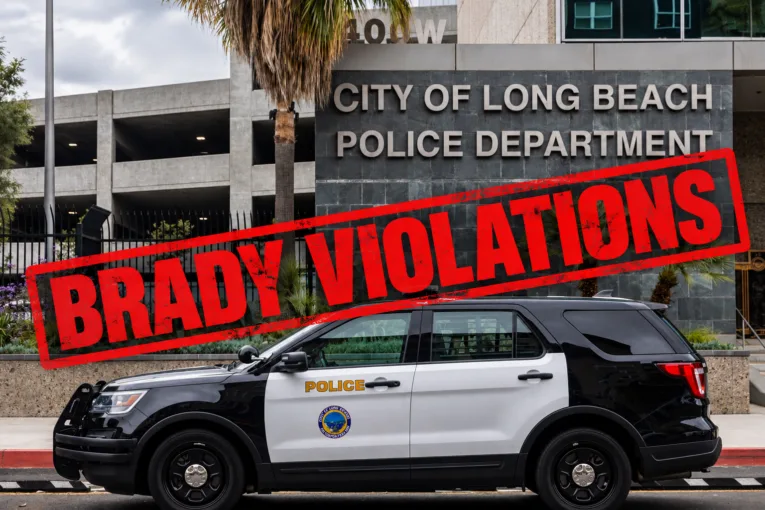
LONG BEACH, Calif. — A defense attorney is seeking dismissal of a criminal case in Los Angeles County Superior Court, alleging that the Long Beach Police Department concealed evidence of an officer’s criminal misconduct for years while also withholding information that could undermine the identification of a Black defendant.
In a 62-page motion filed Nov. 5, attorney Scott Sanders asks the court to dismiss the prosecution of Lonnie Jacobs with prejudice, arguing that the department’s conduct violated constitutional disclosure requirements and potentially California’s Racial Justice Act.
A 29-page supplement filed Nov. 10 broadens those allegations, citing a previously disclosed internal affairs investigation involving a Long Beach homicide detective and a prolific jailhouse informant.
The supplemental filing raises questions about whether misconduct involving informants was adequately investigated and disclosed to defendants in potentially hundreds of criminal cases.
Jacobs faces a felony charge of bringing a controlled substance into the Long Beach Jail under Penal Code Section 4573(a). He pleaded not guilty after the charge was filed in May 2025.
Sanders argues that the prosecution cannot proceed fairly because the department has repeatedly failed to disclose evidence that could assist defendants or undermine the credibility of law enforcement witnesses.
The original motion focuses heavily on former Long Beach police Officer Erik Suarez, whose criminal history was allegedly concealed from prosecutors and defendants despite longstanding disclosure obligations.
According to the motion, Suarez was arrested in Georgia in 2019 following a violent confrontation outside a Waffle House after a baseball game.
Sanders alleges that Suarez repeatedly punched another man, causing serious facial injuries, including fractures around his eye.
Suarez was subsequently indicted in 2021 and convicted of misdemeanor battery in 2022, according to the filing.
The defense contends that the Long Beach Police Department knew about the arrest but failed to notify the Los Angeles County District Attorney’s Office, despite an agreement requiring law enforcement agencies to report arrests and convictions involving officers who testify or may testify in criminal cases.
Sanders argues that the concealment continued even after Suarez’s conviction.
The motion also alleges that the department failed to make relevant misconduct records available through its public disclosure system.
Those allegations carry implications beyond Jacobs’ case because information about an officer’s criminal conduct can constitute impeachment evidence that prosecutors are required to disclose under Brady v. Maryland and related decisions.
The filing cites assurances made by then-Long Beach Police Chief Robert Luna in 2021 that the department was complying with its constitutional and statutory disclosure responsibilities.
Sanders argues that those assurances were inconsistent with the department’s handling of Suarez’s criminal history.
The attorney further alleges that Suarez and Officer Dylan Kelley omitted significant information from police reports documenting the investigation that led to Jacobs’ arrest.
According to the motion, an eyewitness initially identified another person as the individual who had displayed a firearm.
The defense also contends that the witness described physical characteristics inconsistent with Jacobs and made statements reflecting racial prejudice against Black people.
Sanders argues that body-worn camera footage revealed information missing from the officers’ written reports, including evidence that could undermine the identification.
The defense maintains that the omissions prevented Jacobs from fully challenging the evidence used to justify his arrest.
The motion asks the court to consider whether the alleged concealment of racially relevant evidence violated California’s Racial Justice Act, which prohibits convictions or sentences obtained through racial discrimination.
The allegations have not been established by a judicial finding in the materials reviewed.
The supplemental motion expands the case beyond Suarez, focusing on a 2016 internal affairs investigation involving former Long Beach homicide Detective Hugo Cortes.
According to Sanders, that investigation revealed serious deficiencies in the supervision, documentation and oversight of jailhouse informants used in law enforcement operations across Los Angeles County.
The supplement describes an informant identified as “Informant X,” who allegedly participated in approximately 200 operations involving incarcerated suspects.
These operations, commonly called Perkins operations, involve placing an informant or law enforcement agent in contact with a suspect in custody to obtain statements.
Sanders cites investigative records indicating that the informant received substantial payments and other benefits while working with multiple law enforcement agencies.
The filing alleges that those operations lacked centralized recordkeeping, consistent supervision and reliable documentation of compensation.
According to the supplement, Cortes helped arrange the removal of the informant’s electronic monitoring device, including during the Christmas holiday in 2015.
The informant subsequently became involved in an alleged physical confrontation at a movie theater while his monitor was removed.
Sanders alleges that Cortes made misleading statements about the circumstances surrounding the removal of the monitoring device.
The internal affairs investigation ultimately sustained multiple allegations against Cortes, including two findings of dishonesty, according to the filing.
Cortes retired in October 2016, before the investigation reached its final findings. The department subsequently recommended termination as the appropriate discipline.
The supplement states that the district attorney’s office was aware of concerns about Cortes and entered information about his alleged misconduct into its system for tracking potentially disclosable evidence.
However, Sanders questions whether the prosecution adequately investigated the broader informant operation or notified all defendants whose cases may have been affected.
The filing identifies a 2016 murder prosecution involving Jose Castaneda and Frank Cruz in which prosecutors provided notification about Cortes’ misconduct after the defendants had been convicted.
Sanders argues that the department’s investigation should have prompted a much broader review of cases involving Cortes and the informant.
The supplement cites an internal account estimating that the informant participated in approximately 100 operations during part of 2015, in addition to nearly 100 earlier operations.
It also describes financial arrangements under which informants could receive $1,000 for each defendant placed in a jail cell with them.
Sanders contends that the absence of reliable centralized records makes it difficult to determine how many prosecutions may have involved undisclosed evidence affecting an informant’s credibility.
The supplement also raises questions about the Los Angeles County District Attorney’s Office’s response to the 2016 investigation.
According to the filing, prosecutors had information about Cortes’ conduct and potential disclosure obligations, but the extent of any broader investigation remains unclear.
Sanders argues that the issues are directly relevant to whether Jacobs can receive a fair hearing on his motion to suppress evidence and, if necessary, a fair trial.
The defense asks the court to hold an evidentiary hearing at which law enforcement officials could be questioned about their handling of misconduct evidence and disclosure decisions.
The original motion was scheduled for consideration Nov. 12 in Department 20 of Los Angeles County Superior Court in Long Beach.
The supplemental filing acknowledges that the district attorney’s office intends to continue prosecuting Jacobs.
Neither filing establishes that the court has granted the requested dismissal or made findings sustaining the defense’s allegations.
Sanders maintains that the combined evidence warrants judicial examination of whether the prosecution can satisfy its constitutional disclosure obligations.
The supplemental motion concludes by asking the court to permit an evidentiary hearing into the allegations.
To comment please go to one of these social media platforms:
Facebook: https://www.facebook.com/DavisVanguard
LinkedIn: https://www.linkedin.com/company/peoples-vanguard-of-davis-inc/
Instagram: https://www.instagram.com/davisvanguard/
X: https://x.com/davisvanguard
Bluesky: https://bsky.app/profile/vanguardnewsgroup.bsky.social
Subscribe to the Vanguard News letters. To make a tax-deductible donation, please visit davisvanguard.org/donate or give directly through ActBlue. Your support will ensure that the vital work of the Vanguard continues.
