
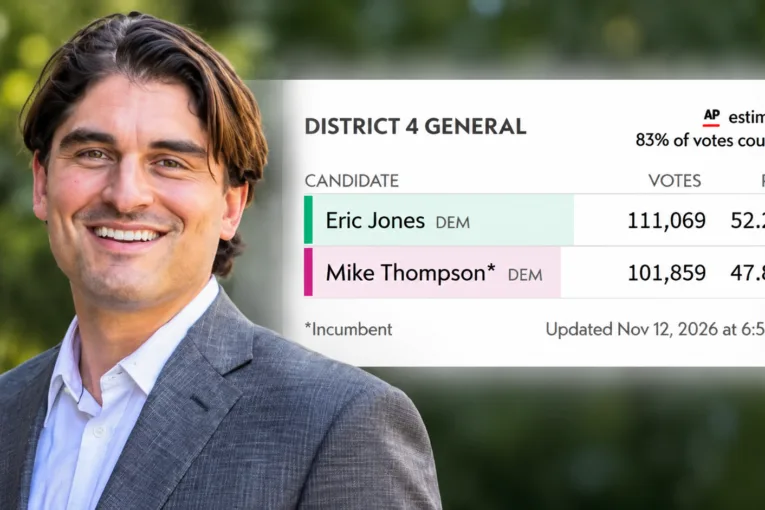
DAVIS, Calif. — Democratic congressional challenger Eric Jones has emerged as the apparent winner of California’s 4th Congressional District, with Decision Desk HQ projecting Thursday evening that the 35-year-old political newcomer has defeated longtime Rep. Mike Thompson in one of the most expensive and closely watched congressional contests in California.
The Associated Press has not yet called the race, and Jones’ campaign has stopped short of declaring victory, but the latest returns show Jones expanding his lead to more than 9,000 votes with approximately 83% of the expected ballots counted.
According to Associated Press election returns published by KQED, Jones had received 111,069 votes, or 52.2%, compared with 101,859 votes, or 47.8%, for Thompson as of Thursday evening.
The 9,210-vote margin represents a 4.4-percentage-point lead, with additional ballots still to be counted.
Decision Desk HQ projected Jones as the winner Thursday evening, marking a significant development in a contest that has remained unresolved since Election Day.
The projection is not an official election result, and county election officials must complete their ballot counts before the outcome is certified.
If the result holds, Jones will unseat a 14-term incumbent who has represented portions of Northern California in Congress since 1999 and has long been considered one of the region’s most established Democratic officeholders.
The outcome would also mark a major political breakthrough for Jones, a former venture capitalist who entered the race arguing that Democrats needed a new generation of leadership and a more aggressive approach to economic inequality, corporate influence and political reform.
Jones, who has two young children, built his campaign around the argument that Washington had become disconnected from the economic pressures facing working families.
In a Nov. 6 telephone interview with the Vanguard, Jones expressed confidence in the trajectory of the race while emphasizing that county election officials should be allowed to complete their work.
“As you know, we’re very deliberate in California when it comes to elections. So the registrars are doing their duties and taking their time and counting every ballot,” Jones said.
He said his campaign had anticipated that later-counted ballots would favor his candidacy because of the coalition he had assembled.
“And we always knew that given our coalition, where our coalition is young, it’s diverse, it’s working class. Honestly, it’s the room that you saw on election night and that coalition tends to vote late.”
Jones said the campaign had expected its weakest performance in the earliest returns and believed subsequent ballot counts would improve its position.
“So we knew that the early drop would be our worst, and we’ve seen more and more data points come in of everything improving from here,” he said. “And given that we’re already in a nice position that we’re feeling very confident.”
The subsequent returns have generally supported that assessment.
On election night, Jones held a relatively narrow lead over Thompson. By Nov. 7, the margin had grown to 4,365 votes, with Jones receiving 51.6% compared with Thompson’s 48.4%.
By Thursday evening, the lead had more than doubled to 9,210 votes.
The contest drew statewide attention because of its extraordinary spending, generational differences and the unusual circumstances of two Democrats competing in the general election under California’s top-two primary system.
According to KQED, Jones contributed approximately $14.8 million of his own money to the campaign, setting a California record for self-funding in a congressional race.
Thompson raised approximately $5.5 million, according to KQED, and benefited from support from prominent Democratic figures, including former House Speaker Nancy Pelosi and Gov. Gavin Newsom.
Jones rejected corporate political action committee contributions and criticized Thompson’s acceptance of money from corporate interests, making campaign finance a central issue in the contest.
Thompson, meanwhile, defended his record of constituent service and legislative accomplishments while portraying Jones as a wealthy political newcomer attempting to purchase a congressional seat.
The race also unfolded under newly redrawn congressional boundaries that significantly altered the district’s electorate.
The 4th District now includes portions of the Napa Valley, Yolo County, the Sacramento suburbs and communities farther north, bringing a substantial number of voters into a district previously represented by Thompson.
Jones sought support from progressive Democrats frustrated with party leadership while also appealing to independent and Republican voters dissatisfied with the political establishment.
The campaign featured disagreements over immigration enforcement, health care, the economy and the influence of money in politics.
Both candidates expressed support for Medicare for All, although they emphasized different approaches to health care policy.
Jones advocated expanding Medicare benefits to include dental, vision, hearing and in-home care, while Thompson pointed to his work on the Affordable Care Act and expanding access to telemedicine.
On immigration, Jones criticized both major political parties for failing to enact comprehensive reform.
“We haven’t had a political solution because both parties have weaponized immigration to their own benefit,” Jones told the Vanguard.
“We need comprehensive immigration reform. We are a country of immigrants. We are a country built on the American dream, and we are a country that’s compassionate.”
Jones also proposed changes to federal immigration enforcement, including requiring ICE agents to wear body cameras, prohibiting face coverings and moving the agency from the Department of Homeland Security to the Justice Department.
Thompson emphasized his opposition to the creation of the Department of Homeland Security in 2002 and his votes against additional funding for the agency.
Beyond individual policy differences, Jones framed the campaign as a challenge to the political and economic structures that he argued had contributed to declining opportunity for working Americans.
“We got to take on the corruption and do politics a different way, and we got to, once again, be a country where we fight for economic opportunity for every single person, and we give every single person a shot,” Jones told the Vanguard.
The challenger also credited the campaign’s volunteer organization for its work over the final weeks before Election Day.
“The overwhelming emotion I’m feeling today and this gratitude, I think it finally hit me today because in the final innings there, we just had hundreds of volunteers and supporters on the phones knocking on doors,” Jones said.
“It was really, really, really special. So it’s a big thank you to everyone who has been fighting with us for 14 months on the campaign.”
Despite the increasingly favorable returns, Jones emphasized during the interview that the campaign would respect the vote-counting process.
“We’ll, again, let the registrars and the counties do the good work that they do to make sure everything is done properly,” he said.
The campaign has not issued a formal declaration of victory following Decision Desk HQ’s projection.
Thompson has also not publicly conceded the contest.
To comment please go to one of these social media platforms:
Facebook: https://www.facebook.com/DavisVanguard
LinkedIn: https://www.linkedin.com/company/peoples-vanguard-of-davis-inc/
Instagram: https://www.instagram.com/davisvanguard/
X: https://x.com/davisvanguard
Bluesky: https://bsky.app/profile/vanguardnewsgroup.bsky.social
Subscribe to the Vanguard News letters. To make a tax-deductible donation, please visit davisvanguard.org/donate or give directly through ActBlue. Your support will ensure that the vital work of the Vanguard continues.
