
OAKLAND, Calif. — What would public safety look like if California invested more heavily in preventing harm, addressing mental health needs, expanding economic opportunities and supporting people returning from incarceration rather than relying so heavily on policing and punishment?
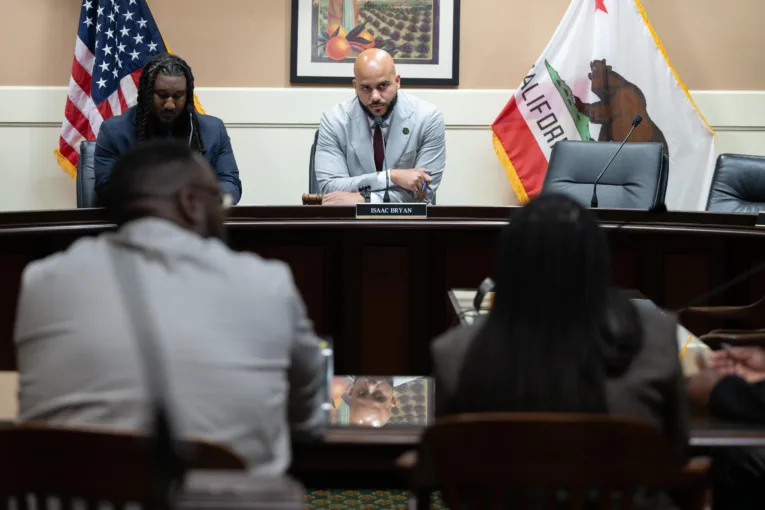
That question was at the center of a Nov. 12 legislative hearing in Oakland examining the disproportionate impact of the criminal legal system on boys and men of color and how California might develop policies that address the underlying conditions contributing to incarceration, violence and recidivism.
The hearing also comes at a potentially significant political moment for criminal justice reform. After several years of political backlash against reforms that gained momentum following the murder of George Floyd in 2020, advocates and some lawmakers see renewed opportunities to advance policies centered on prevention, rehabilitation and community investment following the November election.
But the challenges extend well beyond the criminal legal system itself, encompassing barriers to employment, higher education, housing, mental health services and exposure to environmental hazards.
The California Assembly Select Committee on the Status of Boys and Men of Color, chaired by Assemblymember Isaac Bryan, held its third and final hearing of the 2025-26 legislative session at the offices of Communities United for Restorative Youth Justice (CURYJ) in Oakland in partnership with the Alliance for Boys and Men of Color.
In separate interviews with the Vanguard, Bryan and David C. Turner III, a senior adviser to the alliance and an assistant professor of Black life and racial justice at UCLA, discussed how California could translate community-based approaches to public safety into substantive legislative changes.
“Not every problem that community is facing requires a law enforcement presence,” Bryan said. “The problem is we haven’t invested in alternative responses that are rooted in care and mental health support and other community needs that neighborhoods, especially black and brown neighborhoods are struggling with.”
Bryan pointed to Oakland’s Mobile Assistance Community Responders of Oakland, or MACRO, as an example of how communities can respond to certain emergencies without deploying armed law enforcement officers.
Operated by the Oakland Fire Department, the program deploys unarmed civilian teams that include community intervention specialists and emergency medical technicians to respond to situations that might otherwise generate a police response.
Bryan said California should be examining the experiences of cities such as Oakland and Los Angeles, identifying successful practices and expanding state investment in alternative crisis response programs.
“But the models that have been stood up, including ones in Oakland, are showing success and they deserve greater funding and the state should be learning best practices,” Bryan said.
The Oakland hearing brought together community organizers, researchers and advocates from across California to examine three interconnected areas: interactions with law enforcement, pathways following incarceration and community-based approaches to healing.
Turner said the hearing was intended to explore alternatives to conventional approaches to public safety while giving legislators an opportunity to hear directly from people affected by existing policies.
The Alliance for Boys and Men of Color, Turner said, is a grassroots coalition of more than 200 organizations working to advance racial and gender justice through statewide policy development, community organizing, training and coalition building.
The first panel examined the experiences of Black and Latino boys and men who come into contact with law enforcement, including how those encounters can escalate and how existing enforcement practices can contribute to racial disparities.
Turner pointed to organizing efforts by Pillars of the Community in San Diego, where advocates have raised concerns about how resisting arrest charges are disproportionately applied to men of color.
The second panel focused on what happens after people leave incarceration, including barriers to employment, voting and economic advancement.
Turner said one of the challenges is that even when formerly incarcerated individuals obtain employment, they often find themselves in positions that offer little opportunity for career advancement or long-term economic stability.
“I think the expectation is that post-incarceration, people would seek a job, but the job has no flexibility for career advancement, has no flexibility to become supervisors or anything else that would allow somebody to have a thriving life here in California,” Turner said.
The discussion raises questions about whether California’s existing approach to reentry provides formerly incarcerated people with the resources necessary to rebuild their lives and avoid returning to incarceration.
Bryan argued that disparities within the criminal legal system cannot be separated from broader economic and educational inequalities.
“The problems in the criminal legal system are exacerbated by the problems in our employment and economic opportunities,” Bryan said. “Economic mobility for boys and men of color is stifled and has been going backwards.”
He said criminal convictions continue to create barriers to employment, professional certifications and higher education long after individuals have completed their sentences.
Those barriers can undermine the very objectives of rehabilitation and successful reentry that the criminal legal system is supposed to achieve.
“And then if you make a mistake and you serve your time incarcerated, you should come home with a clean slate and the ability to rebuild your life,” Bryan said. “And that means gaining an economic footing, even if you’ve never had one before.”
Bryan rejected the frequently expressed notion that the criminal legal system is simply broken, arguing instead that many of the barriers confronting formerly incarcerated people are the product of deliberate policy decisions.
“It’s why when people often say the system is broken, I push back and I say very clearly that the system was designed this way and we have an opportunity to design it differently and a responsibility to do so,” Bryan said.
The third panel examined community-based approaches to healing, mental health and violence prevention, including how communities can address intimate partner violence and other forms of interpersonal harm.
Turner said the discussion focused on developing resources that can support survivors of violence while also addressing the behavior of individuals responsible for causing harm.
He highlighted testimony from Uriel Serrano of the USC Equity Research Institute, who examined the role community organizations played during the COVID-19 pandemic and the racial justice protests of 2020.
Those organizations, Turner said, provided young people with opportunities to discuss mental health, racial violence and challenges within their households at a time when many traditional institutions were inaccessible.
They also provided material resources, including food, laptops and internet access, illustrating how community organizations can address both immediate needs and longer-term challenges.
Turner argued that policymakers should view such organizations not simply as service providers but as institutions capable of developing community-based responses to violence, trauma and other public safety concerns.
The select committee’s work has sought to connect those experiences directly to the legislative process.
Two of the committee’s three hearings this year were held outside Sacramento. The first was held at the Youth Justice Coalition in Los Angeles, the second in Sacramento and the third at CURYJ in Oakland.
Turner said holding hearings within communities affected by state policies has helped ensure that legislative discussions are informed by the experiences of people who interact with the criminal legal system.
One of the most tangible examples of that approach emerged earlier this year when lawmakers visited Los Padrinos Juvenile Hall in Los Angeles.
During conversations with incarcerated young people, lawmakers learned that youth were being prohibited from physically embracing their loved ones during visits.
Those conversations led to AB 1646, known as the HUG Act, legislation establishing rights to physical contact during visitation for incarcerated youth in California.
Bryan said the legislation illustrates how direct engagement with incarcerated individuals can identify problems that might otherwise escape the attention of policymakers.
Asked why something as seemingly simple as allowing a young person to hug a parent was important to rehabilitation, Bryan said physical contact helps reinforce the humanity of young people at a critical stage in their development.
“Especially for our young boys, that kind of physical contact and re-grounding in their humanity is essential for their rehabilitation and for them becoming compassionate, civically participatory young men, the kind of men that you want to live next to,” Bryan said.
He argued that depriving young people of something as fundamental as a mother’s hug contributes to their dehumanization rather than preparing them to return successfully to their communities.
“I don’t believe that’s what systems of rehabilitation should look like,” Bryan said. “And thankfully across bipartisan lines, California doesn’t believe that either.”
The legislation received bipartisan support, passing the state Senate on a 32-2 vote before the Assembly concurred in Senate amendments on a 62-7 vote. Gov. Gavin Newsom subsequently signed the bill into law.
The HUG Act represents one legislative accomplishment for a select committee whose broader mandate encompasses issues ranging from educational attainment and economic mobility to incarceration and community health.
During the Nov. 12 hearing, lawmakers also heard testimony about professional licensing restrictions, youth apprenticeships, job training programs and opportunities to expand civic participation among formerly incarcerated people.
Assemblymember Sade Elhawary raised questions about whether professional licensing boards could reduce barriers preventing formerly incarcerated people from entering certain professions.
Assemblymember Mike Fong emphasized the importance of job training, employment opportunities and addressing the mental health needs of boys and men of color.
Looking ahead to 2027, Bryan identified reducing the collateral consequences of criminal convictions, expanding economic and educational opportunities and increasing funding for alternative crisis response programs as areas where he anticipates continued legislative work.
He also pointed to the need to address environmental and public health disparities as part of a comprehensive effort to improve outcomes for boys and men of color.
Bryan cited legislation addressing oil production in Los Angeles and AB 1661, which he said allocates $5 million in fees collected from oil operators toward direct financial assistance for families with children experiencing respiratory illnesses.
He noted that Black children disproportionately experience asthma, particularly when they live near environmental hazards.
“And so thinking comprehensively about the ways that society is letting down boys and men of color, the entire range of those ways are policy areas that we are interested in mitigating and providing substantive change in,” Bryan said.
The question entering 2027 is whether the political environment will provide greater opportunities to advance those policies.
Bryan acknowledged the changing political climate following the November election but noted California has continued to pursue certain criminal justice reforms even during the recent national shift toward more punitive policies.
He pointed to bipartisan legislation increasing compensation for incarcerated firefighters as an example of California’s ability to continue advancing reforms under the Trump administration.
“I think the movement to recognize how intersectional these issues are and that when boys and men of color are thriving in California and in this country, this country is thriving, that’s something that California has been on the cutting edge of,” Bryan said.
Turner similarly expressed optimism about the opportunities created by the election but cautioned that communities continue to confront immediate challenges, including federal immigration enforcement, anticipated cuts to public education and ongoing efforts to address misconduct within law enforcement agencies.
He pointed to continuing organizing efforts surrounding deputy gangs within the Los Angeles County Sheriff’s Department and campaigns to close jail facilities.
For Turner, federal immigration enforcement also illustrates how different forms of policing and criminalization intersect, affecting communities regardless of the immigration status of individual residents.
He argued that immigration enforcement practices cannot be separated from broader concerns about racial disparities in policing and the criminal legal system, particularly when prior contact with that system can expose individuals to additional enforcement actions.
Turner said the alliance’s priorities heading into 2027 include maintaining a legislative forum where community organizations can bring these interconnected issues directly to policymakers.
Assemblymember Ash Kalra, speaking at the Oakland hearing, emphasized that the work of the committee must ultimately translate into legislation and budget proposals when lawmakers return to Sacramento in January.
The committee’s hearings, Turner said, have demonstrated the importance of allowing people directly affected by state policies to participate in shaping them, rather than limiting those discussions to policymakers and institutional representatives.
Turner cautioned against narrowing the alliance’s agenda to any single legislative issue, arguing that employment discrimination, educational disparities, immigration enforcement, incarceration and community violence frequently affect the same individuals and families.
“These issues are interconnected, and that’s why we don’t have single issue organizations because we don’t live single issue lives,” Turner said.
To comment please go to one of these social media platforms:
Facebook: https://www.facebook.com/DavisVanguard
LinkedIn: https://www.linkedin.com/company/peoples-vanguard-of-davis-inc/
Instagram: https://www.instagram.com/davisvanguard/
X: https://x.com/davisvanguard
Bluesky: https://bsky.app/profile/vanguardnewsgroup.bsky.social
Subscribe to the Vanguard News letters. To make a tax-deductible donation, please visit davisvanguard.org/donate or give directly through ActBlue. Your support will ensure that the vital work of the Vanguard continues.
