
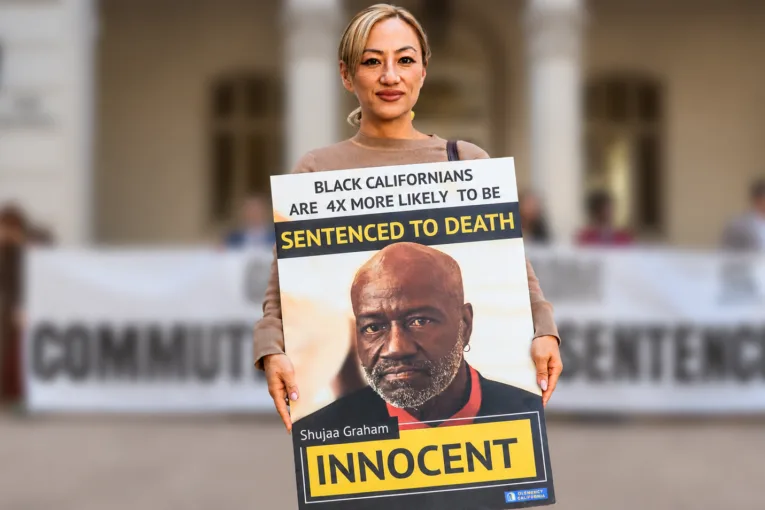
SACRAMENTO, Calif. — For Natasha Minsker, who has spent nearly two decades fighting to end California’s death penalty, Gov. Gavin Newsom’s announcement Thursday that he intends to commute all 548 death sentences in the state was an emotional moment.
“I feel overwhelmed,” Minsker, director of the California Anti-Death Penalty Coalition, told the Vanguard in an interview shortly after the announcement.
Minsker was among a broad coalition of public defenders, civil rights organizations, faith leaders, former prosecutors and families of murder victims who welcomed the governor’s decision, even as significant legal steps remain before all the commutations can take effect.
The governor announced that he would replace death sentences with life imprisonment without the possibility of parole, moving beyond the execution moratorium he imposed in 2019.
The decision would represent the largest mass commutation of death sentences in modern American history if fully implemented, but California’s Constitution requires Supreme Court concurrence for people with multiple felony convictions.
Minsker said advocates had heard rumors that Newsom might act before leaving office, but they had received no confirmation.
“We had heard rumors that it might happen, but we did not know. So we were hopeful, but we did not know,” she said.
She described the decision as a significant act by a governor who has consistently opposed capital punishment but faced potential political consequences for exercising his clemency authority.
“This is a real stand of moral courage by our governor,” Minsker said. “Governor Newsom does not have to do this.”
She added that Newsom’s willingness to act on his convictions presented an opportunity for California to reconsider the relationship between public safety and capital punishment.
Under the process outlined by the governor, 166 death sentences can be commuted through his executive authority after a 10-day notification period for district attorneys and victims’ families.
The remaining 382 cases require a recommendation from the California Supreme Court, with at least four justices concurring, under Article V, Section 8 of the California Constitution.
Newsom submitted those cases to the court Thursday and requested action before the end of his term.
Minsker explained that the Supreme Court’s role in reviewing clemency requests is narrower than reconsidering the merits of each conviction or deciding whether individual prisoners deserve mercy.
She said the court’s established standard focuses on whether the governor has abused his discretion, including circumstances involving corruption or conflicts of interest.
“Granting a commutation to spare someone’s life from execution, that is the most traditional use of the commutation power,” Minsker said. “And this is something the court should approve. How quickly they will act, we don’t know.”
The California Supreme Court has previously explained that its constitutional role is not to substitute its judgment for the governor’s decision about whether clemency should be granted.
Although the proposed commutations would eliminate death sentences for those affected, Minsker acknowledged that life imprisonment without parole remains an exceptionally severe punishment.
“It is important for California to get out of the death penalty business,” she said.
“The reality is not much will change for the people with the death sentences. They’ve been moved into the general prison population and a life without parole sentence is a severe sentence.”
The governor’s decision also comes as a separate constitutional challenge to California’s death penalty continues through the courts, focusing on racial disparities in how capital punishment has been imposed.
Michael Mendoza, an advocate with LatinoJustice, told the Vanguard that the governor’s action carries particular significance for Latino communities.
“Well, Latino Justice, we’re really proud of the decision Governor Newsom has made,” Mendoza said. “We think it was a very courageous decision and a historical one.”
Mendoza pointed to the disproportionate representation of Latino defendants among those sentenced to death since Newsom imposed his moratorium.
“For us, since the moratorium, more than half of the people sentenced to death in California have been Latinos,” he said. “And for us, that’s a huge concern.”
LatinoJustice is among the organizations involved in litigation challenging California’s death penalty on constitutional grounds, alongside the ACLU of California, the Ella Baker Center for Human Rights and other advocates.
The case, Office of the State Public Defender v. Bonta, was initially brought before the California Supreme Court before being transferred to Sacramento Superior Court for further proceedings.
The litigation challenges whether racial disparities in capital sentencing violate constitutional protections, raising questions that extend beyond the governor’s authority to commute existing sentences.
Minsker said the case remains active and that resolving the constitutional questions could take another six months to a year.
Mendoza said a hearing is scheduled for Nov. 23 and expressed hope that the proceedings would continue moving toward a resolution.
The California Public Defenders Association also praised Newsom’s announcement in an open letter, emphasizing racial disparities and geographic inconsistencies in capital sentencing.
The association cited research presented in the constitutional challenge finding that Black defendants are approximately five times more likely, and Latino defendants at least three times more likely, to receive death sentences than similarly situated non-Black defendants.
The organization also pointed to substantial differences among counties in their pursuit of capital punishment.
According to the association, Riverside County, which accounts for approximately 6% of California’s population, imposed more death sentences than any county in the nation in 2015 and accounted for 11 of at least 25 death sentences imposed statewide since Newsom’s moratorium.
The association argued that those disparities demonstrate how charging decisions by individual district attorneys can determine whether defendants accused of comparable crimes face execution.
The public defenders also stressed that a moratorium and commutation are fundamentally different exercises of executive authority.
A moratorium can be reversed by a subsequent governor, while completed commutations replace the underlying death sentences.
Nevertheless, the death penalty would remain authorized under California law, and prosecutors could continue seeking capital punishment in new cases.
The organization urged continued litigation under the California Racial Justice Act and eventual legislative or voter action to abolish the death penalty entirely.
Faith leaders who have spent decades opposing capital punishment also welcomed the announcement.
Regina Banks, director of the Lutheran Office of Public Policy California, a ministry of the Evangelical Lutheran Church in America, told the Vanguard that the decision reflected principles long central to her organization’s work.
Banks said the Lutheran church adopted formal teaching opposing capital punishment in 1991, although its advocacy in California predates that statement.
“I’m a mix of emotions and all of them are good,” Banks said.
She connected the church’s opposition to capital punishment with its understanding of justice, forgiveness and the state’s responsibility to respect human dignity.
Banks also questioned whether decades of capital appeals provide meaningful closure to victims’ families.
“Waiting for an execution that’s never coming, expending the money in the budget to try to exact a vengeance that’s not going to be forthcoming isn’t closure for the families either,” she said.
California has not carried out an execution since 2006, despite maintaining the nation’s largest death row.
The state executed 13 people after reinstating capital punishment in 1978, while more than 1,000 people have received death sentences during that period, according to figures cited by Minsker.
Newsom’s decision has also drawn support from some relatives of murder victims, although other families and prosecutors have criticized the move as overriding jury decisions and disregarding the suffering of survivors.
Jess Nichol, whose sister Polly Klaas was murdered in Petaluma, said in a statement distributed by clemency advocates that her views on capital punishment had changed over time.
“I used to think the man who killed my sister deserved execution,” Nichol said. “But over time I’ve realized that whether he’s executed has absolutely nothing to do with my recovery or with real public safety.”
The man convicted of killing Klaas is among those whose death sentences would be affected by the governor’s decision.
Bethany Webb, whose sister Laura Webb was killed in the 2011 Seal Beach mass shooting, similarly supported the commutations, arguing that prolonged appeals and the prospect of execution do not necessarily provide healing for surviving families.
Former San Quentin State Prison Warden Jeanne Woodford, who oversaw four executions, also supported the decision, citing the possibility of executing an innocent person.
“As someone who has carried out executions in California, I am haunted by the fear that we will execute an innocent person,” Woodford said in a statement.
The Death Penalty Information Center has documented more than 200 people nationwide who were exonerated after being sentenced to death, including eight in California.
Former Los Angeles County District Attorney Gil Garcetti acknowledged that his office had previously sought death sentences in cases affected by Newsom’s announcement.
“I now see that the death penalty is a failed policy that detracts from real public safety solutions,” Garcetti said.
Contra Costa County District Attorney Diana Becton likewise supported the commutations, arguing that resources spent maintaining capital punishment could instead support mental health treatment, law enforcement, drug intervention and violence prevention.
Amnesty International USA Executive Director Nadia Daar described the announcement as an important development in the international movement against capital punishment.
“This is a day that will be remembered in California’s history and resonate globally for years to come,” Daar said.
Amnesty reported that 113 countries had abolished the death penalty for all crimes as of 2025, while 145 had abolished it in law or practice.
The United States remained among 17 countries that carried out executions in 2025, according to the organization, with 47 executions nationwide that year.
Mike Farrell, president and co-founder of Death Penalty Focus, placed Newsom’s decision in the context of earlier efforts to persuade California governors to use their clemency powers.
In a statement published Thursday, Farrell recalled a 2018 appeal by six former governors who had granted clemency in their own states, urging then-Gov. Jerry Brown to commute California’s death sentences before leaving office.
Brown did not grant the requested mass clemency.
Farrell also pointed to the financial costs of maintaining capital punishment, citing research estimating that California had spent more than $4 billion on its death penalty system through 2011.
He argued that the state’s continued expenditures, despite carrying out no executions for two decades, demonstrate the financial and institutional consequences of retaining capital punishment.
Newsom’s announcement comes as California prepares for a transition in gubernatorial leadership following Tuesday’s election.
Governor-elect Xavier Becerra has pledged to continue the moratorium on executions, according to Minsker, who said he has also expressed concerns about racial disparities in capital sentencing.
But advocates emphasized that executive clemency does not resolve the larger constitutional and legislative questions surrounding capital punishment.
California voters rejected measures to repeal the death penalty in 2012 and 2016, leaving the statute in place despite the state’s longstanding suspension of executions.
Minsker said the political environment has changed since voters last considered repeal a decade ago, particularly among younger voters.
Meanwhile, the pending constitutional challenge will continue examining racial disparities in death sentencing even as the governor pursues commutations.
Mendoza said he hopes Newsom’s decision will influence other states considering their own capital punishment policies.
He pointed to Republican Gov. Mike DeWine of Ohio as another governor who has expressed concerns about carrying out executions.
“We’re hopeful that this isn’t just a democratic issue, but a bipartisan issue across the country,” Mendoza said.
For California, the immediate next steps rest with the Supreme Court’s consideration of 382 clemency requests and the governor’s completion of the remaining commutations following the required notification period.
To comment please go to one of these social media platforms:
Facebook: https://www.facebook.com/DavisVanguard
LinkedIn: https://www.linkedin.com/company/peoples-vanguard-of-davis-inc/
Instagram: https://www.instagram.com/davisvanguard/
X: https://x.com/davisvanguard
Bluesky: https://bsky.app/profile/vanguardnewsgroup.bsky.social
Subscribe to the Vanguard News letters. To make a tax-deductible donation, please visit davisvanguard.org/donate or give directly through ActBlue. Your support will ensure that the vital work of the Vanguard continues.
