
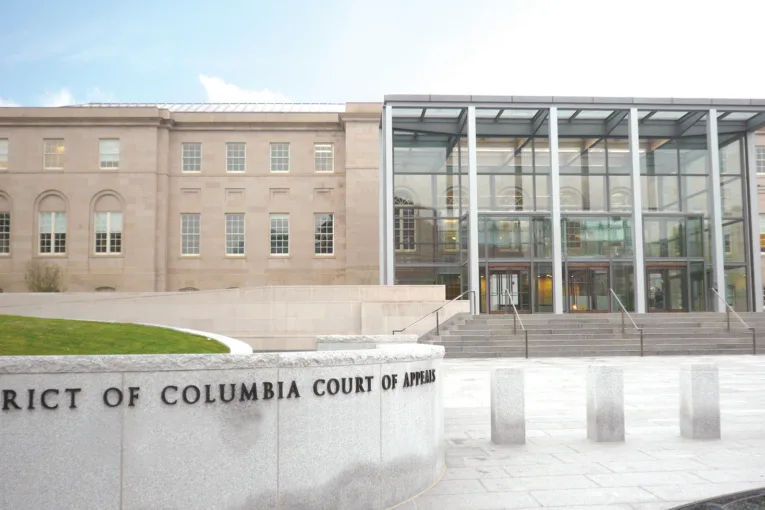
WASHINGTON, D.C. — A federal appeals court heard arguments Nov. 3 over the Trump administration’s requirement that members of Congress provide seven days’ advance notice before visiting immigration detention facilities, examining whether individual lawmakers have standing to challenge restrictions on their oversight authority.
A three-judge panel of the U.S. Court of Appeals for the D.C. Circuit considered the administration’s appeal in Neguse v. U.S. Immigration and Customs Enforcement, a lawsuit brought by 13 Democratic members of Congress challenging restrictions on unannounced inspections of federal immigration detention facilities.
The lawmakers, led by Colorado Rep. Joe Neguse, argue that advance notice requirements undermine congressional oversight by allowing detention facilities to prepare for inspections, potentially preventing lawmakers from observing ordinary conditions and identifying problems involving medical care and the treatment of detained individuals.
The dispute began in June 2025, when the Department of Homeland Security introduced new visitation requirements for lawmakers seeking access to immigration detention facilities.
In July 2025, Neguse and other lawmakers filed suit, arguing that the restrictions violated federal law and interfered with their ability to oversee immigration enforcement operations.
The case centers on Section 527 of the Further Consolidated Appropriations Act of 2024, which prohibits DHS from using covered federal funds to prevent members of Congress from entering detention facilities for oversight purposes or requiring advance notice before such visits.
The lawmakers maintain that unannounced inspections are essential because conditions inside detention facilities can change before scheduled visits.
In December 2025, U.S. District Judge Jia Cobb blocked the administration’s initial visitation policy, finding that it violated federal spending restrictions.
The administration subsequently attempted to reinstate the requirement. On Jan. 8, 2026, then-Homeland Security Secretary Kristi Noem issued a new directive requiring seven days’ advance notice, arguing that the restrictions could be implemented using separate funding provided through the administration’s 2025 One Big Beautiful Bill Act.
The directive also distinguished between immigration detention facilities and ICE field offices, including holding facilities, which DHS maintained were not subject to the same congressional access requirements.
In a March 2 opinion, Cobb rejected the administration’s funding argument, finding that DHS had not demonstrated it could establish and enforce the restrictions without using money subject to congressional spending limitations.
The judge emphasized that federal agencies must comply with restrictions Congress attaches to appropriated funds, even when other funding sources are available.
Cobb also rejected the administration’s request to suspend her ruling during the appeal, finding that federal officials had not identified concrete safety problems caused by unannounced congressional visits.
The administration appealed to the D.C. Circuit, which denied its request for a stay May 8.
The appellate panel concluded that the administration had not satisfied the requirements for suspending the district court’s order while the appeal proceeded.
That decision left Cobb’s restrictions on the seven-day notice policy in place pending further proceedings.
During the Nov. 3 hearing, the administration argued that individual lawmakers lack standing to challenge the visitation policy because the alleged injury concerns Congress as an institution rather than its individual members.
Government attorneys maintained that legislators cannot sue over generalized injuries to congressional oversight authority unless they demonstrate a distinct, personal injury.
Circuit Judges Gregory Katsas, Brad Garcia and Robert Wilkins questioned that distinction during oral arguments.
According to Reuters, Katsas questioned whether lawmakers seeking information for congressional oversight have a stronger claim to access than ordinary members of the public.
“A member (of Congress) seeking information for oversight probably has a more important use for it,” Katsas said.
Garcia also questioned whether each denial of access constitutes a separate injury to the individual lawmaker attempting to inspect a detention facility.
The questions addressed a central legal issue: whether restrictions on congressional oversight represent an institutional dispute between Congress and the executive branch or a concrete injury that individual lawmakers can challenge in federal court.
The administration’s position is that individual members cannot invoke the courts to resolve what it characterizes as an institutional disagreement over oversight authority.
The lawmakers argue that the restrictions directly interfere with their ability to perform oversight responsibilities authorized by federal law.
Following the hearing, Neguse issued a statement defending the lawsuit and the importance of unannounced inspections.
“Real time oversight is a fundamental responsibility for those of us elected to serve the American people and we will continue to exercise it as a vital tool for delivering transparency to the public,” Neguse said.
The Nov. 3 oral arguments included appearances by Justice Department attorney Steven A. Myers, representing the administration, and attorney Christine Coogle, representing the lawmakers.
The appeals court has not issued a decision on the merits of the administration’s appeal. The district court’s order blocking the seven-day advance notice requirement remains in effect.
To comment please go to one of these social media platforms:
Facebook: https://www.facebook.com/DavisVanguard
LinkedIn: https://www.linkedin.com/company/peoples-vanguard-of-davis-inc/
Instagram: https://www.instagram.com/davisvanguard/
X: https://x.com/davisvanguard
Bluesky: https://bsky.app/profile/vanguardnewsgroup.bsky.social
Subscribe to the Vanguard News letters. To make a tax-deductible donation, please visit davisvanguard.org/donate or give directly through ActBlue. Your support will ensure that the vital work of the Vanguard continues.
