
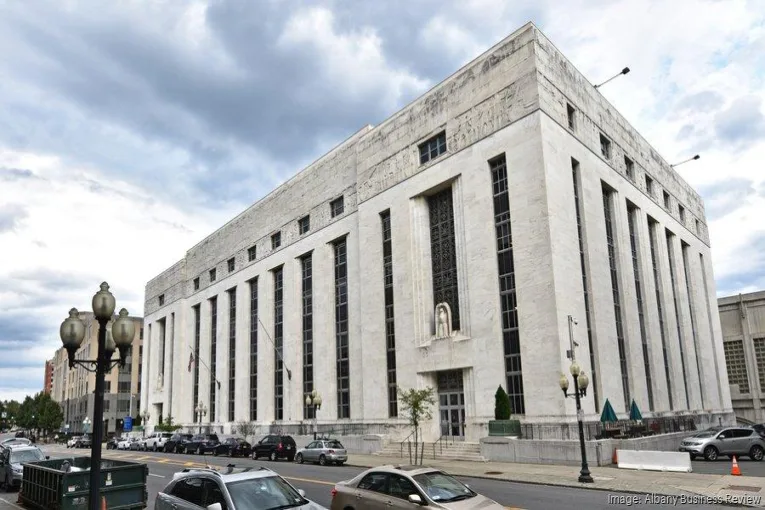
ALBANY, N.Y. — A federal judge denied a request by 15 New York sheriffs to temporarily block a state law restricting local law enforcement cooperation with U.S. Immigration and Customs Enforcement, ruling that the sheriffs had not established grounds for preliminary relief while their constitutional challenge proceeds.
U.S. District Judge Mae A. D’Agostino issued the decision Nov. 4 in Bourgault v. Hochul, leaving New York’s Local Cops, Local Crimes Act in effect without deciding the ultimate constitutionality of the law.
The legislation, signed by Gov. Kathy Hochul on May 27, prohibits state and local law enforcement agencies from entering into or maintaining certain agreements with federal immigration authorities, including those authorized under Section 287(g) of the Immigration and Nationality Act.
Those agreements allow trained local officers to perform specified federal immigration enforcement functions under ICE supervision.
The restrictions also limit arrangements under which local jails hold individuals solely for civil immigration violations, while preserving certain cooperation involving criminal investigations and judicial warrants.
According to the federal court docket, Rensselaer County Sheriff Kyle Bourgault and 14 other sheriffs filed their lawsuit Aug. 25 against Hochul, Attorney General Letitia James and the state of New York.
The sheriffs sought an emergency temporary restraining order and preliminary injunction, arguing that the legislation interfered with their authority as independently elected law enforcement officials.
In their legal challenge, the sheriffs argued that the restrictions would “nullify the ability of independently elected constitutional officers to enter into contracts” and cause imminent, irreparable harm.
The litigation followed a separate enforcement dispute involving Rensselaer County, where state officials accused the sheriff’s office of refusing to terminate its federal immigration enforcement agreement.
In an Aug. 27 announcement, James said her office had filed suit to compel the county to comply with the legislation, which required agencies to dissolve their 287(g) agreements by Aug. 25.
“All law enforcement agencies are expected to uphold New York’s laws,” James said.
“The Rensselaer County Sheriff’s Office has been given every opportunity to follow the law, yet has chosen not to,” she added.
Bourgault has defended the county’s participation in federal immigration screening programs, arguing that they provide information about individuals already held in local custody.
“We utilize this screening to gather information on those brought to our facility,” Bourgault told the Times Union.
Rensselaer County Executive Steve McLaughlin maintained that the county was not conducting independent civil immigration enforcement.
“There is no civil immigration enforcement in Rensselaer County and there never has been,” McLaughlin said.
He argued that local authorities should retain the ability to identify outstanding criminal warrants and determine whether people in custody are wanted elsewhere before their release.
The sheriffs contend that the state law improperly restricts their authority to participate in federal programs, including arrangements involving individuals already detained on criminal charges.
In denying their request, D’Agostino relied in part on New York’s longstanding capacity-to-sue doctrine, which generally prevents municipalities and certain local officials from challenging state laws on constitutional grounds.
According to the Times Union, the sheriffs argued that an exception applied because the restrictions placed them in a legal dilemma.
The judge rejected that argument, finding that they had not identified a constitutional obligation they would violate by complying with the law.
D’Agostino also found that the sheriffs had not identified a New York statute independently authorizing them to enter into the disputed federal agreements.
Although their complaint raised federal preemption arguments, the sheriffs did not develop those claims in their preliminary injunction motion or address relevant appellate precedent, according to the Times Union.
The decision comes amid a separate lawsuit brought by the Justice Department challenging New York’s immigration enforcement restrictions.
In an Aug. 3 ruling in United States v. Russo, D’Agostino considered the federal government’s challenge to provisions of the same legislation.
That proceeding addressed whether New York’s restrictions unlawfully interfered with federal immigration enforcement, including whether the state could prohibit voluntary participation in federal cooperation agreements.
The court granted preliminary relief against restrictions on officers wearing masks but declined to suspend the prohibition on local immigration enforcement agreements.
The Nov. 4 ruling in the sheriffs’ case did not resolve the constitutional questions raised in either lawsuit.
Following the decision, Bourgault told the Times Union that the sheriffs “are reviewing the ruling and determining the next course of action.”
To comment please go to one of these social media platforms:
Facebook: https://www.facebook.com/DavisVanguard
LinkedIn: https://www.linkedin.com/company/peoples-vanguard-of-davis-inc/
Instagram: https://www.instagram.com/davisvanguard/
X: https://x.com/davisvanguard
Bluesky: https://bsky.app/profile/vanguardnewsgroup.bsky.social
Subscribe to the Vanguard News letters. To make a tax-deductible donation, please visit davisvanguard.org/donate or give directly through ActBlue. Your support will ensure that the vital work of the Vanguard continues.
