
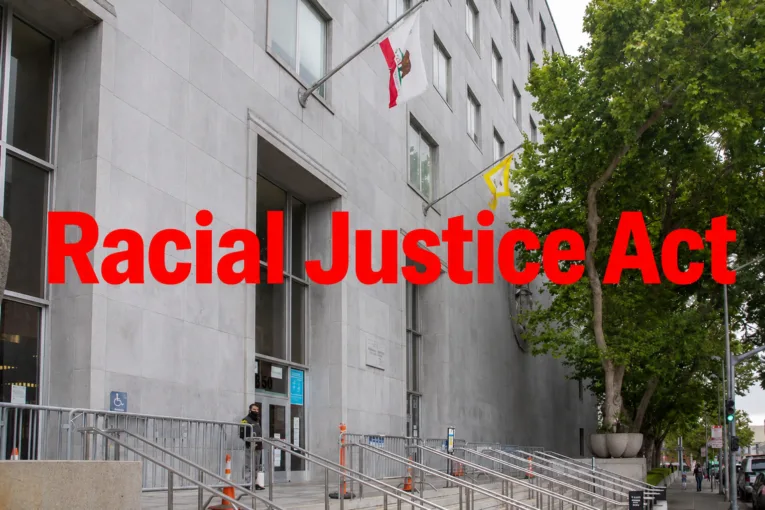
SAN FRANCISCO — The California First District Court of Appeal overturned a ruling by the San Francisco Superior Court on Nov. 20, finding that a man convicted of a 2001 murder met the minimum pleading threshold for the appointment of counsel to pursue a claim under the California Racial Justice Act.
In a unanimous decision certified for publication, the appellate court reinforced the low evidentiary threshold for the appointment of counsel, emphasizing recent legislative amendments intended to address the frequency with which courts have denied legal representation to individuals pursuing racial justice claims.
Clifton Terrell was convicted by a jury in 2005 of murder during an attempted robbery, as well as related robbery offenses, stemming from the fatal shooting of Hunter McPherson during the attempted robbery of two individuals in San Francisco in 2001.
Terrell was sentenced to life without the possibility of parole, along with a consecutive term of 25 years to life for a firearm enhancement.
According to the appellate opinion, Terrell testified at trial that his father was Black and his mother was of Mexican and Indigenous ancestry. The San Francisco District Attorney’s Office confirmed that McPherson was white.
Terrell later appealed his conviction, which was upheld on Aug. 8, 2006. In 2007, following the denial of review of his direct appeal, Terrell filed a federal petition for a writ of habeas corpus, which was denied by the U.S. District Court for the Northern District of California in 2009.
In 2025, Terrell filed a petition in San Francisco Superior Court challenging the felony-murder special circumstance finding in his case, according to the California Court of Appeal’s opinion.
Terrell’s filing falls under the California Racial Justice Act (CRJA), which was passed in 2020 to prohibit the state from seeking or obtaining a criminal conviction or imposing a criminal sentence based on a person’s race, ethnicity or national origin.
Under the CRJA, individuals can challenge convictions or sentences by presenting evidence of racial bias, including the use of discriminatory language during trial or investigation, racial bias in jury selection, or statistical disparities demonstrating racial differences in charging, convictions or sentencing.
In his petition, Terrell claimed that his felony-murder special circumstance finding was “sought and imposed against him on the basis of race.”
Following the superior court’s denial of his petition in January 2026, Terrell sought a writ of mandate from the California Court of Appeal.
Under Section 1085 of the California Code of Civil Procedure, a writ of mandate is a judicial order that can compel a lower court, public body or official to perform a legally required duty or recognize a right to which a person is entitled.
Terrell’s petition relied on statistical evidence suggesting significant racial disparities in San Francisco County’s charging and conviction rates involving special circumstances allegations.
Terrell argued that the evidence supported a claim that his conviction or sentence violated subdivisions (a)(3) or (a)(4) of Penal Code Section 745, which address racial disparities in charging, convictions and sentencing.
According to the Court of Appeal, Terrell cited statistical evidence from two separate reports.
His petition stated that Black individuals make up 53% of people sentenced to life without parole in San Francisco and receive that sentence at 16.8 times the rate of white individuals in the city.
Additionally, Terrell cited research examining San Francisco felony-murder prosecutions between 2011 and 2021, indicating that Black defendants were more than three times as likely to face special circumstances charges when the victim was white rather than nonwhite.
Terrell alleged that both findings were consistent with statewide racial disparities in the population serving life-without-parole sentences, including disparities associated with the race of victims.
The San Francisco Superior Court rejected Terrell’s requests for appointed counsel and discovery, finding that his allegations were overly broad and conclusory.
The superior court reasoned that the statistical evidence addressed life-without-parole sentences and special circumstances allegations generally, without sufficiently addressing Terrell’s specific offense or conduct.
Additionally, the superior court ruled that Terrell had failed to establish good cause for discovery relating to a potential violation of the CRJA.
The appellate court found, however, that the superior court had focused on perceived deficiencies in the statistical reports without adequately considering information contained in Terrell’s petition itself.
Although the superior court questioned whether the data in one report was specific to San Francisco, Terrell’s petition expressly identified San Francisco felony-murder prosecutions as the subject of the research. The District Attorney’s Office subsequently conceded that the data was from San Francisco.
The appellate court explained that, at this preliminary stage, the superior court was required to accept Terrell’s allegations as presented unless they were contradicted by the supporting report.
Central to the appellate court’s reasoning were legislative amendments to Penal Code Section 1473 that took effect Jan. 1, 2026.
In adopting the amendments, the Legislature expressed concern that courts had denied requests for counsel from individuals pursuing Racial Justice Act claims substantially more often than they had granted them, despite the relatively low statutory threshold.
The Legislature amended the statute to require a plausible allegation of a violation rather than allegations of facts that would establish a violation of the CRJA.
The appellate court concluded that the amendment establishes a standard at least as permissive as the previous statutory language and, to some degree, more lenient.
The court emphasized that the threshold for securing legal representation is “extremely low” and that individuals are not required to establish a prima facie violation of the law before an attorney can be appointed.
The appellate court explained that the Racial Justice Act establishes progressively higher evidentiary burdens throughout the litigation process.
While an indigent petitioner seeking appointed counsel must generally present only a plausible allegation of a violation, obtaining discovery requires a showing of good cause.
Securing an order to show cause and an evidentiary hearing requires a higher, prima facie showing. Ultimately, establishing a violation at an evidentiary hearing requires proof by a preponderance of the evidence.
The District Attorney’s Office argued that Terrell’s evidence did not adequately compare similarly situated individuals who had engaged in similar conduct.
Prosecutors also argued that the statistical evidence addressing disparities associated with the race of victims concerned charging decisions rather than sentencing, whereas the relevant statutory provision explicitly addresses sentencing disparities based on a victim’s race.
The appellate court acknowledged that such questions could become relevant as the litigation progresses but concluded that they did not justify denying Terrell legal representation at the preliminary stage.
The court identified two potential theories under which Terrell could pursue relief: racial discrimination associated with his own race and racial discrimination associated with the race of McPherson.
Although the research concerning the race of victims examined charging decisions rather than sentences, the court found it plausible that disparities in special circumstances charging decisions could result in corresponding sentencing disparities.
A felony-murder special circumstance finding can expose a person convicted of murder to life without the possibility of parole, making the prosecution’s decision to pursue such an allegation consequential to the ultimate sentence.
The appellate court also addressed the difficulties facing self-represented incarcerated individuals seeking relief under the CRJA, particularly when they lack legal expertise or access to evidence necessary to substantiate their claims.
Requiring individuals to conduct sophisticated legal and statistical analyses before receiving counsel, the court reasoned, would undermine the statutory framework that provides legal assistance to help petitioners develop their claims.
Under Section 1473, newly appointed counsel may amend previously filed petitions and seek discovery to obtain additional evidence supporting allegations of racial discrimination.
Because the decision was certified for publication, its interpretation of the statutory threshold for appointed counsel has precedential significance beyond Terrell’s individual case.
The First District Court of Appeal also expressly disagreed with the analysis of a recent appellate decision involving Racial Justice Act discovery in Riverside County to the extent that decision conflicts with its ruling.
The appellate decision does not overturn Terrell’s underlying conviction or sentence, nor does it establish that a violation of the Racial Justice Act occurred.
Instead, the court directed the superior court to vacate its denial of Terrell’s petition, appoint legal counsel and conduct a new hearing to consider any discovery requests his appointed attorney elects to pursue, more than 21 years after Terrell was convicted by a jury and more than 20 years after his first appeal.
To comment please go to one of these social media platforms:
Facebook: https://www.facebook.com/DavisVanguard
LinkedIn: https://www.linkedin.com/company/peoples-vanguard-of-davis-inc/
Instagram: https://www.instagram.com/davisvanguard/
X: https://x.com/davisvanguard
Bluesky: https://bsky.app/profile/vanguardnewsgroup.bsky.social
Subscribe to the Vanguard News letters. To make a tax-deductible donation, please visit davisvanguard.org/donate or give directly through ActBlue. Your support will ensure that the vital work of the Vanguard continues.
