
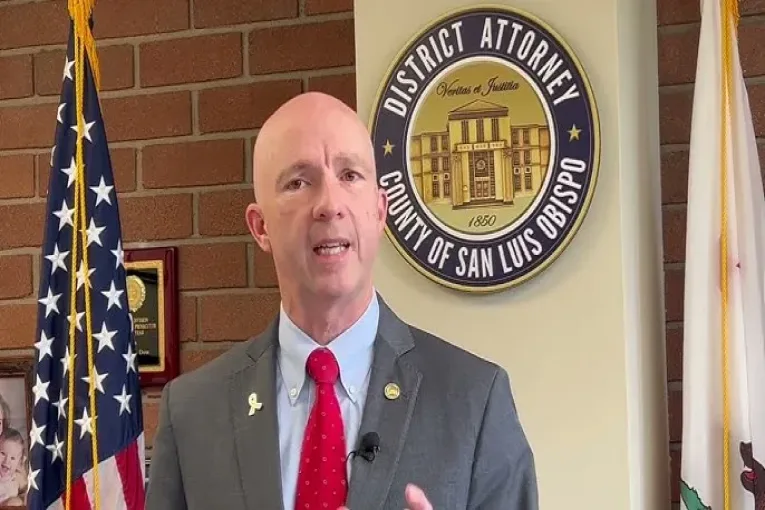
SAN LUIS OBISPO, Calif. — San Luis Obispo County District Attorney Dan Dow criticized Gov. Gavin Newsom’s plan to commute the death sentences of 548 people to life imprisonment without the possibility of parole, arguing that the decision disregards individual jury verdicts and the families of murder victims.
In a Nov. 5 statement, Dow cited two San Luis Obispo County capital cases involving Rex Allan Krebs and Michael Whisenhunt, who were sentenced to death for murders involving three victims: Rachel Newhouse, Aundria Crawford and Kesha Gurke.
Dow argued that the governor’s proposed commutations overlook the circumstances of individual cases and the decisions of juries that imposed death sentences.
Newsom announced his intention to commute the sentences of all 548 people on California’s death row, replacing their death sentences with life imprisonment without the possibility of parole. Those affected would remain incarcerated and would not become eligible for release as a result of the commutations.
The commutations are not yet final, and the governor must complete the applicable legal procedures before the sentence changes can take effect.
Dow argued that each death sentence resulted from a legal process in which juries considered evidence, determined guilt and evaluated whether capital punishment was appropriate.
He emphasized that juries convicted the defendants of first-degree murder, found special circumstances beyond a reasonable doubt and selected death sentences following separate penalty proceedings.
The district attorney also cited subsequent judicial review by trial judges and the California Supreme Court, criticizing Newsom’s decision to pursue a statewide commutation rather than evaluate each case individually.
According to Dow’s statement, Krebs kidnapped, sexually assaulted and murdered Newhouse and Crawford in San Luis Obispo County. Dow described Krebs as a repeat violent offender who was on parole when the crimes occurred.
Dow also cited the murder of 19-month-old Kesha Gurke in Paso Robles, for which Whisenhunt was convicted and sentenced to death.
San Luis Obispo County juries sentenced both men to death, and the California Supreme Court unanimously affirmed their judgments, according to the district attorney.
Dow argued that the governor’s announcement failed to adequately recognize the experiences of victims’ families, criticizing Newsom for not identifying individual victims in his public explanation of the commutation plan.
The district attorney maintained that victims’ families should have an opportunity to be heard before the proposed commutations are finalized.
Dow also questioned the decision in light of California voters’ previous actions concerning capital punishment.
He pointed to elections in which voters restored the death penalty, expanded its application and rejected proposals to repeal it, arguing that the governor’s action would undermine those decisions and the verdicts reached by juries.
California voters rejected measures to abolish the death penalty in 2012 and 2016. In 2016, voters also approved Proposition 66, which was intended to accelerate death penalty appeals and executions.
Although Newsom’s proposed commutations would change the sentences of people currently on death row, they would not repeal California’s death penalty law or prevent prosecutors from seeking capital punishment in future cases.
The governor’s clemency authority is established under Article V, Section 8 of the California Constitution, which permits the governor to grant reprieves, pardons and commutations after sentencing, subject to certain restrictions.
One restriction applies to people who have been twice convicted of a felony. In those cases, the governor cannot grant a commutation without a recommendation from the California Supreme Court supported by at least four justices.
According to the Habeas Corpus Resource Center, approximately 30% of people currently under death sentences do not have a separate felony conviction requiring such a recommendation.
The Los Angeles Times reported that 382 of the proposed 548 commutations require a recommendation from the California Supreme Court before Newsom can proceed.
Dow asserted that both Krebs and Whisenhunt fall within that constitutional requirement because they have prior felony convictions.
He called on the California Supreme Court to examine their cases individually and provide victims’ families and prosecutors an opportunity to be heard before issuing any recommendation.
The constitutional provision requires a recommendation from four justices in qualifying cases but does not expressly mandate hearings for prosecutors or victims’ families.
Newsom’s proposal comes more than two decades after California’s last execution in 2006. The governor imposed a moratorium on executions in 2019, citing concerns about fairness, racial disparities and the risk of wrongful convictions.
The proposed commutations would go further by replacing existing death sentences with life imprisonment without the possibility of parole, although the death penalty would remain authorized under California law.
Dow concluded his statement by expressing support for the families of Newhouse, Crawford and Gurke and reaffirming his office’s opposition to the proposed commutations.
To comment please go to one of these social media platforms:
Facebook: https://www.facebook.com/DavisVanguard
LinkedIn: https://www.linkedin.com/company/peoples-vanguard-of-davis-inc/
Instagram: https://www.instagram.com/davisvanguard/
X: https://x.com/davisvanguard
Bluesky: https://bsky.app/profile/vanguardnewsgroup.bsky.social
Subscribe to the Vanguard News letters. To make a tax-deductible donation, please visit davisvanguard.org/donate or give directly through ActBlue. Your support will ensure that the vital work of the Vanguard continues.
