
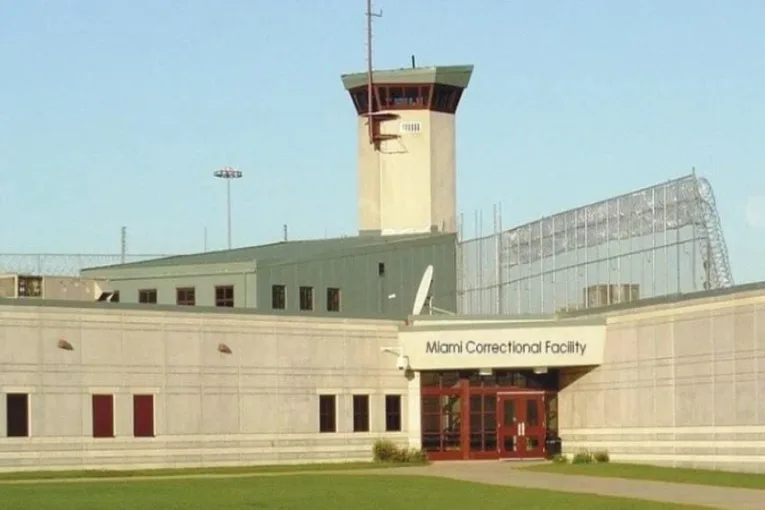
BUNKER HILL, Ind. — Three immigrants detained at an Indiana state prison have filed a federal class-action lawsuit alleging that people held in civil immigration custody face unconstitutional punishment, dangerous medical neglect, prolonged solitary confinement and abusive living conditions at a facility where at least two immigration detainees have died.
The lawsuit, brought against federal immigration authorities and Indiana correctional officials, challenges conditions at Miami Correctional Facility in Bunker Hill, which began housing detainees for U.S. Immigration and Customs Enforcement in 2025.
According to an Oct. 29 press release from the American Civil Liberties Union of Indiana, the facility, which the Department of Homeland Security dubbed the “Speedway Slammer,” has become one of the largest and deadliest immigration detention centers in the Midwest.
The plaintiffs seek to represent all current and future civil immigration detainees at the facility, alleging that federal and state officials have subjected them to conditions that violate constitutional protections against punishment without due process.
The complaint describes inadequate medical and mental health care, excessive lockdowns, racist and xenophobic abuse, and insufficient access to food, water, medication, clothing and hygiene supplies.
Immigrants are allegedly confined in two-person cells measuring just five feet by 11 feet, each containing a metal sink and toilet.
“Immigration detention is not supposed to be punitive – being held in Miami Correctional is not just punitive; it is dangerous,” said Katie Hickey, a staff attorney with the ACLU of Illinois. “The federal and Indiana governments have needlessly chosen to put people’s lives at risk.”
The lawsuit identifies three plaintiffs whose experiences illustrate the conditions they allege are widespread throughout the facility.
Sergei Vasenin, a Ukrainian-born immigrant from Russia, entered the United States in October 2022 seeking asylum and was granted humanitarian parole.
According to the complaint, Vasenin has no criminal convictions but was arrested by ICE agents at his home in October 2025 and transferred to Miami Correctional.
He alleges that he spent approximately nine weeks in solitary confinement, sometimes remaining in a small, cold cell for 23 to 24 hours a day.
During that period, he was allegedly denied consistent mental health treatment and medication despite a deterioration in his psychological condition that led him to repeatedly contemplate suicide.
The second plaintiff, Kemoye Muslar, is a Jamaican immigrant who entered the United States in September 2024 and subsequently applied for lawful permanent residency based on his marriage to a U.S. citizen.
Muslar, who has no criminal convictions or pending criminal charges, was arrested by ICE in November 2025 while attending a scheduled biometrics appointment related to his immigration application.
According to the complaint, Muslar experienced and witnessed dangerous delays in medical and mental health treatment, punitive lockdowns lasting up to 10 days, inadequate food and shortages of appropriate clothing and hygiene supplies.
The third plaintiff, Cynthia Acevedo, is a Guatemalan immigrant who has lived in the United States for 26 years and was arrested by ICE while working in July 2026.
Acevedo, a transgender woman who previously operated a house-cleaning business in Florida, has epilepsy and requires regular medication to control seizures.
The complaint alleges that facility medical personnel switched her to a less effective medication and repeatedly failed to provide it consistently, causing her to experience multiple seizures each week.
Acevedo also alleges that she was sexually assaulted by another detainee and that officials failed to respond appropriately despite her efforts to report the incident.
According to the complaint, officials delayed documenting her report, failed to conduct a sexual assault forensic examination and did not provide requested HIV testing or preventive medication.
The lawsuit further alleges that officials frequently failed to provide interpretation services during her medical appointments despite her limited English proficiency.
The plaintiffs’ allegations come amid broader concerns about safety at Miami Correctional.
According to the ACLU, at least two immigrants have died while detained at the facility during the past year, and another detainee recently attempted suicide.
The complaint alleges that staff failed to respond adequately to warnings about the detainee’s deteriorating mental health before the suicide attempt.
The facility has also faced longstanding allegations of dangerous conditions involving people incarcerated under state criminal sentences.
According to the complaint, 133 incarcerated people died at Miami Correctional between 2019 and August 2025, before or around the beginning of its use for federal immigration detention.
An Indiana Department of Correction official acknowledged longstanding safety problems during testimony before the Indiana State Budget Agency, stating that officials had struggled with the ability to keep incarcerated people safe.
The ACLU also cited previous litigation involving people held in darkened cells, sewage-contaminated housing areas and dangerous conditions involving exposed electrical wiring.
Those cases resulted in more than $1.2 million in settlements involving 31 lawsuits, according to the complaint.
“The State of Indiana and Federal government are working together to create a human rights disaster in one of Indiana’s most dangerous prisons,” said Alexa Van Brunt, director of the MacArthur Justice Center’s Illinois office. “The conditions are cruel and have resulted in the deaths of innocent people. Both the state and federal government must be held accountable for their heinous treatment of people locked inside Miami.”
The lawsuit raises constitutional questions about the use of state prisons to house people detained for civil immigration proceedings.
Unlike individuals serving criminal sentences, immigration detainees are held for administrative purposes, including proceedings to determine their immigration status or potential removal from the United States.
In its 1979 decision in Bell v. Wolfish, the U.S. Supreme Court held that pretrial detainees cannot be subjected to conditions amounting to punishment without due process.
The Court explained that restrictions imposed on people who have not been convicted of a crime must not constitute punishment.
The plaintiffs also rely on constitutional protections applicable to civil detainees, arguing that their confinement at Miami Correctional imposes punitive conditions inconsistent with the purposes of immigration detention.
“Every person in government custody is owed adequate medical care, basic safety, and humane treatment under our Constitution,” said William Isaacson, founding partner of Dunn Isaacson and Rhee. “There is no excuse for immigrants in an ICE detention facility being treated as less than human beings.”
The lawsuit seeks declaratory and injunctive relief requiring federal and state officials to end the allegedly unconstitutional practices, provide adequate medical care and take immediate steps to protect detainees from further harm.
The plaintiffs contend that court intervention is necessary because the conditions threaten the health and safety of people who are being held in civil rather than criminal custody.
The allegations have not been adjudicated, and the court has not determined whether the challenged conditions violate constitutional protections.
To comment please go to one of these social media platforms:
Facebook: https://www.facebook.com/DavisVanguard
LinkedIn: https://www.linkedin.com/company/peoples-vanguard-of-davis-inc/
Instagram: https://www.instagram.com/davisvanguard/
X: https://x.com/davisvanguard
Bluesky: https://bsky.app/profile/vanguardnewsgroup.bsky.social
Subscribe to the Vanguard News letters. To make a tax-deductible donation, please visit davisvanguard.org/donate or give directly through ActBlue. Your support will ensure that the vital work of the Vanguard continues.
