
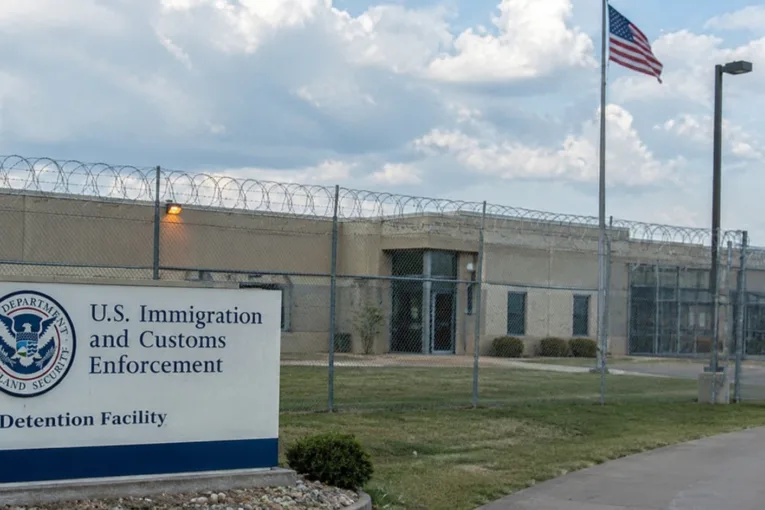
COVINGTON, Ky. — A federal judge has ruled that the prolonged immigration detention of a Polish woman who has lived in the United States for more than three decades violated her constitutional right to due process, ordering the government to provide a new bond hearing after approximately 15 months in custody.
In a Nov. 3 ruling, U.S. District Judge Karen K. Caldwell of the Eastern District of Kentucky granted a petition for a writ of habeas corpus filed by Beata Siemionkowicz, a lawful permanent resident and single mother of two U.S. citizen daughters who has been detained by Immigration and Customs Enforcement since August 2025.
Caldwell concluded that although federal immigration law authorized Siemionkowicz’s detention, the government could not continue holding her indefinitely without providing adequate procedural protections.
The judge ordered an individualized bond hearing within seven days and required the government to demonstrate by clear and convincing evidence that continued detention was necessary.
Siemionkowicz, who has lived in the United States since 1995 and obtained permanent resident status in 2003, worked for years as a caregiver, including caring for hospice patients, to support her family.
According to the court’s opinion, ICE detained her Aug. 2, 2025, and transferred her to the Campbell County Detention Center in Kentucky, where she remained while contesting deportation.
Her detention stemmed from two misdemeanor retail theft convictions in Lake County, Illinois, involving merchandise valued at less than $150 in 2005 and less than $300 in 2011.
The convictions formed the basis of the government’s claim that she was deportable under federal immigration law because she had committed two crimes involving moral turpitude.
According to the American Civil Liberties Union of Illinois, Siemionkowicz has never been charged with or convicted of a violent crime and has not faced any criminal charges in more than 15 years.
On Aug. 26, 2025, an immigration judge denied her request for bond after determining that she presented a flight risk.
Siemionkowicz subsequently applied for cancellation of removal, a form of immigration relief that would allow her to remain in the United States despite the government’s efforts to deport her.
An immigration judge denied that application and ordered her removed to Poland. Siemionkowicz appealed the decision to the Board of Immigration Appeals.
While her immigration appeal remained pending, she separately challenged the legality of her continued detention by filing a federal habeas corpus petition.
The two proceedings address different legal questions. Her immigration appeal challenges the decision to remove her from the United States, while the habeas petition challenges whether the government may continue detaining her during those proceedings without a constitutionally adequate bond hearing.
In defending the detention, federal officials argued that Siemionkowicz was subject to mandatory detention under 8 U.S.C. § 1226(c), which requires the detention of certain noncitizens facing removal because of specified criminal convictions.
Siemionkowicz argued that her detention was governed by a different provision, Section 1226(a), which generally permits individualized bond determinations.
Caldwell agreed with the government that Section 1226(c) applied to her case, meaning Siemionkowicz did not have an automatic statutory right to a bond hearing.
However, the judge emphasized that the absence of a statutory right did not eliminate the constitutional protections afforded by the Fifth Amendment’s Due Process Clause.
The court examined whether Siemionkowicz’s prolonged detention had become unconstitutional under the three-part balancing test established by the U.S. Supreme Court in Mathews v. Eldridge.
That test considers the individual’s liberty interest, the risk of an erroneous deprivation of that interest without additional procedural protections, and the government’s interest in maintaining its existing procedures.
Caldwell found that all three factors favored Siemionkowicz.
The judge emphasized that freedom from involuntary detention is a fundamental liberty interest protected by the Constitution and that Siemionkowicz had been detained substantially longer than the periods considered in earlier Supreme Court decisions involving mandatory immigration detention.
The court also found that the procedures available to people detained under Section 1226(c) provided little opportunity for individualized review of whether continued confinement was necessary.
Because Siemionkowicz had already acknowledged the convictions underlying her removal proceedings, the limited procedures available to challenge mandatory detention offered little meaningful protection against unnecessary confinement.
Caldwell further concluded that requiring a new bond hearing would impose minimal administrative costs on the government because immigration courts already have established procedures for conducting such hearings.
The court determined that the government’s legitimate interest in preventing flight and ensuring the completion of removal proceedings did not justify denying Siemionkowicz an individualized assessment after more than a year in custody.
The ruling follows other federal court decisions recognizing that prolonged mandatory immigration detention can raise constitutional concerns even when the initial detention is authorized by statute.
Caldwell cited decisions from federal courts in Kentucky that had required bond hearings for noncitizens detained for 14 and 19 months, respectively.
The court also addressed the burden of proof at Siemionkowicz’s new hearing, requiring the government rather than the detained individual to justify continued confinement.
Under the order, federal officials must establish by clear and convincing evidence that continued detention is necessary.
The ruling does not automatically release Siemionkowicz or overturn the immigration judge’s removal order. Instead, it requires the government to provide a new hearing at which her eligibility for release must be individually assessed.
The decision was welcomed by Siemionkowicz’s family and attorneys, who have argued that her prolonged detention has separated her from her daughters without sufficient justification.
“My sister and I are grateful to the court,” said Gabi Siemionkowicz, her younger daughter, in a statement released by the ACLU of Illinois. “This ruling gives us hope that we might be able to hug our mother soon.”
Her older daughter, Claudia Siemionkowicz, said the family wanted an opportunity to challenge her mother’s continued confinement.
“All we want is a fair chance for our mother in the courts,” she said. “We hope this is a step in getting her back to the family that loves her.”
Hirsh M. Joshi, a staff attorney with the ACLU of Illinois, said the decision recognized that the government must justify keeping Siemionkowicz detained.
“The court recognized that Beata’s lengthy detention merits a new bond hearing with the burden on the government to demonstrate that she should still be detained,” Joshi said.
“Our client is a hard-working mother, someone who has cared for hospice patients. Her detention serves no purpose other than cruelty. She deserves to be released, and this is a step in the right direction.”
Bethany Baxter, a staff attorney with the ACLU of Kentucky, also welcomed the ruling, emphasizing the constitutional concerns surrounding prolonged detention without adequate review.
“From the beginning, we have maintained that the government should bear the burden of justifying why someone should remain detained, and we are pleased the court recognized the serious constitutional concerns at stake,” Baxter said.
Caldwell ordered federal officials to submit a status report by Nov. 17 confirming compliance with the ruling.
The report must identify when Siemionkowicz’s bond hearing occurred, whether bond was granted or denied, and, if denied, the reasons for that decision.
To comment please go to one of these social media platforms:
Facebook: https://www.facebook.com/DavisVanguard
LinkedIn: https://www.linkedin.com/company/peoples-vanguard-of-davis-inc/
Instagram: https://www.instagram.com/davisvanguard/
X: https://x.com/davisvanguard
Bluesky: https://bsky.app/profile/vanguardnewsgroup.bsky.social
Subscribe to the Vanguard News letters. To make a tax-deductible donation, please visit davisvanguard.org/donate or give directly through ActBlue. Your support will ensure that the vital work of the Vanguard continues.
