
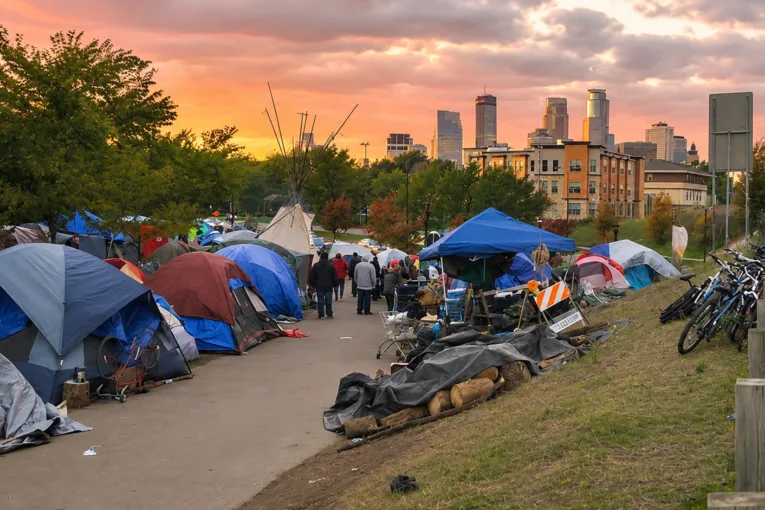
MINNEAPOLIS — Clearing homeless encampments in Minneapolis was associated with a 65% increase in nearby overdose risk during the following three days, according to new research from the University of Minnesota that raises questions about the public health consequences of forcibly displacing unhoused residents.
The research, led by University of Minnesota epidemiologist Kumi Smith, found that the risk of a nonfatal overdose was 65% higher than expected within approximately two to four blocks of an encampment during the first three days after it was cleared.
The findings, first reported by Axios on Oct. 19, suggest that policies intended to address safety concerns associated with homeless encampments may also create additional health risks in surrounding communities.
Working with community members who had experienced homelessness, Smith and her colleagues documented 87 encampment clearances in Minneapolis between April 2024 and March 2025.
Researchers compared the locations and timing of those clearances with 1,431 calls to 911 involving nonfatal overdoses during the same period.
The analysis found a significant increase in overdose risk immediately following encampment clearances, with the strongest association occurring within several blocks during the first three days.
The researchers also examined a larger geographic area and a longer period following the clearances.
According to Axios, the increase remained statistically significant when the researchers expanded their analysis to an area extending approximately eight blocks from the encampments over two weeks.
The findings were presented at the Society for Epidemiologic Research conference under Poster 0982, titled “The Health Impacts of Displacement: Modeling Community Spread of Overdose Following Homeless Encampment Sweeps.”
As of Nov. 10, the findings had not been identified in a publicly available peer-reviewed manuscript or preprint, although the University of Minnesota had previously announced the research project.
Smith told Axios that repeated encampment clearances consume public resources while frequently moving unhoused residents only a short distance from their previous locations.
She argued that the practice can increase overdose risk without addressing the underlying causes of homelessness.
The findings challenge a central justification for encampment clearances: that removing camps improves public safety by reducing conditions associated with drug use, violence and other hazards.
Minneapolis and St. Paul officials have defended encampment clearances by pointing to concerns about fires, shootings, overdoses, sanitation and other dangers affecting both encampment residents and surrounding neighborhoods.
However, the new research suggests that clearing an encampment may not eliminate those risks and could instead contribute to their displacement into nearby areas.
Joshua Barocas, a physician and public health researcher at the University of Colorado Anschutz Medical Campus, told Axios that the Minneapolis research benefited from the involvement of people with direct experience of homelessness in documenting encampment clearances.
Barocas has conducted related research examining the consequences of involuntary displacement, including a study finding that encampment sweeps in Denver did not produce measurable reductions in nearby crime.
The Minneapolis findings also build on a 2023 study published in JAMA that modeled the potential health consequences of involuntary displacement among unhoused people who inject drugs in 23 U.S. cities.
That research, conducted by investigators affiliated with the University of Colorado Anschutz Medical Campus and other institutions, projected that continued involuntary displacement could account for approximately 15% to 25% of deaths among the population studied over a decade.
The researchers also projected increases in overdose deaths, serious infections and hospitalizations when people experiencing homelessness were repeatedly forced to relocate.
Unlike the Minneapolis research, which examined actual overdose-related emergency calls following documented encampment clearances, the earlier study used computer modeling to estimate the potential long-term consequences of displacement policies.
The Colorado researchers identified several mechanisms through which displacement could increase health risks, including disrupted access to addiction treatment, medications, harm-reduction services and established social support networks.
People forced to leave encampments may lose medications, identification documents, personal belongings and contact with service providers, making it more difficult to maintain treatment or obtain emergency assistance.
The Minneapolis research provides additional evidence of a possible relationship between these disruptions and increased overdose risk, although the findings do not establish that the clearances directly caused the additional overdose calls.
The study examined geographic and temporal patterns in 911 calls rather than tracking the individual health outcomes of people displaced from specific encampments.
Consequently, the available findings do not establish whether those experiencing overdoses were former encampment residents or other individuals living in nearby neighborhoods.
The reported 65% increase also represents a relative increase in estimated overdose risk, rather than a 65% increase in the total number of overdoses citywide.
Publicly available reporting does not establish how many additional overdose calls occurred as a result of the increased risk or whether other factors contributed to the observed pattern.
Stanford University professor Keith Humphreys cautioned against drawing broad conclusions from the research without considering the potential harms associated with allowing encampments to remain in place.
Humphreys told Axios that policymakers must also consider public safety, access to parks and public spaces, and the effects of encampments on nearby residents and businesses.
He also suggested that encampment clearances could encourage some individuals to seek housing or addiction treatment, although the Minneapolis findings did not evaluate those potential outcomes.
Smith argued that cities have alternatives to both allowing encampments to remain indefinitely and repeatedly clearing them without addressing residents’ needs.
She pointed to approaches that connect people experiencing homelessness with housing and support services before removing encampments.
The University of Minnesota research comes as local governments in the Twin Cities continue debating how to respond to homelessness and the safety concerns associated with encampments.
St. Paul officials have considered policies emphasizing low-barrier housing and advance outreach before encampment closures, while Minneapolis has examined proposals for designated overnight parking areas for people living in vehicles.
The new findings provide a measurable indication of the potential short-term health consequences associated with encampment clearances, showing that overdose-related emergency calls increased in nearby areas immediately after the documented sweeps.
To comment please go to one of these social media platforms:
Facebook: https://www.facebook.com/DavisVanguard
LinkedIn: https://www.linkedin.com/company/peoples-vanguard-of-davis-inc/
Instagram: https://www.instagram.com/davisvanguard/
X: https://x.com/davisvanguard
Bluesky: https://bsky.app/profile/vanguardnewsgroup.bsky.social
Subscribe to the Vanguard News letters. To make a tax-deductible donation, please visit davisvanguard.org/donate or give directly through ActBlue. Your support will ensure that the vital work of the Vanguard continues.
