
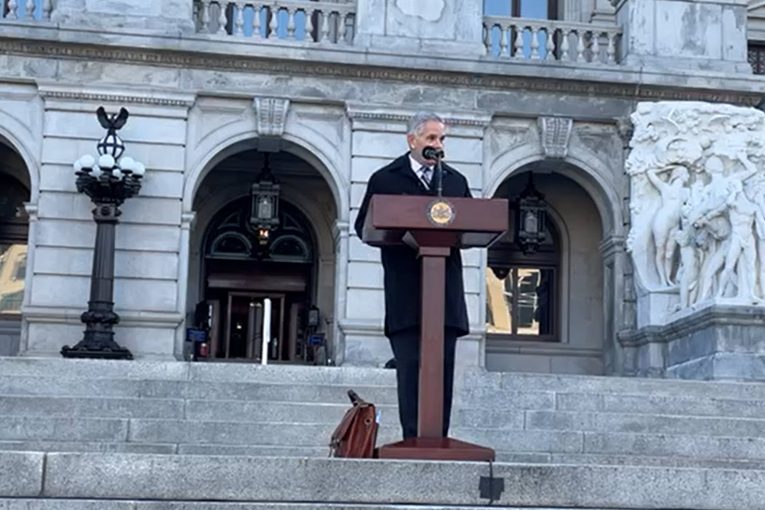
PHILADELPHIA — Since taking office in 2018, Philadelphia District Attorney Larry Krasner has sought to transform a criminal justice system he argues has been marked by wrongful convictions, excessive incarceration and longstanding abuses of prosecutorial power.
Those efforts have brought sustained opposition from political officials, law enforcement organizations and members of the judiciary, including an impeachment effort by Republican state lawmakers and legal challenges to his authority.
Now, a federal criminal investigation into allegations that Krasner and a senior prosecutor misled a judge during proceedings involving a murder conviction has become the latest confrontation surrounding his reform agenda.
The investigation follows a referral by U.S. District Judge Paul S. Diamond, who raised concerns about the handling of a habeas corpus petition filed by Dennis Johnson, a man serving a life sentence following a 2009 murder conviction.
The dispute arose after Krasner’s office reversed its previous position and supported overturning Johnson’s conviction because of alleged constitutional violations during his trial.
The case illustrates a broader conflict over the responsibilities of prosecutors who seek to revisit convictions obtained under previous administrations and the resistance those efforts can encounter within the criminal justice system.
Krasner’s reform agenda has included reviewing questionable convictions, reducing the use of incarceration and changing charging and sentencing practices. His administration has made post-conviction review a central part of its efforts to address past injustices.
But those policies have repeatedly generated opposition.
In 2022, Pennsylvania’s Republican-controlled House of Representatives voted to impeach Krasner, accusing him of misconduct and challenging policies that lawmakers argued undermined public safety.
The impeachment proceedings ultimately ended without a trial after the Pennsylvania Supreme Court ruled that the articles had expired with the legislative session.
State lawmakers also enacted legislation authorizing the appointment of a special prosecutor for crimes committed on Philadelphia’s public transit system, removing certain cases from the district attorney’s ordinary jurisdiction. Krasner challenged the legislation in court.
These conflicts have placed Krasner at the center of a continuing struggle over the authority of elected prosecutors to depart from traditional approaches to criminal prosecution.
The latest confrontation involves Johnson, whose efforts to overturn his conviction have continued for more than a decade.
Johnson was convicted of second-degree murder in 2009 in connection with the 2007 killing of Kenyatta Smith and was sentenced to life in prison in 2010.
According to testimony from the original trial, later reported by The Philadelphia Inquirer, witnesses identified Johnson as the shooter, testimony that formed part of the basis for his conviction.
Following his conviction, Johnson pursued an extended appeals process, arguing that his trial attorney had provided ineffective assistance and failed to protect his constitutional rights.
Johnson filed a petition under Pennsylvania’s Post Conviction Relief Act, claiming that his representation at trial was inadequate. The petition was denied without a hearing in 2013 by the Philadelphia Court of Common Pleas.
The Pennsylvania Superior Court upheld that decision in 2015, concluding that Johnson had failed to demonstrate that his attorney’s alleged errors prejudiced his defense.
In its opinion, the court stated, “in any event, we also conclude that Appellant cannot demonstrate that he was prejudiced by trial counsel’s failure.”
Johnson also pursued federal habeas corpus relief, alleging constitutional violations, including a violation of his Sixth Amendment right to confront witnesses against him.
According to the federal court’s account of the proceedings, a detective testified during Johnson’s trial that Amin Vicks, who did not testify, had identified Johnson as the shooter during a police interview.
Johnson argued that his attorney’s failure to object to that testimony violated his constitutional rights.
His federal petition was stayed by Diamond in 2017, pending the resolution of related state proceedings.
For years, the Philadelphia District Attorney’s Office opposed Johnson’s attempts to overturn his conviction.
That position changed under Krasner’s administration.
In November 2022, Assistant District Attorney Jaclyn Mason filed a brief agreeing that Johnson was entitled to habeas relief because his trial attorney had failed to object to the detective’s testimony about Vicks’ identification.
The filing recommended that Johnson’s conviction be overturned.
The reversal reflected a central feature of Krasner’s approach to prosecution: a willingness to reconsider convictions defended by previous administrations when evidence suggests that constitutional violations may have occurred.
His administration has credited its work with helping overturn dozens of wrongful convictions and has “made post-conviction review a centerpiece of his reform agenda,” according to The Philadelphia Inquirer.
However, the effort to overturn Johnson’s conviction subsequently became the subject of a dispute over the accuracy of the information submitted to the federal court.
After Mason’s brief was filed, Diamond scheduled an evidentiary hearing to examine the evidence underlying Johnson’s claims.
In June 2026, four assistant district attorneys moved to withdraw the office’s earlier filing, acknowledging that it contained “material misstatements,” according to the court’s Sept. 15 memorandum.
Mason resigned on June 2, 2026, before the motion to withdraw the brief was filed.
She subsequently testified before Diamond that Matthew Stiegler, chief of the district attorney’s Conviction Integrity Unit, had directed her work on the filing and pressured her to support Johnson’s request for relief.
Mason also alleged that efforts to place responsibility for the inaccuracies on her were intended to shield Stiegler and the district attorney’s office from scrutiny.
Other supervisors testified about concerns surrounding the filing, the effort to withdraw it and the office’s handling of potential conflicts of interest.
Stiegler disputed Mason’s account and denied improperly directing her work.
According to testimony described in Diamond’s memorandum, Krasner insisted that his office remain involved in the case to “protect the office,” a statement some supervisors interpreted as prioritizing the office’s institutional interests over its legal obligations.
Several supervisors believed the district attorney’s office had a conflict of interest and urged that the case be transferred to the Pennsylvania Attorney General’s Office.
Krasner opposed removing his office from the proceedings.
Following evidentiary hearings in July, August and September, Diamond concluded that Krasner and Stiegler had conflicts of interest that prevented them from continuing to participate in Johnson’s case.
The judge also expressed concern that their conduct may have involved efforts to create and present a misleading account of how Mason’s filing had been prepared and subsequently withdrawn.
In his Sept. 15 memorandum, Diamond wrote that evidence presented during the hearings raised the possibility of criminal violations, including false statements, perjury, obstruction of justice and conspiracy.
Diamond disqualified Krasner and Stiegler from further participation in Johnson’s federal habeas case, although he declined to disqualify the entire Philadelphia District Attorney’s Office.
The judge also referred the district attorney’s office, Krasner and Stiegler to the U.S. Attorney’s Office for the Eastern District of Pennsylvania for investigation and possible further action.
Krasner has vigorously disputed Diamond’s findings, arguing that the judge misinterpreted the evidence and improperly characterized disagreements within his office.
In a statement following Diamond’s memorandum, Krasner said he “respectfully and vigorously” disagreed with the judge’s findings and intended to pursue an appeal.
Krasner has also argued in court filings that prosecutors have a responsibility to investigate errors made by their predecessors and correct convictions affected by constitutional violations.
His position raises a broader issue about whether prosecutors can meaningfully address systemic problems if efforts to revisit past convictions expose them to additional institutional conflict and legal scrutiny.
At the same time, Diamond’s findings concern specific allegations about the accuracy of representations made to the court and the handling of potential conflicts of interest, rather than the legitimacy of post-conviction review itself.
The dispute has unfolded against Krasner’s longstanding opposition to the Trump administration, which he has accused of using federal law enforcement authority against political opponents.
In court filings, Krasner raised concerns that the Justice Department could be used against him because of his public criticism of President Donald Trump and his administration.
On Oct. 20, The Philadelphia Inquirer reported that federal prosecutors had opened a criminal investigation into Krasner’s office and issued grand jury subpoenas seeking information related to potential obstruction of justice.
The subpoenas followed Diamond’s referral, although the existence of a criminal investigation does not establish that the allegations are true.
Neither Krasner nor Stiegler has been charged with a crime.
To comment please go to one of these social media platforms:
Facebook: https://www.facebook.com/DavisVanguard
LinkedIn: https://www.linkedin.com/company/peoples-vanguard-of-davis-inc/
Instagram: https://www.instagram.com/davisvanguard/
X: https://x.com/davisvanguard
Bluesky: https://bsky.app/profile/vanguardnewsgroup.bsky.social
Subscribe to the Vanguard News letters. To make a tax-deductible donation, please visit davisvanguard.org/donate or give directly through ActBlue. Your support will ensure that the vital work of the Vanguard continues.
