
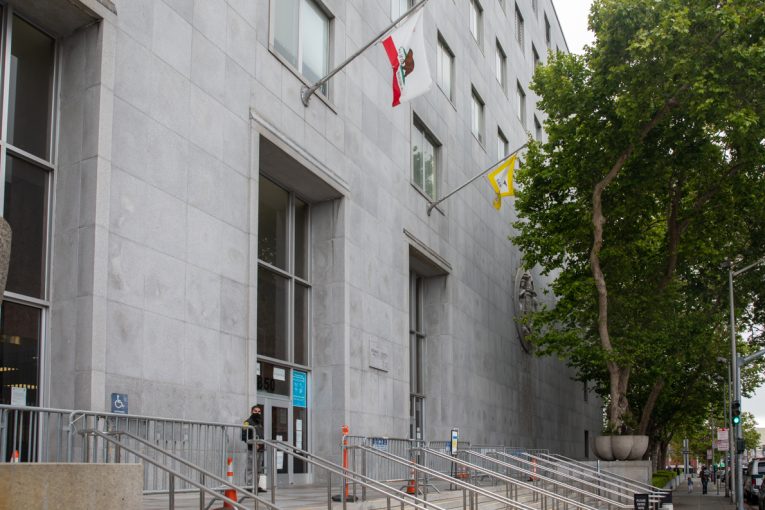
SAN FRANCISCO — A San Francisco County Superior Court jury returned guilty verdicts Monday morning on charges of gross vehicular manslaughter while intoxicated and related offenses after approximately two days of deliberations.
The case stemmed from a February 2021 crash that killed Sheria Musyoka, a 27-year-old pedestrian. Central to the trial was whether the accused was conscious of his actions at the time of the crash and whether his mental state resulted from mental illness or voluntary intoxication.
The jury trial began in early October, with opening statements delivered Oct. 19. San Francisco police officers, nurses, mental health experts and other witnesses testified over approximately three weeks.
During closing arguments, Assistant District Attorney Mark Koo emphasized evidence of the accused’s impairment. According to multiple eyewitnesses, the accused was driving between 50 and 70 mph on Lake Merced Boulevard.
The accused drove straight through a red light from a left-turn lane, striking a pedestrian in the crosswalk and causing a four-vehicle collision that injured two others.
Koo also emphasized the accused’s toxicology report from San Francisco General Hospital following the crash, which revealed a blood alcohol concentration of 0.07% and a methamphetamine concentration of 84 nanograms per milliliter.
Koo cited testimony indicating that the methamphetamine concentration exceeded therapeutic levels and that combining methamphetamine and alcohol could amplify the effects of both substances.
During his closing argument, Deputy Public Defender Maloof reiterated the defense’s position that the accused was unconscious of his actions at the time of the crash, not because of intoxication but because of a psychotic episode associated with schizophrenia.
Maloof cited evidence that the accused had experienced symptoms of psychotic disorders since 2008 and had been diagnosed with schizophrenia in 2016.
The defense attorney also pointed to the accused’s history of depression, anxiety, polysubstance use disorder, echolalia, psychotic symptoms and bipolar disorder, arguing that his substance use began as an attempt to self-medicate.
Maloof argued that the concentrations of substances in the accused’s blood were insufficient to explain his behavior immediately following the crash.
The defense attorney played recordings of police officers describing their difficulty communicating with the accused, saying he was “useless to get info” from and that they “might as well just let him babble.”
Maloof also highlighted the accused’s incoherent and sometimes sexually explicit statements following the crash. Nurses testified that the accused was hyperverbal, fidgety and laughing inappropriately upon his admission to the hospital.
Maloof repeatedly described the accused as “gravely disabled,” a legal designation that can provide grounds for an involuntary psychiatric hold under California law.
Two experts testified regarding the accused’s mental state.
The prosecution called Dr. Kris Mohandie, a clinical psychologist, who testified that the accused’s behavior was consistent with intoxication that could have resulted from the substances found in his blood.
The defense called Dr. Ashley Mezzasalma, a forensic neuropsychologist who evaluated the accused, confirmed his schizophrenia diagnosis and testified that his behavior was consistent with a psychotic episode.
Maloof also reminded jurors of testimony from a San Francisco General Hospital toxicologist who stated that “what you saw far exceeds what meth and alcohol can produce at those numbers.”
Under California law, when sufficient evidence raises the defense of unconsciousness, the prosecution bears the burden of proving beyond a reasonable doubt that the accused was conscious at the time of the alleged offense.
Koo pointed to the accused’s ability to engage with officers and medical staff, his recollection of events preceding the crash, his goal-oriented behavior and his request, made in the third person, to have his handcuffs removed.
Maloof argued that this evidence did not establish consciousness beyond a reasonable doubt, given the accused’s mental health history, the concentrations of substances in his blood and his erratic behavior following the crash.
After approximately two days of deliberations, the jury found the accused guilty on all counts, including gross vehicular manslaughter while intoxicated, driving under the influence, driving a stolen vehicle and related charges.
The jury also found the accused guilty of a separate count of driving under the influence stemming from an incident in December 2020.
At the time, the accused had a methamphetamine concentration of 410 nanograms per milliliter and a blood alcohol concentration of 0.01%.
Officers observed the accused swerving, driving well below the speed limit and running stop signs. He was arrested but subsequently released under supervision before the fatal February crash.
A bench trial on aggravating factors is scheduled for Wednesday, Nov. 25, in Department 24 of the San Francisco Hall of Justice.
To comment please go to one of these social media platforms:
Facebook: https://www.facebook.com/DavisVanguard
LinkedIn: https://www.linkedin.com/company/peoples-vanguard-of-davis-inc/
Instagram: https://www.instagram.com/davisvanguard/
X: https://x.com/davisvanguard
Bluesky: https://bsky.app/profile/vanguardnewsgroup.bsky.social
Subscribe to the Vanguard News letters. To make a tax-deductible donation, please visit davisvanguard.org/donate or give directly through ActBlue. Your support will ensure that the vital work of the Vanguard continues.
