
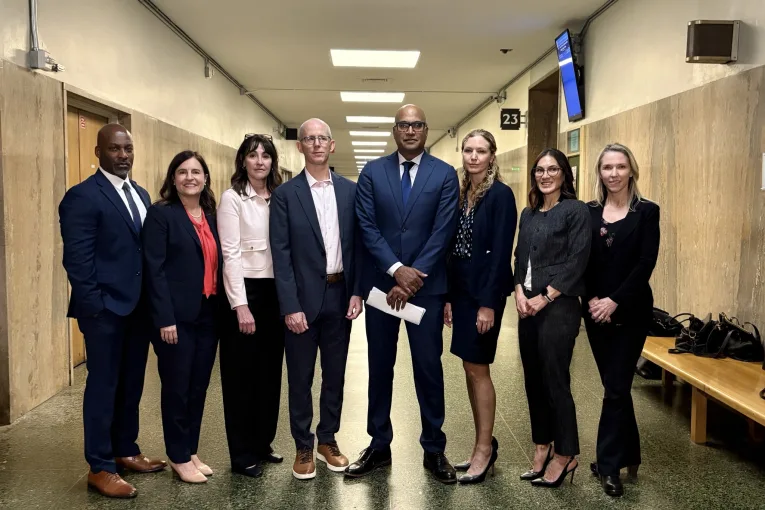
SAN FRANCISCO — San Francisco Public Defender Mano Raju challenged a contempt judgment and $26,000 in sanctions before the First District Court of Appeal Thursday, as 36 public defense leaders from across California rallied behind him in a dispute over excessive caseloads, inadequate funding and the constitutional right to effective legal representation.
The appellate hearing follows more than a year of escalating tensions over public defense workloads in San Francisco, including months of evidentiary hearings extensively covered by the Vanguard last fall.
On March 10, San Francisco Superior Court Judge Harry Dorfman found Raju in contempt after his office continued limiting the number of new criminal cases it could accept, citing excessive workloads and ethical obligations to existing clients. On March 24, Dorfman imposed $26,000 in sanctions.
Raju’s attorney, Kory DeClark, a partner at BraunHagey & Borden LLP, presented oral arguments Thursday challenging the contempt judgment and sanctions. A ruling is expected within 90 days.
Raju defended his decision Thursday, arguing that public defenders cannot fulfill their constitutional obligations without reasonable limits on their workloads.
“Across the country, public defender offices are grossly under-resourced compared to police and prosecutors. In San Francisco we have seen a significant increase in our workload and the length of time it takes cases to work their way through our overburdened courts,” Raju said.
“I stand by my decision to adopt modern professional workload standards for public defenders to protect due process for our clients and ensure my staff have the capacity to provide the effective representation every client deserves.”
DeClark argued that the trial court exceeded its authority by overriding the professional judgment of defense attorneys regarding their ability to represent additional clients.
“The U.S. Constitution and California’s Rules of Professional Conduct require public defenders to provide effective representation to every client. Extensive case law supports our position that a Superior Court judge lacks the authority to arbitrarily override the professional judgment of defense attorneys and their supervisors to assess their capacity to take on more cases,” DeClark said.
The dispute dates to May 2025, when the San Francisco Public Defender’s Office began declaring itself unavailable for a limited number of new criminal cases because of excessive workloads.
As the Vanguard reported in November 2025, the office declined approximately 11% of felony cases and 15% of misdemeanor cases between May 7 and Oct. 23, continuing to accept the overwhelming majority of new appointments.
The resulting pressure on San Francisco’s conflict counsel panel became a central issue during the hearings. Julie Traun, who oversees the panel, testified that it typically received 10 to 20 new cases per week but had recently received as many as 48.
Throughout the hearings, Assistant Chief Attorney Hadi Razzaq argued that the office’s growing workloads could not be understood simply by examining the number of cases filed. He pointed to increasingly complex litigation and the demands placed on attorneys, investigators and other support staff.
During a Nov. 25 hearing, Razzaq warned that the office was already operating in what he described as the “red zone,” where excessive workloads threatened attorneys’ ability to meet their constitutional and ethical obligations.
Dorfman acknowledged that many attorneys were overworked but questioned whether every felony-qualified attorney had reached capacity.
The District Attorney’s Office challenged the Public Defender’s Office’s explanation, with Assistant District Attorney Ana Gonzalez arguing that structural changes in law and court practices, rather than prosecutorial filing decisions, were driving the backlog of unresolved cases.
During December hearings, Dorfman explored whether supervising attorneys and attorneys assigned to specialized units could assume additional felony cases.
Razzaq cautioned that reassigning managers would undermine supervision, while moving attorneys from specialized units could jeopardize grant funding supporting immigration and post-conviction legal services.
By the conclusion of the evidentiary hearings in December, Dorfman emphasized his obligation to appoint counsel for people accused of crimes who could not afford attorneys. Public defenders maintained that those appointments could not come at the expense of effective representation for existing clients.
In January, Dorfman ordered the office to resume accepting felony appointments. Raju continued limiting new cases, leading to the March contempt proceedings.
During the March 24 sanctions hearing covered by the Vanguard, attorneys, investigators and social workers testified about the consequences of excessive workloads.
Raju warned that delays in providing legal services could prolong incarceration, separate families and pressure people into accepting guilty pleas.
Social worker Mileti Afuhaamango testified that requests for assignments in the reentry unit increased by 54% in 2025 compared with the previous year. Inadequate staffing, she explained, prevented social workers from completing work that could help secure clients’ release.
Deputy public defenders also described increasingly demanding trial preparation, extensive evidence review and the toll excessive workloads were taking on their health and personal lives.
Dorfman nevertheless maintained that the court had the authority and responsibility to appoint attorneys it determined were available. He imposed $1,000 in sanctions for each of 26 declined appointments.
Nine California chief public defenders attended the March hearing in support of Raju, and national organizations subsequently condemned the sanctions.
On April 8, the Court of Appeal stayed enforcement of the sanctions.
Ahead of Thursday’s appellate hearing, 36 public defense leaders representing 34 California counties issued a joint statement supporting Raju and calling for greater state investment in indigent defense.
“Every person accused of a crime is entitled to constitutionally effective representation, and that promise means nothing when defenders are carrying more cases than anyone can responsibly handle,” the chiefs said.
“Telling a court ‘we cannot take more’ is not defiance. It is honesty about what the Sixth Amendment requires.”
Among those signing the statement were Los Angeles County Public Defender Ricardo D. García, Alameda County Public Defender Brendon Woods, Sacramento County Public Defender Amanda Benson, Santa Cruz County Public Defender Heather Rogers and Yolo County Public Defender Tracie Olson.
In a separate statement, García argued that public defenders were being punished for systemic failures beyond their control.
“No public defender should be punished for upholding their ethical obligations and protecting clients’ constitutional right to meaningful representation,” García said.
“We cannot continue to hold public defender offices accountable for broader systemic failures, including expanding policing, prosecution, and incarceration while underinvesting in public defense and the communities most impacted by the criminal legal system.”
Olson pointed to efforts in Yolo County to secure additional state funding and address disparities between prosecution and defense resources.
“What is happening in San Francisco should serve as a wake-up call to the State of California,” Olson said.
“Earlier this year, the Yolo County Board of Supervisors unanimously adopted a resolution recognizing that counties are being asked to shoulder an increasingly costly constitutional mandate without sufficient state funding.”
On March 24, the same day Dorfman imposed sanctions against Raju, the Yolo County Board of Supervisors unanimously adopted Resolution 26-28, calling on California to establish adequately funded statewide approaches to indigent defense that incorporate empirical workload standards, promote sustainable staffing and address funding inequities between prosecution and defense.
The resolution cited the U.S. Supreme Court’s landmark 1963 decision in Gideon v. Wainwright, which established the constitutional right to appointed counsel for people accused of crimes who cannot afford an attorney.
It also cited the 2023 National Public Defense Workload Study, which documented how excessive workloads and chronic underfunding undermine constitutionally effective representation.
Although indigent defense in California is primarily funded and administered at the county level, the Yolo County resolution asserted that the state bears ultimate responsibility for ensuring constitutional rights are protected.
“This is not simply a concern raised by public defenders. Local governments are recognizing that the current system is unsustainable,” Olson said.
“The State cannot continue to leave counties responsible for fulfilling a constitutional mandate without providing the resources necessary to meet it.”
Rogers, the Santa Cruz County public defender, emphasized the increasingly complex needs of people represented by public defenders, including mental illness, substance use disorders, housing instability, trauma and potential immigration consequences.
“We work to address the root causes that brought them into the system while litigating cases that are often aggressively charged under laws like Prop 36,” Rogers said.
“Constitutionally effective representation demands far more than a warm body in the courtroom. It requires sustained investment, and respect for leaders who have the courage to say, ‘We cannot take any more cases and still meet our constitutional obligations.’ Something has to give.”
The chief defenders are pursuing a greater state role in indigent defense funding through the California Independent Commission on Public Defense, the California Public Defenders Association and advocacy within their respective counties.
“The answer is not to punish defenders for naming the problem,” the chiefs said. “The answer is to fund public defense so that every office can do what the Constitution requires and give the vulnerable people we serve the time, care and skill they deserve.”
To comment please go to one of these social media platforms:
Facebook: https://www.facebook.com/DavisVanguard
LinkedIn: https://www.linkedin.com/company/peoples-vanguard-of-davis-inc/
Instagram: https://www.instagram.com/davisvanguard/
X: https://x.com/davisvanguard
Bluesky: https://bsky.app/profile/vanguardnewsgroup.bsky.social
Subscribe to the Vanguard News letters. To make a tax-deductible donation, please visit davisvanguard.org/donate or give directly through ActBlue. Your support will ensure that the vital work of the Vanguard continues.
