
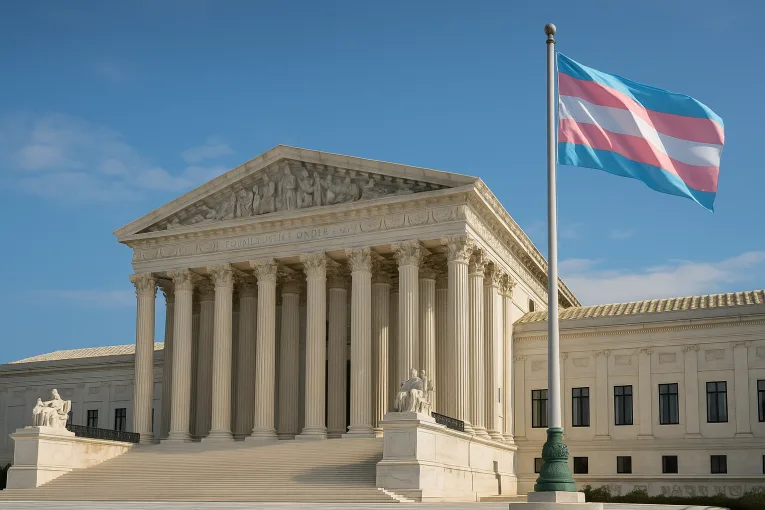
WASHINGTON — The U.S. Supreme Court on Monday, Nov. 9, vacated a federal appeals court ruling in a civil rights lawsuit brought by a transgender woman challenging her treatment at a Colorado jail, directing the court to reconsider its decision in light of two recent Supreme Court rulings concerning transgender rights.
The case, Roybal v. Griffith, No. 25-442, concerns Darlene Griffith, who challenged her placement in a men’s housing unit and searches conducted by male officers while detained at the El Paso County Jail.
According to Griffith’s complaint and the Tenth Circuit opinion included in the Supreme Court appendix, she alleged that jail officials assigned her to a men’s housing unit based on biological sex despite her identification as a woman. She also challenged restrictions on access to women’s clothing and personal items.
Griffith further alleged that she was sexually assaulted by another detainee while housed in the men’s unit. She also claimed that male deputy Andrew Mustapick participated in a visual body-cavity search despite her requests for a female deputy.
Additionally, Griffith alleged that male officers conducted pat-down searches involving her breasts and groin. These allegations have not been established as facts.
According to USA Today, the Tenth Circuit revived portions of Griffith’s lawsuit in February 2025 after a lower court dismissed her claims.
The appeals court concluded that Griffith had plausibly alleged violations of the Fourteenth Amendment’s Equal Protection Clause concerning the jail’s housing and commissary policies, as well as Fourth Amendment violations involving searches.
The court reasoned that the jail’s policies potentially classified detainees based on sex, raising questions about whether those policies satisfied intermediate scrutiny.
Under that standard, the government must demonstrate that a sex-based classification serves an important governmental objective and is substantially related to achieving that objective.
The Tenth Circuit also revived Griffith’s claim that Mustapick conducted an abusive search, although it upheld qualified immunity for the deputy regarding his participation in the cross-gender search itself.
The appeals court did not determine that the jail’s policies were unconstitutional. Instead, it found that Griffith had sufficiently alleged certain constitutional violations to allow those claims to proceed.
In its Nov. 9 order, the Supreme Court granted the county officials’ petition for review, vacated the Tenth Circuit’s judgment and remanded the case for reconsideration in light of United States v. Skrmetti (2025) and West Virginia v. B.P.J. (2026).
The action, known as a grant-vacate-remand order, does not resolve the underlying constitutional questions. Instead, it directs the lower court to reconsider its earlier decision under the legal framework established by the more recent rulings.
One of those decisions, United States v. Skrmetti, was issued in June 2025 and concerned a Tennessee law restricting certain medical treatments for minors experiencing gender dysphoria.
In a majority opinion written by Chief Justice John Roberts, the Supreme Court upheld the law, concluding that its restrictions did not classify individuals based on sex or transgender status in a manner requiring heightened scrutiny under the Equal Protection Clause.
The Court instead applied rational basis review, which requires a government policy to bear a rational relationship to a legitimate governmental interest.
The decision may affect Griffith’s lawsuit because it addresses how courts determine whether policies affecting transgender individuals constitute sex-based classifications.
The Tenth Circuit must now reconsider whether the reasoning in Skrmetti changes its earlier assessment of the jail’s housing and commissary policies.
The second precedent, West Virginia v. B.P.J., was decided in June 2026 and concerned a transgender girl challenging West Virginia’s restrictions on transgender girls participating in female school athletic teams.
The Supreme Court upheld the state’s law, concluding that its sex-based classification satisfied intermediate scrutiny because it was substantially related to important governmental interests involving competitive fairness and safety.
The Court also rejected the constitutional challenge to the restrictions, reasoning that the law’s classification based on biological sex did not violate the Equal Protection Clause under the circumstances presented.
Although B.P.J. concerned school athletics rather than correctional facilities, its reasoning may influence how the Tenth Circuit evaluates sex-based classifications in Griffith’s case.
Neither decision directly establishes the constitutional standards governing housing assignments or searches involving transgender detainees in correctional facilities.
The county officials who petitioned the Supreme Court for review, including Sheriff Joseph J. Roybal, argued that the Tenth Circuit applied the wrong constitutional standard.
They maintained that correctional facilities require flexibility when making decisions involving institutional security, employee safety and detainee privacy.
The officials also argued that housing classifications based on biological sex serve legitimate correctional interests and that courts should defer to jail administrators when evaluating search policies.
Griffith opposed the petition, arguing that institutional security concerns do not automatically eliminate the requirement to evaluate whether sex-based classifications satisfy constitutional standards.
Her attorneys maintained that the Tenth Circuit correctly determined that her allegations warranted further proceedings.
The dispute raises questions about how courts should balance correctional institutions’ security interests with constitutional protections against discrimination and unreasonable searches.
Following the Supreme Court’s order, the case returns to the Tenth Circuit for reconsideration under Skrmetti and B.P.J.
The appeals court must revisit its previous constitutional analysis and determine how the newer precedents affect Griffith’s claims.
The Supreme Court has not determined whether Griffith’s treatment was unconstitutional or whether the county’s policies violated federal law.
To comment please go to one of these social media platforms:
Facebook: https://www.facebook.com/DavisVanguard
LinkedIn: https://www.linkedin.com/company/peoples-vanguard-of-davis-inc/
Instagram: https://www.instagram.com/davisvanguard/
X: https://x.com/davisvanguard
Bluesky: https://bsky.app/profile/vanguardnewsgroup.bsky.social
Subscribe to the Vanguard News letters. To make a tax-deductible donation, please visit davisvanguard.org/donate or give directly through ActBlue. Your support will ensure that the vital work of the Vanguard continues.
