
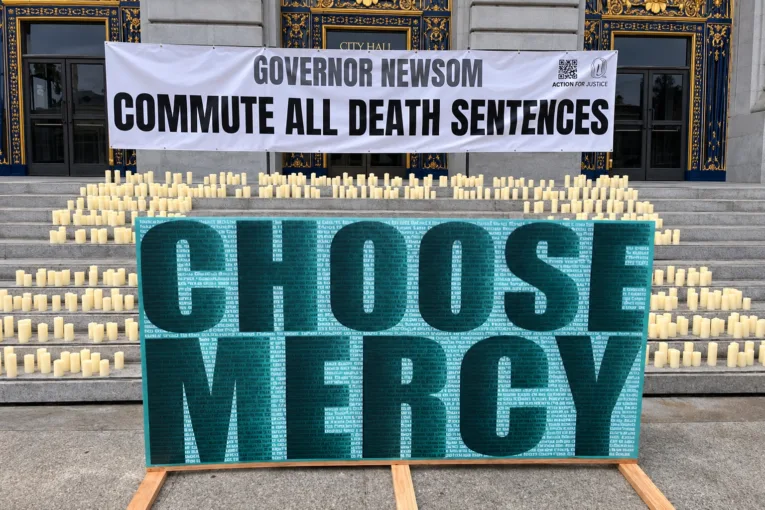
SACRAMENTO, Calif. — The sisters of Polly Klaas, whose 1993 kidnapping and murder became one of California’s most notorious crimes, joined other families of murder victims Monday in supporting Gov. Gavin Newsom’s decision to commute California’s death sentences, describing decades of grief, painful court proceedings and their belief that executions cannot provide the healing they have sought.
During an emotional virtual news conference, survivors recounted the murders of their sisters, spouses, children and other loved ones, explaining why they oppose capital punishment even as they continue to live with the consequences of violent crime.
The speakers urged the California Supreme Court to act quickly on the commutations requiring its recommendation, allowing Newsom to complete the process before leaving office in January.
The news conference highlighted divisions among murder victims’ families over capital punishment, including the opposition of some survivors to executions carried out in the names of their loved ones.
Jess Nichol and Annie Nichol, the stepsister and half-sister, respectively, of Polly Klaas, offered a perspective on the death penalty that contrasts with the public opposition to Newsom’s decision expressed by Polly’s father, Marc Klaas.
Their participation was particularly significant because Newsom has credited an October meeting with the two women inside a former death row cell at San Quentin with helping solidify his decision to commute the sentences of California’s 548 condemned prisoners.
In a Nov. 6 interview with the San Francisco Chronicle, Newsom described the conversation as one of the most profound meetings of his political career.
The sisters told Newsom that their opposition to executions had developed over years of reflection on Polly’s murder and the criminal justice policies adopted in its aftermath.
During Monday’s news conference, Jess Nichol explained that their position did not arise from forgiveness of the man who killed Polly.
“My sister Annie and I are sisters of Polly Class, the girl who was taken from her bedroom by a stranger when she was 12 years old and murdered,” Nichol said, according to a transcript of the news conference. “It devastated us and it changed the course of our lives.”
“We do not forgive the man who did this. And yet we’ve also come to realize that as long as he is never able to cause harm again, it is irrelevant to our process of healing or justice what actually happens to him, including how he ultimately dies.”
Nichol said her opposition to capital punishment emerged through years of reflection rather than forgiveness.
“It’s taken many years of healing and reflection to come to the understanding that we oppose the death penalty. Killing a person in our name does not undo what was done to Polly and it is not something we want done in her memory.”
She challenged the assumption that all murder victims’ families want executions.
“Some victims obviously want an execution. Others like us don’t. When victims are this divided, the death penalty shouldn’t be the default answer.”
Nichol acknowledged the pain experienced by families who supported death sentences and now face the possibility that those sentences will be changed.
“Many were promised something and they’re hearing that this commutation takes it away, but you deserve more than a promise,” she said. “You deserve real tangible support, counseling, financial help, safety, clear information, and a voice in the process.”
She argued that resources devoted to capital punishment should instead support survivors and violence prevention.
“For years, California has poured enormous resources into capital punishment while victims have been left to piece their lives back together mostly on their own. And I’d like to see that flip. Let’s put the money and effort into helping survivors heal and into programs that prevent harm in the first place.”
Annie Nichol described the lasting consequences of having punitive criminal justice policies associated with Polly’s murder.
“Jess and I carried the shame of the policies passed in Polly’s name for years. It was incredibly painful to know how much harm had been done in our sister’s memory.”
She said speaking publicly against extreme punishment had become part of her own recovery.
“Jess and I often say that healing is the process of imagining what justice could be. Public policy should not take survivors at the most acute moment of our pain and turn that moment into an irreversible punishment that can follow a family for decades.”
Annie Nichol said the death sentence imposed more than three decades ago had not brought the family closure.
“For decades, that sentence has kept our family tethered to hearings, appeals, headlines, and the possibility of another death. It did not give us closure. It did not help us heal.”
“Nothing will undo what happened to Polly. Nothing can give her back to us, but California can choose not to compound violence in her name or in the names of thousands of other victims.”
She urged the court to move quickly, saying prolonged uncertainty would impose another burden on survivors.
“Execution is not a system responding to victim’s needs. Too often it is a system borrowing our pain to justify another act of violence. Survivors deserve more than that.”
The sisters’ statements stood in contrast to those of Marc Klaas, who has sharply criticized Newsom’s decision and previously urged him not to suspend executions.
The Chronicle reported that Newsom weighed his recent conversation with the sisters against a meeting he had with Marc Klaas in 2019, shortly before announcing California’s execution moratorium.
Bethany Webb, whose sister Laura was killed in the 2011 Seal Beach mass shooting in Orange County, described how the prosecution of the gunman prolonged her family’s suffering.
Nine people were shot and eight were killed in the attack. Webb said her mother, Hattie Stretz, was the only person shot who survived and had authorized Webb to speak on her behalf.
“After my sister was murdered, we were re-traumatized for six years in a death penalty trial,” Webb said.
Webb accused the Orange County Sheriff’s Office and District Attorney’s Office of withholding evidence and committing perjury during the proceedings. Those allegations were her account of the case and were not independently established during the news conference.
She challenged prosecutors who claim to represent victims’ interests in opposing the commutations.
“They are saying that they speak for us, that they understand our pain. No, you have witnessed pain maybe, but you don’t understand it.”
“And what you do re-traumatizes us every time you ask us to hold onto that pain, that you’re somehow going to heal us with the murder of another person.”
Webb described Newsom’s decision as an effort to interrupt the cycle of violence rather than perpetuate it.
“The person that murdered my sister called her collateral damage when asked why he shot everybody. I am the sister of collateral damage.”
She connected that experience to the possibility of wrongful executions.
“If you understand that there are innocent people on death row and there are, and you still support this process, you support collateral damage, you support making another sister or another mother or another husband collateral damage.”
“I do not.”
Paul Wilson, whose wife Christie was also killed in the Seal Beach shooting, described how his position on capital punishment changed after years of involvement in the prosecution.
Wilson said he had been married to Christie for 26 years. She was the mother of their three children and grandmother of their five granddaughters.
“I wanted Christie’s killer to be punished and I wanted him to die, but an unexpected and very painful series of events eventually led me to question whether the death penalty would provide the true justice that I sought.”
“It is not sympathy that changed my mind. It was what I learned about our criminal justice system and the win at all cost mentality and the pursuit of the death sentence and what it did to the families of the people that were killed, and I’m one of those people.”
Wilson said the lengthy trial became dominated by the Orange County jailhouse informant scandal rather than the murders themselves.
“I sat for six years in a trial that became about the largest snitch scandal in US history and not about the killing of my wife, Christie.”
He said his experience had given him an understanding of both the desire for severe punishment and the damage caused by the capital punishment process.
“I know what it feels like to want someone to die because they took the person you love. I know the anger and I know the desire for that ultimate punishment, but I also know what happens when the machinery of death becomes part of a victim’s life. It can prolong the suffering rather than resolve it.”
Wilson emphasized that commuting a death sentence does not erase the underlying crime or require victims’ families to forgive the person responsible.
“The commutation does not erase the crime. It does not mean forgiving someone, and it does not require the families to forgive, to forget or to stop grieving.”
He urged the California Supreme Court to act quickly.
Nick and Amanda Wilcox, whose daughter Laura was killed in a January 2001 shooting at a Nevada County mental health clinic, described their opposition to capital punishment as a belief that survived the murder of their own child.
Nick Wilcox recalled dropping Laura off at work while she was home on winter break from college. A gunman entered the clinic intending to kill his psychiatrist, ultimately killing three people and severely injuring others at the clinic and a nearby restaurant.
Laura was shot four times at close range.
Wilcox said he and his wife had been raised in the Quaker faith, which taught them that killing was wrong, including executions.
After the district attorney announced an intention to seek the death penalty, the couple met with him to explain their position.
“We recognized that he was free to do as he felt appropriate, but we communicated that under no circumstances could he do so in our names.”
The person responsible ultimately pleaded guilty and was found not guilty by reason of insanity. Wilcox said he would likely spend the rest of his life at Napa State Hospital.
“For me, it would have brought no sense of closure as I could never have what I wanted most, which was to have Laura back.”
Amanda Wilcox described the devastation of losing her daughter and the difficulty of rebuilding her life.
“After Laura was killed, my life was turned upside down. I spent months in a state of shock, disbelief, pain, and physical illness. I could not sleep. I’d lost the future that I had envisioned. My oldest child, my only daughter, was dead. I could not imagine a life without Laura.”
She said she wanted the public and the justice system to focus on Laura’s life rather than the punishment of the person who killed her.
“What I wanted most, I could never have, which was to have my daughter alive again. I wanted the focus to be on remembering Laura, not the fate of her murderer.”
Amanda Wilcox described California’s death penalty as a source of prolonged uncertainty for families.
“I think all survivors want legal finality, but the death penalty in California is a false promise that traps survivors into decades of legal proceedings and delays.”
She said Newsom’s announcement had brought an emotional response.
“When I read Governor Newsom’s open letter regarding the commutations, I felt like Laura was leaving it with me. I shed tears of gratitude for his courage, moral conviction, and sensitivity.”
Judy Kerr, whose brother Bob was murdered in 2003, said she had spent years advocating against capital punishment following his death.
Kerr described how her brother was beaten, strangled and forced to withdraw money from an ATM before his body was abandoned beside a road.
She said executions would not provide justice for her family.
“State sanctioned killing has never and will never be about justice for victims’ families. It’s about who we are as a society.”
Kerr said the possibility of wrongful convictions made capital punishment particularly troubling, while the appeals necessary to guard against mistakes could prolong the suffering of survivors.
“The risk of wrongful conviction is real and the risk of executing an innocent person is reprehensible and will never help me heal from my brother’s murder.”
She said she had previously supported legislative efforts to abolish capital punishment in Washington state and viewed Newsom’s commutations as a step toward ending the practice in California.
Suzanne Verge, whose brother Peter was murdered in Santa Monica when he was 18 and she was 15, described how her initial desire for revenge changed during the legal proceedings.
“As we went through the trial, I slowly realized that killing the perpetrator would not bring my brother back. I hated the perpetrator with every fiber of my being, but I could not ignore the other family’s devastation. Two families were forever changed.”
Verge said the anger she experienced after her brother’s death became damaging to her own well-being.
“I had so much anger and I was seeking revenge, but it was so toxic and debilitating for me.”
She invoked a saying commonly attributed to Confucius: “Before you embark on a journey of revenge, dig two graves.”
“For me, the death penalty would not have brought peace,” Verge said.
She also expressed sympathy for victims’ families who disagree with Newsom’s decision.
“My heart goes out to the victims that believe differently from me. I know this must be a very challenging and painful time, so I urge the courts to move swiftly.”
Rebecca Weiker described the murder of her sister Wendy, a psychologist who worked with adolescents and young adults at a community mental health clinic.
Wendy was 31 when she was killed 34 years ago.
“She was my oldest sister, protector, teacher, role model, and inspiration,” Weiker said. “Wendy was a great swimmer, cook, mother, friend, and advocate for children and women.”
Weiker said her experience led her to restorative justice work involving dialogue between victims and people responsible for harm.
She emphasized that survivors have different responses to violence and should be free to determine their own paths toward healing.
“After violence, those of us left behind have so many needs, the need to have our loved one remembered beyond what happened to them, the need to understand why this happened, the need to prevent any other family from experiencing such senseless pain and loss, need for resources and time to heal, to grieve, the need for hope and healing.”
“For me, vengeance and killing Do not meet any of these needs.”
Rabbi Suzanne Singer, whose sister and brother-in-law were murdered, discussed her opposition to executions through the teachings of Jewish tradition.
“As a rabbi, I believe in the sanctity of life. We’re all created in the image of God.”
Singer explained that although capital punishment appears in biblical law, rabbinic tradition established demanding evidentiary requirements that made executions rare.
She also cited the Reform Jewish movement’s longstanding opposition to capital punishment, including a formal position adopted in 1959.
Singer quoted Rabbi Richard Levy on the possibility of redemption even for people responsible for terrible crimes.
“To deny the possibility of finding the image of God and human beings who have committed awful crimes is to declare that evildoers are more powerful than God, that they have the power to destroy the image that God gave them.”
She also emphasized the irreversible consequences of executing someone wrongfully convicted.
“A person improperly imprisoned for murder can be exonerated and set free, but someone put to death for a crime he or she did not commit can never be redeemed,” she said, quoting Rabbi Dan Polish.
Natasha Minsker, who organized and moderated the news conference, said the speakers represented a broader group of 50 murder victims’ family members who had written to Newsom urging him to commute death sentences.
Minsker also read a statement from Golden State Warriors head coach Steve Kerr, whose father, Malcolm Kerr, was assassinated in Lebanon in 1984 while serving as president of the American University of Beirut.
“I know firsthand the pain of losing a loved one to violence. I was 18 when my father was assassinated. I miss him every day.”
“My father taught me that the death penalty has no place in a civilized society that values human dignity and human rights. I applaud the governor for commuting all death sentences.”
The survivors repeatedly emphasized that the commutations would not release incarcerated people from custody and that life imprisonment without the possibility of parole would remain a severe punishment.
Newsom announced Nov. 5 that he would commute all 548 death sentences in California. According to the Death Penalty Information Center, approximately one-third of those commutations can take effect immediately, while the remainder require approval from a majority of the California Supreme Court because the incarcerated individuals have multiple felony convictions.
The speakers urged the justices to act before Newsom leaves office, with several describing the prospect of additional delays as another source of uncertainty for families who have already spent years or decades confronting the consequences of violent crime.
To comment please go to one of these social media platforms:
Facebook: https://www.facebook.com/DavisVanguard
LinkedIn: https://www.linkedin.com/company/peoples-vanguard-of-davis-inc/
Instagram: https://www.instagram.com/davisvanguard/
X: https://x.com/davisvanguard
Bluesky: https://bsky.app/profile/vanguardnewsgroup.bsky.social
Subscribe to the Vanguard News letters. To make a tax-deductible donation, please visit davisvanguard.org/donate or give directly through ActBlue. Your support will ensure that the vital work of the Vanguard continues.
