
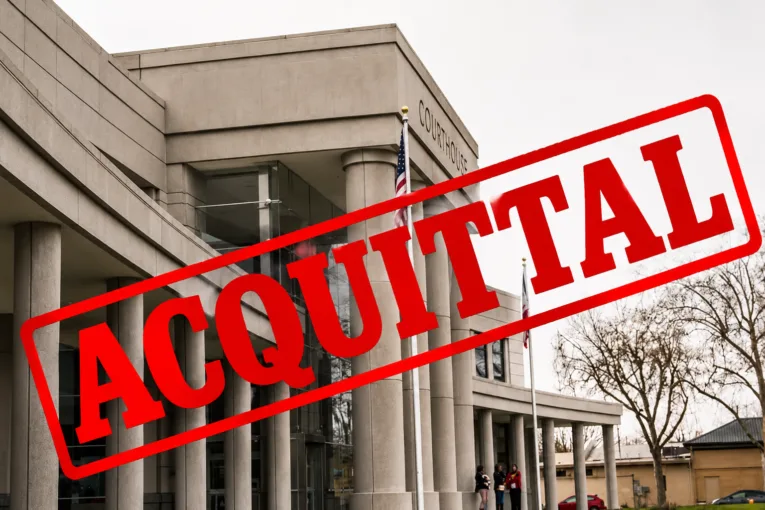
WOODLAND, Calif. — A Yolo County man who faced a potential sentence of 35 years to life in prison before being acquitted of murder and manslaughter last week spent approximately 18 months in custody, endured two jury trials and lived under court-ordered restrictions while his attorney maintained that he had acted lawfully to protect his wife.
In an interview with the Vanguard following the verdict, defense attorney Dale R. Gomes sharply criticized both the Woodland Police Department’s investigation and the Yolo County District Attorney’s Office’s decision to prosecute the case, arguing that authorities failed to properly evaluate evidence supporting self-defense.
Gomes, a former prosecutor with 20 years of experience, said the case illustrates a broader problem in criminal prosecutions: the unwillingness of some district attorneys to decline charges when the evidence does not establish criminal wrongdoing beyond a reasonable doubt.
“I believe the first gateway is the district attorney, and it’s their job to first decide that justice requires a conviction and that the evidence and the facts support somebody being punished for a criminal act,” Gomes told the Vanguard.
The jury acquitted David Manuel Sanchez Gallardo, identified by his attorney as David Gallardo, of second-degree murder and voluntary manslaughter following a retrial stemming from a fatal shooting outside a Woodland business on Dec. 3, 2023.
The verdict was returned in Department 7 of Yolo County Superior Court, with Judge Paul K. Richardson presiding, according to earlier Vanguard Court Watch reporting.
The jury also rejected two enhancement allegations, while a remaining aggravating circumstance was dismissed.
The case originated from a confrontation outside a business on West Main Street in Woodland, where Gallardo fatally shot his brother-in-law, Isaias Jaime.
Initial reports described the shooting as the culmination of an ongoing family dispute. However, Gomes said those accounts failed to capture the threats, family history and circumstances that led Gallardo to believe his wife’s life was in immediate danger.
According to Gomes, Gallardo and Jaime were related through their marriages to two sisters, and the family had experienced years of turmoil involving Jaime’s alleged drug use, threatening behavior and violence.
Gomes said the situation escalated during the Thanksgiving holiday weekend in 2023, when Jaime allegedly pulled a firearm on extended family members and threatened to kill them.
Following that confrontation, Gomes said, Jaime was told he could no longer remain in the family home, and his relationship with his wife effectively ended.
Over the following week, according to Gomes, Jaime sent threatening messages to family members, including threats to kill them.
On the evening of Dec. 3, Jaime went to his estranged wife’s residence seeking to speak with her but was turned away by his mother-in-law.
Gomes said Jaime and his brother then traveled to a massage business owned by Gallardo’s wife on West Main Street.
The business was closed, but Gallardo’s wife had arrived shortly beforehand to prepare for the following day.
According to Gomes, she saw the vehicle approach, recognized the potential danger and locked herself inside.
Jaime began demanding entry, and over approximately seven or eight minutes, his behavior escalated into threats to shoot and kill people inside the business.
Gomes said a Ring security camera captured the confrontation, including Jaime pounding on the glass door and making threats.
Gallardo’s wife called her husband, who lived approximately a mile away.
“Oh my gosh, Isaias is here. He’s threatening to shoot me,” she told him, according to Gomes’ account.
Gallardo instructed her to call 911 and retreat to the back of the business while he came to help.
Gomes said the call between the couple lasted approximately 20 seconds. Gallardo retrieved a firearm from his safe, drove toward the business and called 911 himself.
Both Gallardo and his wife were speaking with emergency dispatchers as the confrontation unfolded.
Gomes said the recordings were particularly important because they documented Gallardo’s attempt to obtain police assistance before the shooting.
When Gallardo arrived, Jaime was still outside the business.
According to Gomes, Gallardo believed Jaime was armed, based on his previous threats and history of carrying firearms.
Gallardo drove his truck toward Jaime, attempting to incapacitate him with the vehicle, but Jaime moved out of the way.
Gomes said Jaime then ran around the truck and approached the driver’s side window, where he began attacking Gallardo.
Gallardo retrieved his firearm from the center console and fired three shots through the open driver’s side window, one of which struck Jaime fatally.
The shooting was captured on Gallardo’s ongoing 911 call, Gomes said.
Following the shooting, Gallardo backed his vehicle into a parking space and remained on the telephone with the dispatcher.
“I’m sorry, sir, but I just shot him,” Gallardo told the dispatcher, according to Gomes.
He then followed instructions to unload his firearm and surrendered when Woodland police arrived.
Gomes acknowledged that Jaime was not armed during the final confrontation but argued that Gallardo reasonably believed otherwise, given the preceding threats and circumstances.
Under California law, a claim of lawful self-defense or defense of another can depend on whether the defendant reasonably believed there was an imminent danger of death or great bodily injury and that immediate deadly force was necessary.
The defense maintained that Gallardo’s belief was reasonable even if he was mistaken about whether Jaime possessed a gun.
“You don’t have to be right. You just have to be reasonable,” Gomes said.
Gomes argued that the Woodland Police Department failed to conduct an adequate investigation into those circumstances.
“The Woodland Police Department candidly just never did an investigation in this case,” he said.
He characterized the initial police response as focusing on the fact that Gallardo acknowledged shooting Jaime and that officers did not find a gun near the deceased man.
Gomes said that approach ignored the broader evidence of threats, the emergency calls and the events immediately preceding the shooting.
The case first went to trial in 2025, but the jury was unable to reach a unanimous verdict.
Gomes said the initial jury leaned toward acquittal on the murder charges, although he could not recall the precise vote, and was more evenly divided on manslaughter.
The case proceeded to a second trial, where Gomes said he was better positioned to challenge the prosecution’s evidence.
“I tried the case better because I had done it once before,” Gomes said.
He explained that testimony from the first trial gave him a clearer understanding of the prosecution’s case and allowed him to prepare a more effective cross-examination of the lead Woodland police detective.
“At this point, I had the lead detective’s testimony locked in from the first trial,” he said.
Gomes said he was able to challenge more of the detective’s sworn testimony and expose what he considered deficiencies in the original investigation.
“I think the case definitely tried better in the second time for us and certainly did not try better for the DA,” he said.
He also credited the second jury with applying the legal standards governing self-defense despite the fact that Jaime was not carrying a gun during the confrontation.
Gomes said the central question was not whether Gallardo’s perception of danger was ultimately correct, but whether his actions were reasonable under the circumstances as he understood them.
He argued that prosecutors should have recognized that distinction before pursuing a case that exposed Gallardo to decades in prison.
Gomes said that following the first trial, Gallardo was released from custody after spending approximately a year and a half incarcerated.
Although Gallardo returned to work and resumed family life, he remained subject to electronic monitoring and other restrictions while awaiting the retrial.
Gomes said Gallardo’s employer welcomed him back and that people who knew him continued to support him.
The acquittal ended those restrictions.
Following the verdict, the court ordered Gallardo’s monitoring device removed, his $50,000 bond exonerated and his vehicle returned, according to the Vanguard’s courtroom reporting.
Gomes said Gallardo had remained remarkably composed throughout the proceedings, despite the possibility of a lengthy prison sentence.
“I would characterize him as a man of great faith,” Gomes said.
He described Gallardo as confident in the circumstances that led him to intervene and convinced that he had no reasonable alternative when he believed his wife was in danger.
“I was very impressed. He was calmer than I was,” Gomes said.
In a written statement issued after the verdict, Gomes described the outcome as vindication for Gallardo and his family.
“It is with great satisfaction that I can issue this statement following today’s jury verdict finding Mr. Gallardo not guilty of both second-degree murder and manslaughter in Yolo County,” Gomes wrote.
“The jury’s verdict reflects what the evidence showed: Mr. Gallardo acted lawfully in self-defense in order to protect his wife from a very dangerous man. David Gallardo is a hero.”
Gomes also accused authorities of failing the family by pursuing the prosecution.
“Mr. Gallardo and his family were the victims here, but those who were vested with the responsibility of vindicating the innocent failed the Gallardo family,” he wrote.
The attorney’s criticism extended beyond the specific investigation to the responsibilities of prosecutors when evaluating cases involving potentially lawful uses of force.
Gomes acknowledged the difficulty of explaining to grieving families why a criminal prosecution may not be justified.
“And it takes a lot of courage if you’re an elected district attorney to look a mother in the eye and say, ‘I’m sorry, I can’t prosecute anybody for the death of your son,'” he said.
Drawing on his experience as a prosecutor, Gomes argued that the responsibility to determine whether a case warrants criminal punishment rests initially with the district attorney rather than the jury.
“I wish the takeaway was that district attorneys became more emboldened to be willing to have those hard conversations rather than just say, ‘I don’t want to make a decision. I’m going to let a jury decide,'” he said.
Gomes said prosecutors should independently evaluate whether the evidence establishes a criminal offense rather than simply allowing a jury to resolve every contested case.
“Because really, I just fundamentally disagree with that from a philosophical standpoint,” he said.
The Yolo County District Attorney’s Office has not provided a response to the criticisms raised in the interview. The acquittal resolved the criminal charges in Gallardo’s favor but did not independently establish that police or prosecutors engaged in misconduct.
For Gomes, the case raised a fundamental question about whether prosecutors are willing to exercise their discretion when the evidence supports a defense rather than a conviction.
“But I think their job is to try to do justice,” he said. “And if justice supports the person who acted in self-defense and not the person who’s dead, their job is to fight for that too. And I was disappointed that they weren’t willing to do that.”
To comment please go to one of these social media platforms:
Facebook: https://www.facebook.com/DavisVanguard
LinkedIn: https://www.linkedin.com/company/peoples-vanguard-of-davis-inc/
Instagram: https://www.instagram.com/davisvanguard/
X: https://x.com/davisvanguard
Bluesky: https://bsky.app/profile/vanguardnewsgroup.bsky.social
Subscribe to the Vanguard News letters. To make a tax-deductible donation, please visit davisvanguard.org/donate or give directly through ActBlue. Your support will ensure that the vital work of the Vanguard continues.
