
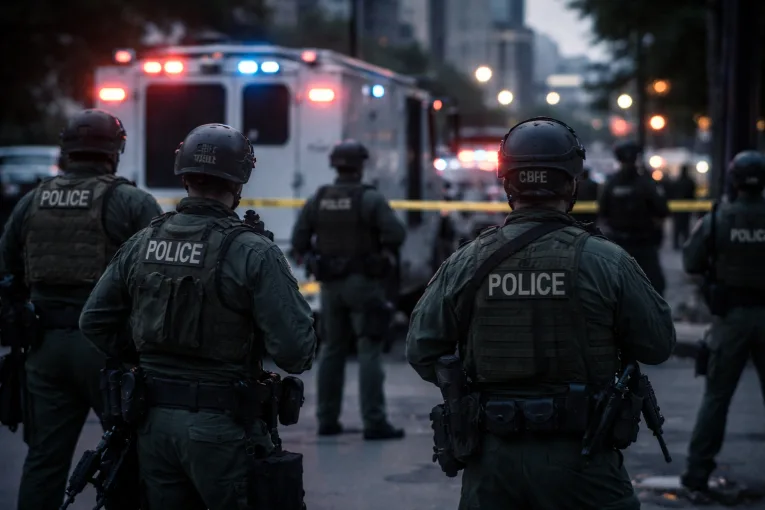
- “The problem, Fox argues, is not a lack of constitutional protections, but the erosion of enforcement mechanisms designed to give those protections meaning.” – Mike Fox, legal fellow at the Cato Institute
When federal agents kill civilians, the courthouse doors often remain closed to their families—not because the Constitution permits excessive force, but because the modern legal system has made such claims nearly impossible to bring.
That is the argument advanced by Mike Fox, a legal fellow at the Cato Institute, who says a dense web of Supreme Court doctrine and federal statutes has created what he calls a “legal black hole” around misconduct by federal officers.
In an interview with The Vanguard, Fox described a system that, in practice, insulates federal agents from civil accountability even in cases involving fatal shootings of U.S. citizens.
“The Framers entrusted citizen juries to adjudicate disputes between citizens and their government,” Fox said. “Consequently, assessing whether a police officer violated an individual’s Fourth Amendment right to be free from excessive force is precisely the type of judgment call the Framers tasked jurors to make.”
Fox’s critique comes amid renewed scrutiny of federal law enforcement following the killings of Renee Good and Alex Pretti, a 37-year-old ICU nurse and U.S. citizen who was fatally shot by a Border Patrol agent during a large-scale immigration enforcement operation in Minneapolis.
Video footage appears to contradict initial government statements that portrayed Pretti as posing a lethal threat, yet Fox said the legal system offers little recourse even when official accounts unravel.
The problem, Fox argues, is not a lack of constitutional protections, but the erosion of enforcement mechanisms designed to give those protections meaning.
Victims of misconduct by state or local police officers can bring civil rights lawsuits under Section 1983, a Reconstruction-era statute enacted in 1871. That law allows individuals to sue state and local officials for violating constitutional rights.
No comparable statute exists for federal officers.
To fill that gap, the Supreme Court in 1971 recognized an implied cause of action in a case known as Bivens v. Six Unknown Named Agents, allowing individuals to sue federal officials directly for constitutional violations. The decision involved an unlawful search and arrest and was grounded in the Fourth Amendment.
But Fox said the promise of Bivens has steadily eroded.
“The court extended it a little bit to gender discrimination claims and prison conditions claims,” he said. “But the court never went very far with it, and they started withering it away to the point that it almost is not even a viable remedy anymore.”
Over the past decade, the Supreme Court has repeatedly refused to extend Bivens to new contexts, particularly cases involving immigration enforcement.
In decisions such as Egbert v. Boule and Hernandez v. Mesa, the court declined to allow constitutional claims against Border Patrol agents, citing national security and foreign policy concerns.
“So basically the point here is that Bivens is really not a viable remedy,” Fox said. He added that several justices have openly questioned whether the doctrine should exist at all, raising the possibility that the court could eliminate it entirely.
Even in the rare case where a plaintiff survives the narrowing of Bivens, Fox said another obstacle almost always ends the case: qualified immunity.
The doctrine shields government officials from civil liability unless a court has previously found nearly identical conduct unconstitutional in the same jurisdiction.
“Unless the plaintiff can identify a case where the exact same facts happened in the exact same jurisdiction where a judge already said it was unconstitutional, your case is gone,” Fox said.
The result, he said, is a Catch-22. Courts dismiss cases because there is no prior precedent, but no precedent can develop because cases are dismissed at the outset. “Federal officials for constitutional violations are functionally immune from anything,” Fox said. “You can’t reach them.”
When constitutional claims fail, plaintiffs often turn to state-law tort claims, such as assault, battery or trespass.
But Fox said those claims, too, are routinely neutralized by the Westfall Act, a federal statute that allows the government to substitute itself as the defendant when federal employees are sued for actions taken within the scope of their employment.
“If you were to then go to court and sue that agent for trespass under state tort law, what would happen is the government would come in and certify that the agent was acting in their official capacity,” Fox said. “Then the agents would be removed as defendants. They’d be replaced with the United States government under the Federal Tort Claims Act.”
That substitution often proves fatal to a case. Fox described the Federal Tort Claims Act, or FTCA, as a “mind-numbingly complex labyrinth” filled with procedural traps and broad exceptions.
Among the most powerful is the discretionary function exception, which allows the government to avoid liability if an agent’s actions are deemed to involve policy judgment.
“We’ve argued in the past that of course agents can’t have discretion to violate the Constitution,” Fox said.
But the Supreme Court has never squarely resolved that question, leaving lower courts to dismiss claims on the theory that even mistaken raids or uses of force can qualify as discretionary acts.
“If raiding the wrong house is a policy judgment,” Fox said, “using excessive force is also a policy judgment.”
Even when plaintiffs overcome those barriers, the FTCA eliminates another safeguard central to Fox’s critique: the jury trial. Claims are decided by federal judges, not juries of ordinary citizens.
“Statistically speaking, there’s a high probability that judge is a former government lawyer,” Fox said. “You’re certainly not going to get the same level of deference you would get from 12 citizen jurors.”
That shift, Fox argued, represents a sharp departure from the constitutional design. “These are common-sense questions the Framers intended for juries to wrestle with,” he said. Instead, he said, modern doctrine has placed federal agents beyond the reach of both juries and meaningful civil accountability.
Fox situates the problem within the broader expansion of federal immigration enforcement under the Trump administration. Historically, he said, most Americans’ interactions with federal officials were limited to nonconfrontational contexts such as mail delivery or airport security. That has changed dramatically.
“Now with the proliferation of immigration enforcement under the Trump administration, ICE has gone from strategically targeting violent offenders to terrorizing people based on the color of their skin, the cities they live in and things like that,” Fox said.
He emphasized that accountability failures are structural, not merely the result of individual bad actors. While some lawmakers have called for the removal of specific DHS officials, Fox said such changes would be largely symbolic without legal reform.
“If they were serious about stopping things, Gregory Bovino wouldn’t have an operational command,” Fox said of the Border Patrol leader linked to the Pretti case. “He would be fired. He would be indicted.”
Fox argued that Congress has the tools to intervene if it chooses to use them. Lawmakers could create a statutory cause of action allowing people to sue federal officials directly for constitutional violations, similar to Section 1983, and explicitly eliminate immunity defenses.
“What that would do is that would create a statutory analog to Section 1983 to sue federal officials,” Fox said. “In doing so, they can abrogate immunities.”
Congress could also impose limits through the appropriations process, Fox said, by conditioning or withholding funding from agencies that repeatedly violate civil liberties. “Congress controls the power of the purse,” he said, adding that it is unreasonable to fully fund institutions “that are literally killing their constituents.”
Fox warned that unchecked federal power poses risks regardless of who holds office.
While aggressive enforcement currently targets immigrants and marginalized communities, he said the same tools could be turned elsewhere under a different administration.
“It’s a matter of who they’re targeting,” Fox said. “They’re targeting marginalized communities.”
He added: “When they can abuse it against people you don’t like, they could also weaponize it against you when someone else is in power.”
For Fox, the central question is not partisan but constitutional. As long as legal doctrine continues to insulate federal agents from accountability, he said, the law ceases to function as a constraint on power.
“Federal agents will operate with the knowledge that the law is not a barrier,” Fox said, “but a shield.”
Follow the Vanguard on Social Media – X, Instagram and Facebook. Subscribe the Vanguard News letters. To make a tax-deductible donation, please visit davisvanguard.org/donate or give directly through ActBlue. Your support will ensure that the vital work of the Vanguard continues.

“It’s a matter of who they’re targeting,” Fox said. “They’re targeting marginalized communities.”
True – they’re targeting white protestors who interfere with immigration officers. Those people are always marginalized. In fact, they’re in the margin (minority) regarding their underlying views on illegal immigration, which is the reason they’re out there in the first place.
I’m not marginalized, since I’m not an extremist regarding my underlying view. That’s why I’m not caught up in this. As a result, I’m not marginalized – despite sharing a skin color with the vast majority of protestors.
(Note how I didn’t say anything regarding my view of enforcement activities, since it’s pretty well established that there’s a problem with that.)