
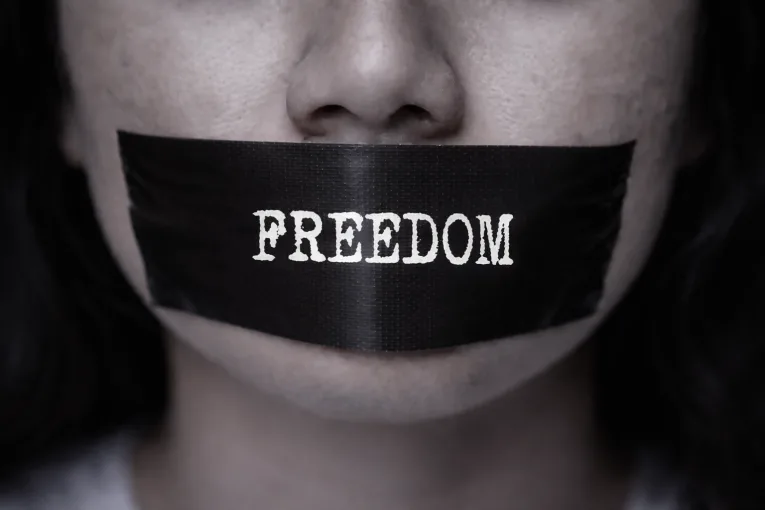
The most dangerous violence does not start with a fist. It starts with a word. It starts with a policy paper. It starts with a politician on a stage, or a commentator on a screen, speaking a sentence that is not a statement of fact, but a blueprint for harm.
We have been trained to call this “political speech.” We have been trained to treat it as part of the debate. We are told that the remedy for bad speech is more speech. This is a lie. It is a lie that confuses the symptom for the disease. When the speech is the mechanism of violence, more speech is just more violence.
The legal standard for when speech becomes criminal incitement was established in Brandenburg v. Ohio. The ruling held that the government cannot forbid advocacy of violence unless that advocacy is “directed to inciting or producing imminent lawless action and is likely to incite or produce such action.”
For decades, we have interpreted this test narrowly, applying it only to the man on the soapbox urging an angry mob to burn down a building right now. This interpretation is a failure of imagination and a failure of law. It has allowed a more insidious, bureaucratic form of incitement to flourish. It has allowed the architects of violence to replace the soapbox with the senate floor, the mob with a voting bloc, and the match with a piece of legislation.
The “imminent lawless action” is no longer a riot in the street. It is a death in a hospital room. It is a suicide in a child’s bedroom. This interpretation is a failure of imagination and a failure of law. It has allowed a more insidious, bureaucratic form of incitement to flourish. The courts have never applied Brandenburg’s logic to the legislator proposing a bill that will cause death. They have reserved it for the rioter with a brick. This is the fatal flaw. It treats the match as criminal but licenses the architect of the arson. It has allowed the architects of violence to replace the soapbox with the senate floor, the mob with a voting bloc, and the match with a piece of legislation. It is a famine in a poor neighborhood. It is a climate disaster decades in the making. The time delay does not make the violence less real. It makes it more efficient. It allows the inciter to distance themselves from the corpse.
We must expand the frame.
A call for “the eradication of transgenderism” from public life is not a policy position. It is a call for the eradication of transgender people. When a governor signs a law banning gender-affirming care for minors, they are not engaging in a medical debate. They are signing a death warrant. The data is unequivocal: transgender youth with access to affirming care see a 73% reduction in suicidality1. Denying that care does not pause a debate. It ends a life. The lawmaker who champions such a ban is not a conservative. They are an accessory to murder. Their speech, their law, is the first step in a chain of events that ends with a child in a coffin. That chain is the very definition of “imminent lawless action.”
The same logic applies to the movement to ban abortion. The slogan “abortion is murder” is not a philosophical claim. It is a legal one. It is an attempt to redefine a medical procedure as a homicide. The logical end point of that redefinition is the state-sanctioned punishment of women and doctors. When abortion is banned without exception, women with ectopic pregnancies and septic miscarriages are forced to the brink of death before receiving care. Maternal mortality rates in states with abortion bans have risen significantly2. The rhetoric of “murder” directly incites a legal environment that produces maternal death. The speech is the spark. The law is the fuse. The dead mother is the explosion.
Consider the rhetoric of “invasion” at the southern border. This is not a metaphor about immigration levels. It is a deliberate dehumanization. An “invasion” is an act of war committed by an enemy. The logical response to an invasion is military force. When politicians and media figures endlessly repeat this framing, they are not describing a policy challenge. They are inciting a paramilitary response. This incitement has a direct, documented correlation with a rise in hate crimes against Latinos and vigilante violence at the border3 and across the nation. The speech creates the category of “invader,” and the violence follows.
Or examine the calls to cut the Supplemental Nutrition Assistance Program (SNAP) benefits. This is not an argument about fiscal responsibility. It is a death sentence written in a budget line. We know with statistical precision what happens when food assistance is cut: hospital admissions for malnutrition rise, child development is stunted, and people die4. To vote for such cuts while knowing these consequences is not an economic choice. It is a violent act. The speech on the floor of Congress justifying the cuts is the incitement. The starvation that follows is the imminent, lawless action.
Climate denialism is perhaps the purest example. To reject climate science while accepting fossil fuel funding is not a difference of opinion. It is a death cult. The “lawless action” is the continued emission of greenhouse gases that will drown cities, burn continents, and cause mass famine5. The scientists have provided the warning. The deniers, through their speech and policy, are inciting the crime. They are removing the barriers to planetary violence. The corpses will number in the millions. The incitement is happening today, on the floor of Congress and in the boardrooms of oil companies.
Even voter suppression is a form of incitement to violence. To call an election “fraudulent” without evidence is to lay the groundwork for its overturning. To pass laws that surgically remove voting access from certain populations is to incite the violence of disenfranchisement. The January 6 insurrection was not an isolated event. It was the predictable, imminently likely result of months of speech declaring the election stolen6. The speech was the kindling. The riot was the fire.
In each case, the pattern is identical. First, the dehumanizing rhetoric: “groomers,” “murderers,” “invaders,” “freeloaders,” “alarmists.” Second, the policy proposal: bans, walls, cuts, deregulation. Third, the material harm: death, suicide, starvation, disaster, disenfranchisement.
The current application of the Brandenburg test looks only for a direct, immediate line between the word and the act. It fails to see the slower, more bureaucratic, and more devastating violence of policy. This failure is a choice. It is a choice to protect the speech of the powerful while punishing the reactions of the powerless.
The counterargument is predictable. They will scream about a slippery slope. They will say that calling for a ban on abortion is not the same as yelling “fire” in a crowded theater.
They are wrong. It is worse.
Yelling “fire” causes a panic that might lead to death. Calling for an abortion ban guarantees it. The slope is not slippery. It is paved with the bodies of those who were denied care. We are not at the top of a peak wondering what might happen. We are at the bottom, counting the dead, and being told their deaths are not “imminent” enough to count.
They will cry censorship. But we are not talking about censorship. We are talking about consequence. We are talking about applying the existing legal standard for incitement to a form of incitement that is more sophisticated and more deadly than the law originally contemplated.
The violence is not imminent because it happens in an instant. It is imminent because the chain of causation, once initiated, is unstoppable. Pass the law, and the woman dies. Cut the benefits, and the child starves. Spread the lie, and the mob storms the building.
The Brandenburg test was meant to protect a society from speech that threatens its very foundation. The eliminationist rhetoric of our current political moment is that speech. It is a clear and present danger. It is directed at inciting lawless action. It is likely to succeed.
The law must see it for what it is. The words are not just words. They are the first bullet in the chamber.
Follow the Vanguard on Social Media – X, Instagram and Facebook. Subscribe the Vanguard News letters. To make a tax-deductible donation, please visit davisvanguard.org/donate or give directly through ActBlue. Your support will ensure that the vital work of the Vanguard continues.

MS, as always, a logical argument full of holes unless the filler to each hole is ‘because I, Matt Stone, said so’. You expand the word “violence” until it includes almost any political disagreement that produces harm somewhere down the causal chain. The rest of your argument follows automatically: speech leads to policy, policy leads to harm, therefore speech is violence and can be treated as incitement.
The problem is your logic is unbounded and politically one directional. It makes sense only if you believe only the far-left is totally correct. You provide no method for deciding what counts as violence except ‘of course because I’m correct politically’. Once violence means anything that eventually contributes to harm, nearly every political position becomes violent depending on which outcomes someone chooses to emphasize. What your essay lacks is a principled rule for deciding which causal chains count and which do not. Except, “I’m correct”.
You begin by insisting that the most dangerous violence starts with words, policies, and legislation rather than fists. That is an evocative metaphor. It is also an analytical trap. Every law passed in a democratic society produces risks, benefits, and unintended harms. If downstream harm becomes the definition of violence, politics itself becomes indistinguishable from violence. Ok, too easy. But to eliminate violence is to eliminate the opposition, itself ultra-violence. And too often the actual result of socialist extremism. Except you’ll do it right this time, won’t you?
Once the politics –> violence door opens, it does not remain confined to the examples you prefer. Consider abortion, which you cite as an instance where rhetoric supposedly incites lethal policy. One does not need to agree with the rhetoric of “abortion is murder” to see the structural problem in your framework. For millions of people, the premise of the debate is that abortion ends a human life. In their moral universe, policies expanding abortion access constitute systemic killing. Within your logic the argument writes itself: speech advocating abortion access incites a legal environment that produces death. The law is the fuse. The dead fetus is the explosion. How do you remove those who believe this from your equation? Eliminate their right to vote? Kill them all?
You may reject the above premise. But your framework, sans violence or constitutional revolutions, provides no way to reject it. If downstream harm defines violence, both sides can claim the other is inciting violence.
The immigration example shows the same asymmetry. You condemn the language of “invasion” because it can encourage hostility or vigilantism. Yet under your structure someone else can argue that policies encouraging migration create harms to housing markets, wages, those trying to cross the border facing perils, and public services, and therefore the advocacy of those policies becomes violence as well.
Your reinterpretation of Brandenburg rests on the same expansion. You treat policy advocacy that may produce harmful outcomes as equivalent to incitement. But Brandenburg draws a line at speech directed toward immediate lawless action precisely to prevent political disagreement from being reframed as criminal violence. Nothing a little violence won’t solve.
If the boundary you propose were adopted, nearly any political movement could accuse its opponents of incitement simply by tracing a chain of harm from policy to outcome. Your essay warns about rhetoric that dehumanizes opponents. Yet your framework risks doing the same thing by labeling political adversaries as murderers or accessories to death by advocating policies you oppose.
Your essay utterly fails to provide a consistent method for deciding how “speech is violence” can be applied across ideological divides. Without that limiting principle, the definition of violence expands until it simply mirrors whichever harms the speaker finds morally decisive. Unless you eliminate that speaker, through violence.
Sigh…
You mistake a boundary for a hole. You claim my logic is unbounded, that defining violence by “downstream harm” would criminalize all policy disagreement. You then perform a sleight of hand, substituting a broad, vague cause for a specific, lethal mechanism. This is not a debate about harm. It is a dissection of a specific poison. The poison is not policy outcome. The poison is the intentional construction of a social and legal permission structure for physical violence against a dehumanized group.
You demand my limiting principle. Here it is, sharpened: Does the rhetoric systematically strip a class of people of their humanity and moral standing, recasting them as existential threats, contaminants, or subhuman entities, thereby making violence against them appear as a defensive, necessary, or hygienic act?
This intention is not a mystery of private thought. It is evidenced by the predictable social function of the language chosen. When a leader reaches for the historical lexicon of genocide, words like “vermin,” “infestation,” or “poison,” they are not offering a novel policy analysis. They are activating a pre existing, lethal script. The test is not “what did they mean.” The test is “what does this language, in this context, universally do?” It constructs a target.
Apply this filter to your own straw men.
You argue that under my framework, advocating for abortion rights could be construed as violence by those who believe it causes death. This is a profound confusion of categories. Advocating for a medical procedure, however contested, does not dehumanize a class of people to justify extra legal violence against them. The chain is: belief, policy, outcome. The chain for “abortion is murder, doctors are murderers” is: dehumanizing redefinition, constructed permission for violence, targeted harassment, bombings, assassination. The first is a political disagreement about life. The second is the manufacture of a kill list. Conflating these is either intellectual sloth or a deliberate attempt to muddy the waters.
Your immigration example fails for the same reason. You claim someone could argue pro immigration policies cause housing harm, making that advocacy “violence.” This is nonsense. Arguing for a points based system is a policy position. Describing human beings as an “invasion,” a “poison,” or “vermin” is not policy debate. It is the linguistic construction of a bio threat. It does not seek to persuade you on economics. It seeks to reconfigure your perception of other humans from “people” to “pathogen.” The policy may have debatable effects. The rhetoric has a documented, foreseeable effect: it creates the social consent for cruelty and the moral justification for violence. We are not debating spreadsheets. We are identifying the rhetoric that precedes mass graves.
You claim my use of Brandenburg is an expansion. It is a clarification. Brandenburg was about imminent lawless action. My argument is about the architecture of lawless action, the cultural groundwork that makes violence not just imminent but justified, even righteous, in the minds of its perpetrators. The “clear and present danger” test was abandoned because it chilled speech. But the underlying logic, that you cannot shout “fire” in a crowded theatre, remains sound. Why? Because it creates an immediate, predictable, lethal panic. Dehumanizing rhetoric is the slow, societal version of shouting “fire.” It does not cause a stampede today. It lays the kindling and sells the matches for the purge next year. To ignore this because the fuse is longer than two minutes is not philosophical rigor. It is a fetishization of the immediate over the inevitable.
You say my framework would label political adversaries as murderers. Only if their advocacy meets the strict test above: the intentional dehumanization of a group to construct permission for their physical harm. Disagreeing with me on economics is not violence. Framing my existence, or the existence of any group, as a disease to be eradicated, is. The line is not “which harms the speaker finds morally decisive.” The line is “which speech actively seeks to remove a group from the universe of moral concern, making violence against them not a crime, but a public service.”
You cry “slippery slope” and “censorship.” This is a coward’s defense that mistakes precision for vagueness. We are not discussing offense or discomfort. We are identifying the specific linguistic patterns, proven by history, that precede the transition from social prejudice to organized killing. This is not a call for a government speech code. It is a demand for precise moral and social condemnation. It is the argument that certain speech acts are not merely “disagreeable.” They are the functional equivalent of drawing a target on a group’s back and handing out rifles. Naming this is not censorship. It is the most basic form of civic self defense.
Your final charge is that this framework is one directional, serving only a far left view. This is false, and your own failed examples prove it. The principle is universal. It would condemn speech calling for the lynching of a political opponent as readily as it condemns speech calling for the “elimination” of a marginalized group. It would, however, not mistake “Fascism is a cancer” for dehumanization. The former attacks intrinsic identity. The latter attacks a chosen, harmful ideology. “Punch a Nazi” is a call to physically resist a political movement that openly seeks the destruction of others. It is not a dehumanizing generalization about ethnic Germans. Conflating criticism of ideology with dehumanization of people is the very sleight of hand used to shield violent rhetoric. You do not get to claim persecution for your ideas while you build gallows for other people’s existence.
What you call a logical hole is the precise target. My argument does not seek to criminalize harmful policy. It seeks to name and dismantle the specific, lethal alchemy that turns words into weapons by turning people into targets. You want a principle that protects all political speech. I am describing the poison that masquerades as politics.
You came looking for a hole in my logic. You found a canyon between your debate and their fucking destruction.
MS, co’mon, your “clear boundary” disappears the moment it is applied. You claim speech becomes violence when it dehumanizes a group, yet in the same breath you excuse rhetoric like “Punch a Nazi” by redefining the target as an ideology rather than a human, and the whole problem is so many today call everyone they disagree with a “Nazi”. All you’ve done with all those words is to create a discretionary exception for rhetoric you approve of.
The moment the definition of “dehumanization” depends on who is speaking and which group is being discussed, the framework stops being a rule and becomes a weapon – in your hands. A principle that applies only to your enemies is not a moral standard, it’s just partisan labeling dressed up as philosophy.
You came looking for moral clarity. You found a canyon between your theory and its application. You call that philosophy. I call it the collapse of your entire argument and its f destruction.
By the way, what is with the sheer quantity of words (hyperverbosity) ? Is it some form of defensive overcompensation? Are you trying to gain some sort of rhetorical dominance through word quantity when argument quality is out of your grasp? I’m asking you for a limiting principal and the best you can do is invent a boundary with borders built from a border-wall of verbosity that will also face f destruction. I win! Because I used “f destruction” twice!
Your confusion is not philosophical. It is perceptual. You cannot, or will not, see the canyon between attacking an idea and attacking a people. That failure is the foundation of your entire rebuttal.
Let’s be clear: the sloppy, partisan misuse of the word “Nazi” on Twitter does not erase the historical and philosophical meaning of Nazism. Nazism is an ideology. A murderous, supremacist, genocidal ideology. To call it a “cancer” is to describe an idea. To call Jews “vermin” is to dehumanize a people. If you cannot grasp this difference, you are not equipped for this discussion. You are arguing that because some people cry “fire” in a crowded theatre as a joke, we should therefore ignore the person calmly dousing the seats in gasoline and handing out matches. Your argument is a celebration of your own blindness.
My principle is universal. It would condemn a leftist who called a racial group “subhuman filth” just as swiftly as it condemns a right-wing demagogue who does the same. That you see this as a “partisan weapon” only reveals which side of the political spectrum has made dehumanizing rhetoric its central, organizing principle. The framework is a diagnostic tool. The diagnosis is uncomfortable for you. That is not the tool’s fault.
You accuse me of creating a “discretionary exception.” There is no exception. There is a categorical distinction. One is a critique of a chosen set of hateful beliefs. The other is the stripping of inherent humanity from a group based on identity. Your inability to tell these apart is not a counterargument. It is a confession.
As for your fascination with word count: yes, I use more words than you. I use them to draw distinctions. You use fewer words to blur them. Your preference for brevity is not a sign of intellectual rigor; it is the hallmark of an argument too simple to survive contact with reality. This is not “hyperverbosity.” It is called “explaining an idea to someone who has failed to grasp it at a fundamental level.” Your smug little victory lap about “f destruction” is the rhetorical equivalent of a child spelling “cat” and demanding a Nobel Prize. You haven’t engaged with the argument. You’ve performed a pantomime of engagement, mistaking your own noise for refutation.
You came looking for a hole in my logic. You mistook your own inability to see a boundary for its absence. The canyon is not between my theory and its application. The canyon is between a mind capable of moral distinction and one that finds such distinctions inconvenient.
Your “rebuttal” is not a critique. It is a symptom. It is the sound of a worldview scrambling to defend its right to call its enemies subhuman, while dressed in the threadbare costume of philosophical consistency. You don’t have a better principle. You just resent the one that names your behavior.
I win, because the argument stands. You lose, because you are arguing for the right to be a moral …
MS, we actually agree on your central moral point: dehumanizing a people is reprehensible and historically dangerous. Calling Jews “vermin,” Tutsis “cockroaches,” or any group subhuman is the rhetorical prelude to atrocity. No argument there. Where your framework fails is in the boundary you insist is obvious but never actually define. You say attacking an ideology is categorically different from attacking people. In theory that sounds neato, but collapses. History is full of examples where “ideology” labels became proxies for human targets. “Kulaks,” “counter-revolutionaries,” “Zionists,” “class enemies.” You begin with a critique of beliefs and end with real human beings treated as disposable. That is the canyon your framework refuses to see.
Your gasoline and matches metaphor also proves too much. If every harsh ideological label is the first step toward extermination, then the diagnostic tool you describe flags nearly every revolution. Either the standard is narrow enough to be applied consistently, or it becomes exactly what I said: a discretionary moral alarm triggered by the rhetoric you happen to dislike.
So yes, we agree that dehumanizing people is poison. The disagreement is simpler than the lecture you keep writing. You claim your line between ideology and people is bright and universal. Reality keeps showing that line blurs the moment politics gets serious. Calling me blind does not fix your problem.
You say the canyon is between minds capable of moral distinction and those that resist it. No, the canyon is between a theory that sounds clean on paper and a world where categories mutate into targets the moment power and reality enters the room. That gap is your framework breaking on contact with reality.
Nobody wins.
Wait, what? Why does the author get to say, “F*****g Destruction” in his comment, but mine gets edited to “f”. “I only swore because Matthew swore, mommy!!” DG, at least give me an “f-ing” so it makes grammatical sense. And maybe do the same to . . . “him”. A level playing field in the Vanguard looks like the Joker’s headquarters on the original Batman!
The filter isn’t working for some reason. Don’t have time to deal with it today.
Alan, so well said, that’s how I see it too:
“The problem is your logic is unbounded and politically one directional. It makes sense only if you believe only the far-left is totally correct. You provide no method for deciding what counts as violence except ‘of course because I’m correct politically’. Once violence means anything that eventually contributes to harm, nearly every political position becomes violent depending on which outcomes someone chooses to emphasize. What your essay lacks is a principled rule for deciding which causal chains count and which do not. Except, “I’m correct”.”